Guns, Gangs And Honey Traps. The Rise Of Women In North India’s Underworld
In Delhi’s crime files, a subtle pattern has begun to surface. Women (once seen as peripheral to gangland operations) are increasingly appearing at the centre of investigations. Not as spectators, but as facilitators, strategists and, at times, decisive actors in some of north India’s most violent networks.


For decades, organised crime in Delhi and across north India carried a predictable image: armed men, territorial rivalries, prison networks, and a hierarchy defined almost entirely by male dominance. The underworld, like many other spheres of power in the region, appeared to have little room for women.
That assumption is now being steadily dismantled.
Police officials in the national capital say women are increasingly visible within criminal syndicates; not merely as companions of gangsters, but as facilitators, planners, recruiters, social media operators and, in some cases, operational decision-makers. Their presence is not incidental but strategic.
Investigators describe a pattern emerging across multiple cases: women being deployed to avoid suspicion, move narcotics, manage logistics, conduct reconnaissance, and execute what gangs refer to as “honey-trap operations.” In an ecosystem that thrives on invisibility, women often blend in more easily – exploiting long-standing societal perceptions of vulnerability and innocence.
The result is a quiet but unmistakable shift. Organised crime in north India may still be male-dominated, but it is no longer exclusively male-run in its visible layers. And that distinction matters.
The Arrests That Exposed The Pattern
Recent arrests have brought this evolution into sharp focus.
In one high-profile operation, police apprehended sharpshooter Bobby Kabootar, an aide of Lawrence Bishnoi, who was wanted in multiple murder cases, including the killing of Punjabi singer Sidhu Moosewala. Arrested alongside him was Khushnuma Ansari, also known as Neha or “Madam Zeher.”
On the surface, Ansari appeared to lead an unremarkable life. She ran a beauty parlour in northeast Delhi and maintained an active presence on Instagram. Behind that façade, investigators allege, she was operating a drug supply network connected to the same criminal ecosystem. Police say she is far from an isolated case.
Another case that drew national attention was the June 2024 shooting at a Burger King outlet in Rajouri Garden. According to investigators, Anu Dhakhar allegedly used a fake social media profile to befriend Aman Joon and lure him to the restaurant, where shooters opened fire, discharging around 40 rounds. The killing was later claimed by associates of gangster networks operating out of Delhi’s Tihar Jail.
Then there was Zikra Khan, widely dubbed the “Lady Don” of Seelampur, who was allegedly present during the stabbing of a 17-year-old boy in April 2024. While three men carried out the attack, she reportedly stood at the scene, an image that fuelled headlines and amplified public fascination.
The arrest of Anuradha, popularly known as “Madam Minz,” further underlined the expanding role of women within these networks. Highly educated and once engaged in share trading, she allegedly entered the criminal world after falling into debt. Investigators claim she served as a strategist for gangster Anandpal Singh, helping plan operations and modernise his public image before his death in a police encounter.
Different cases. Different backgrounds. But a common thread: women positioned not merely as bystanders, but as operational assets and Police sources insist this is not coincidence – it is design.

Why Gangs Are Using Women
Criminal syndicates, by nature, adapt faster than institutions chasing them. And in recent years, they appear to have recalibrated their understanding of risk.
Women, investigators say, are less likely to attract immediate suspicion during surveillance operations or narcotics movement. A woman conducting reconnaissance in a marketplace, arranging meetings over social media, or transporting small quantities of contraband is statistically less likely to be stopped than her male counterpart. That perception, whether accurate or not, is being strategically exploited.
“Women criminals can be colder than men. While male gangsters often seek notoriety, these women focus on outcomes,” a senior police officer said.
The roles assigned to them are varied. Some manage logistics and financial channels. Others operate fake social media accounts to lure targets. In certain cases, women have allegedly been involved in shootings themselves. But more often, they function as the connective tissue of the operation, the layer that makes the violence possible.
Their ability to blend into everyday urban life – running salons, attending college, maintaining curated social media profiles – creates an operational advantage. They move between the ordinary and the criminal with relative ease.
Yet beneath this tactical logic lies a deeper question: are these women exercising agency within a male-dominated structure, or are they being used as expendable shields in a hierarchy that ultimately remains controlled by men?
That complexity is what makes this shift less about sensational headlines and more about structural change.
Power, Patriarchy And The Psychology Of Crime
If the headlines suggest rebellion, the sociological reality is more complicated.
Divyanjali V, a forensic psychiatrist based in Lucknow, argues that women’s entry into organised crime cannot be understood without examining the structure of Indian society itself. In deeply patriarchal family systems, women often occupy subordinate roles – dependent on fathers, husbands, or sons for economic and social mobility.
“We know there is a high rate of crime against women because they are biologically and socially more vulnerable,” she notes. “Women have been subject to patriarchy for centuries and continue to feel pushed downwards.”
India ranks 128 out of 177 countries on the Women, Peace and Security Index 2023, reflecting persistent gaps in inclusion and justice. Meanwhile, National Crime Records Bureau data shows crimes against women rose by nearly 13% between 2018 and 2022, with the majority committed by husbands or relatives.
Against that backdrop, some women’s turn toward crime may not stem from thrill-seeking or ambition alone, but from trauma, coercion, financial desperation or the search for agency.
Divyanjali points out that most crimes feel rational to the person committing them. “They believe it is justified and will make them feel better,” she explains. “Previous trauma, strong emotions, love, or the desire to escape a bad situation can become powerful motivators.”
In other words, crime may appear as control in a life otherwise defined by constraint. But this does not automatically make it empowerment. Nor does it make it rebellion. The line between agency and exploitation is often blurred.

Disposable Assets, The Hierarchy Within
A former woman inmate at Tihar Jail, offers a more unsentimental view.
“Women are expendable,” she says bluntly.
According to her, organised crime operates in layers. The men at the top insulate themselves through multiple buffers – mid-level operators, field agents, and finally, women recruited for specific assignments such as courier work, recon, honey-traps or financial handling.
“The men heading the gang will hire a layer of people around themselves, who then hire another layer. Women are often in the outer layers. If something goes wrong, they are the first to fall.”
The promise of protection, she adds, is rarely honoured.
This layered structure explains why women often appear prominently in arrest records, yet rarely in the command structure of syndicates. They are visible enough to draw headlines – “Lady Don,” “Revolver Rani,” “Honey Trap Queen” – but seldom positioned at the financial or strategic apex.
Barsha, a Delhi-based criminal psychologist, reinforces this view. Organised crime in India remains overwhelmingly male-dominated. “We rarely see women heading gangs,” she says. “Many are fronts. There will be one or more men leading from behind the scenes.”
Pragnya Joshi of the People’s Union for Civil Liberties estimates that less than five percent of women could be involved in structured organised crime networks. The majority of female prisoners, she notes, are first-time offenders – often linked to domestic violence cases rather than gang operations.
The mythology of the “Lady Don” may therefore exaggerate the scale of female command. What it does not exaggerate, however, is the changing visibility.
Survival, Status And The Pandemic Effect
Beyond patriarchy lies another powerful force: economics.
Several cases point to financial collapse or disrupted livelihoods as entry points. Anuradha, for instance, reportedly turned to the criminal network after a failed share-trading venture left her deeply indebted. Others entered illegal ecosystems during the Covid-19 pandemic, when job losses and business closures upended fragile incomes.
Pragnya Joshi observes that many semi-educated young women gravitated toward phishing rackets, online scams, trafficking networks or illicit trade during this period. “Some had businesses or stable jobs before Covid,” she says. “The economic downturn forced them to look for alternatives. Several were single mothers.”
The digital layer has also transformed recruitment. Social media platforms allow fake identities to be built quickly. Relationships are initiated online. Targets are scoped digitally. For women balancing domestic roles with financial pressure, online crime offers anonymity and perceived flexibility.
In other cases, proximity to criminal families becomes the gateway. A husband jailed. A brother killed in a police encounter. A father entrenched in illicit liquor or narcotics trade. With limited legal employment options and social stigma attached to the family name, crime becomes both inheritance and survival strategy.
Yet Vaidya, founder of Voluntary Action for Rehabilitation & Development (VARHAD), adds another dimension: attraction to power. “In a male-dominated society, crime can be a source of authority,” he says.
“Young women sometimes see gangsters commanding fear and influence and that visibility has its own appeal.”
It is here that survival intersects with status. For some, it is economic compulsion. For others, it is access to a lifestyle otherwise unattainable.
But even then, the hierarchy persists – as reiterated by the former inmate at Tihar Jail – “despite doing everything, a woman cannot wield the same power as a man because she is a woman.”
Not Entirely New, The Women Who Came Before
The idea of women in India’s underworld is not new. What has changed is frequency, visibility and media amplification.
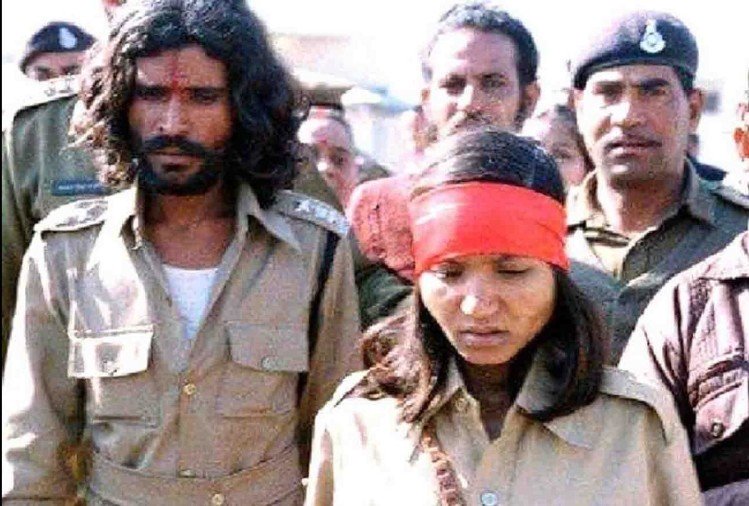
Long before social media-fuelled “Lady Don” headlines, there was Phoolan Devi – perhaps the most famous female outlaw in modern Indian history.
Born into a marginalised caste in rural Uttar Pradesh, Phoolan Devi’s story was rooted in violence, sexual assault and public humiliation. She joined a bandit gang in the Chambal ravines in the late 1970s and was later accused of orchestrating the Behmai massacre. After surrendering in 1983 and spending 11 years in prison without trial, she re-entered public life, not as a fugitive, but as a Member of Parliament. Her life inspired the film Bandit Queen and remains one of India’s most complex crime-to-politics stories.
She was not a foot soldier. She was a symbol – of revenge, caste rage, and defiance against social hierarchy. But she was also a product of extreme brutality.
Decades later, a very different archetype emerged in Delhi: Sonu Punjaban.
Dubbed the “Delhi’s most notorious sex racketeer,” Sonu Punjaban operated a trafficking network that preyed on vulnerable minors and women. Unlike Phoolan Devi, her criminal enterprise was not born out of rebellion or revenge – it was structured, profit-driven exploitation. She became a recurring figure in police dossiers and courtrooms through the 2000s and 2010s.
Then there were figures like Shantadevi Patkar, labelled the “Drug Queen of Mumbai,” whose entry into narcotics networks was reportedly linked to domestic abuse and financial desperation.
These cases differ sharply in motive, scale and structure. Yet they share one common thread: women have periodically surfaced in organised crime, especially when personal trauma, social exclusion or economic collapse converged.
What distinguishes the current moment is not merely the presence of women – it is the operational integration of women within structured, interstate criminal syndicates. Earlier figures often stood out as anomalies. Today’s cases suggest something more systemic.
The evolution is subtle but significant: from isolated female outlaws to women embedded within professionalised gang ecosystems.
And that shift may say as much about society as it does about crime.
Beyond The “Lady Don” Headline
It is tempting to frame the rise of women in organised crime as either empowerment or moral decline. Both explanations are too convenient.
The reality is less cinematic.
Organised crime, like any power structure, evolves. It adapts to surveillance, to technology, to economic downturns – and to social assumptions. For decades, gangs relied on the predictability of male aggression. Today, they are leveraging the invisibility historically imposed on women.
But invisibility cuts both ways.
For some women, crime offers financial survival, protection, even a distorted sense of authority in a society that otherwise restricts their autonomy. For others, it is coercion, proximity to male power, or the absence of alternatives. In many cases, it is both – agency and manipulation coexisting uneasily.
The public fascination with the “Lady Don” says as much about society as it does about the underworld. We are startled not because women commit crime — statistics show they always have but because crime violates the role we expect them to play. Nurturer. Caregiver. Moral anchor.
When women step into violent spaces, it disrupts a deeply embedded perception.
Yet, despite the headlines and social media mythology, the structure remains largely intact. Organised crime in India is still overwhelmingly male-led. Women may be more visible, but visibility is not the same as control. Power, in most cases, still sits elsewhere.
The deeper question, then, is not whether women are becoming more criminal. It is whether the systems that marginalise them are evolving or merely finding new ways to use them.
Because if gangs are adapting faster than institutions, and if economic distress continues to push vulnerable individuals toward illicit networks, the gender of those involved may become increasingly irrelevant.

The Last Bit,
As organised crime digitises, urbanises and decentralises, its recruitment patterns are likely to shift further drawing from demographics once considered peripheral to its core.
Crime does not discriminate but opportunity often does. And somewhere between power and survival, between rebellion and recruitment, lies the uncomfortable truth: the underworld is not becoming feminist; it is simply becoming efficient.