How Dubai Has Become A Safe Haven For Criminals & Economic Offenders Of India In Recent Years
From Dawood Ibrahim To Satish Sanpal, Why All Criminals & Economic Offenders Fly To Dubai

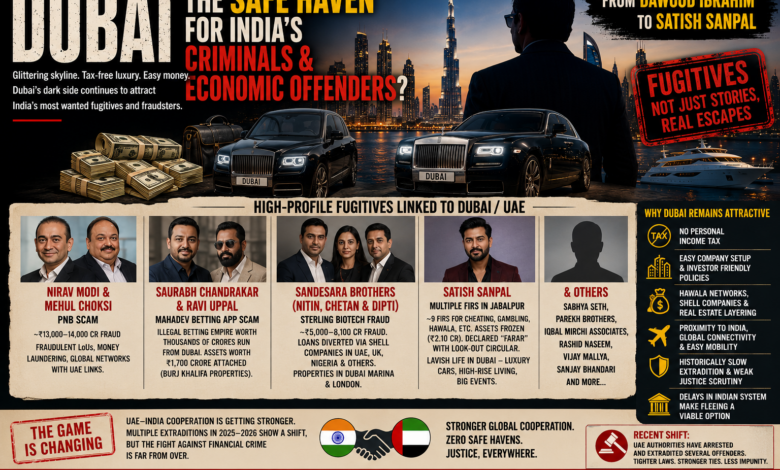
How Dubai Has Become a Safe Haven for India’s Criminals and Economic Offenders: From Dawood Ibrahim to Satish Sanpal
In recent decades, Dubai and the broader United Arab Emirates (UAE) have emerged as a preferred destination for many high-profile Indian fugitives, ranging from underworld dons to corporate fraudsters. The city’s glittering skyline, tax-free environment, luxurious lifestyle, and strategic location have made it an attractive base for those evading Indian law enforcement. While the UAE has strengthened cooperation with India in recent years—leading to several extraditions—the perception of Dubai as a “safe haven” persists due to historical patterns, legal loopholes, and the ease of integrating illicit wealth into legitimate businesses.
The Historical Roots: Dawood Ibrahim and the Shift from Dubai
The archetype of this phenomenon is Dawood Ibrahim, India’s most wanted fugitive. The mastermind behind the 1993 Mumbai serial blasts fled India and initially established a lavish base in Dubai in the 1980s and early 1990s. Reports describe him living in a white palace, driving Rolls-Royces, hosting Bollywood stars, and enjoying front-row seats at cricket matches in Sharjah. Dubai served as a hub for his operations in smuggling, hawala, and organized crime.
After international pressure following the blasts, Dawood reportedly relocated to Karachi, Pakistan, where he is believed to reside to this day (though Pakistan denies it). His case set a precedent: Dubai offered proximity to India, business opportunities, and relative anonymity for building networks before moving to even safer jurisdictions.
The Modern Wave: Economic Offenders Flocking to Dubai
Post-2010, especially after major scams, a new class of fugitives—Fugitive Economic Offenders (FEOs)—has dominated the narrative. India’s Enforcement Directorate (ED) has declared over 20 individuals as FEOs, many with strong Dubai links.
Key High-Profile Fugitives Linked to Dubai/UAE
- Nirav Modi & Mehul Choksi (PNB Scam, ~₹13,000–14,000 crore fraud) Diamond merchants accused of using fraudulent Letters of Undertaking (LoUs) to siphon funds from Punjab National Bank. Modi fled to the UK (currently in prison fighting extradition), while Choksi obtained Antiguan citizenship before his 2025 arrest in Belgium. Both had extensive international networks, including UAE connections for money laundering.
- Saurabh Chandrakar & Ravi Uppal (Mahadev Betting App Scam) Former juice seller Chandrakar and associate Uppal allegedly ran a massive illegal online betting empire worth thousands of crores from Dubai. ED probes revealed hawala links, political payoffs, and operations spanning UAE, Pakistan, and beyond. Chandrakar was arrested in Dubai; Uppal reportedly fled after detention. Assets worth ₹1,700 crore (including Burj Khalifa properties) were attached.
- Sandesara Brothers (Nitin, Chetan & Dipti Sandesara – Sterling Biotech Fraud, ~₹5,000–8,100 crore) Accused of diverting bank loans through shell companies in UAE, UK, Nigeria, and elsewhere. They fled using Albanian passports. Properties in Dubai Marina and London were linked to the case. They later settled parts of the case but were declared FEOs.
- Satish Sanpal (Multiple FIRs in Jabalpur – Gambling, Hawala, Cheating) Featured in Netflix’s Desi Bling, Sanpal is Chairman of ANAX Holding, a claimed $3 billion diversified group in real estate, hospitality, and investments. He faces ~9 FIRs in Madhya Pradesh (e.g., FIR 271/2022 at Omti P.S., FIR 170/2022 at Madan Mahal P.S.) under IPC sections 420, 120-B, Public Gambling Act, etc. Raids seized cash, shell company seals, and froze ₹2.10 crore. He is listed as “Farar” (absconding) with CrPC 82/83 proceedings and a Look-Out Circular. In Dubai, he lives a lavish lifestyle—luxury cars (Rolls-Royces, Bugattis), Burj Khalifa-adjacent developments, and high-profile events.
- Others:
- Sabhya Seth, Parekh Brothers (jewellery/bank fraud, Dubai links).
- Iqbal Mirchi associates (Dawood links, Dubai properties attached).
- Rashid Naseem (investment fraud, arrested in Dubai 2026).
- Vijay Mallya (UK-based but with broader networks), Sanjay Bhandari, and more.
Luxurious Lifestyles in Dubai: From Fugitives to “Entrepreneurs”
Many fugitives rebrand as legitimate businessmen in Dubai. Satish Sanpal promotes ANAX Holding with projects like ELLE Residences, luxury cars for family members, and a public image of success. Saurabh Chandrakar hosted extravagant weddings that drew ED attention. Sandesaras owned Dubai Marina apartments. This lifestyle is enabled by:
- No personal income tax.
- Golden visas for investors.
- Ease of setting up companies.
- Cosmopolitan environment where wealth obscures origins.
Why Dubai Remains Attractive: Systemic Factors
1. Extradition Challenges: India-UAE ties have improved (multiple extraditions in 2025–2026), but processes are slow, require dual criminality, and face political/diplomatic hurdles. Historical reluctance (e.g., Dawood case) lingers.
2. Financial Integration: Hawala networks, shell companies, and real estate allow laundering proceeds into “legitimate” businesses.
3. Proximity and Mobility: Short flights to India, easy access to Europe/Africa, and multiple passports facilitate operations.
4. Weak Early Scrutiny: Dubai’s growth-at-all-costs model historically overlooked dubious wealth sources.
5. Indian Systemic Issues: Delays in investigations, political connections, and weak asset recovery make fleeing viable. Many return only after settlements or when pressure mounts.
Shifting Realities: Is Dubai Still Safe?
Recent years show change. UAE authorities have arrested and extradited several offenders (e.g., Rashid Naseem in 2026). Increased FATF compliance and bilateral agreements are tightening the net. However, for non-extraditable or low-priority cases, Dubai continues to offer a comfortable exile.
Conclusion: A Call for Stronger Global Cooperation
Dubai’s transformation from a haven for figures like Dawood Ibrahim to a base for modern economic offenders like Satish Sanpal highlights deeper issues: globalization of crime, uneven international justice, and the allure of untaxed luxury. While India has made strides with the Fugitive Economic Offenders Act and better diplomacy, closing loopholes requires faster extradition treaties, real-time financial intelligence sharing, and domestic reforms to deter flight. Until then, the glittering towers of Dubai will likely continue sheltering some of India’s most wanted.
Note: All information is based on public reports, court records, and media investigations. Allegations against individuals are disputed until proven in court; many maintain innocence.