Vikas Garg’s SkyExchange Shadow: How the Alleged Owner of a Mahadev-Linked Betting App Reportedly Laundered Crores into Listed Companies — A Detailed Exposé of Deceit, Manipulation, and Desperate Cover-Ups

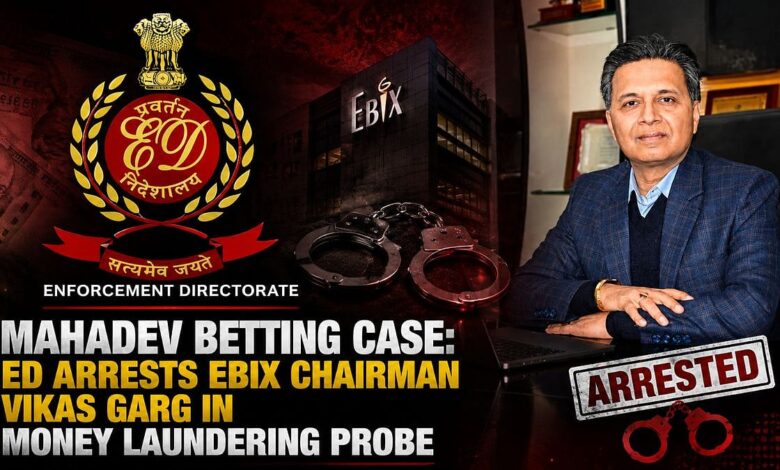
On 14 July 2026, the Enforcement Directorate (ED) arrested Vikas Garg, chairman of Ebix Group and promoter of multiple listed companies, from his Delhi residence in connection with the Mahadev Online Book/Skyexchange illegal betting syndicate money laundering case. Days earlier, the agency had provisionally attached properties worth ₹940.77 crore belonging to Garg, his family members, and entities he allegedly controlled. This is no ordinary enforcement action. It represents the dramatic unravelling of what investigative documents describe as a sophisticated alleged pipeline: the transformation of proceeds from one of India’s largest illegal betting operations into the share capital, loans, and balance sheets of publicly listed companies.
The story, pieced together from a detailed 22-page evidentiary note, ED complaints (ECIR/RPZO/10/2022), statements recorded under Section 50 of the PMLA, bank records, shareholding disclosures, and balance sheet extracts, paints a picture of alleged corporate engineering at scale. According to these materials, Vikas Garg did not merely receive betting money — he allegedly owned and controlled SkyExchange (also referenced in public reporting as part of the Mahadev network alongside Skyrocket Exchange), used close associate Hari Shankar Tibrewal (HST) as his investment manager, and systematically routed the illicit flows into companies such as Vikas Lifecare Ltd, Vikas Ecotech Ltd, GG Engineering Ltd (GGEL), Advik Capital Ltd, Integra Essentia Ltd, and Teamo Productions HQ Ltd.
This is not a story of one rogue transaction. It is the alleged architecture of a parallel financial system — one that allegedly exploited listed company structures, manipulated share prices, deployed proxy directors, extended interest-free or low-interest loans to related parties, and ultimately planned a merger to erase the paper trail. The recent arrest and attachment order suggest the ED has connected enough dots to move from investigation to decisive action.
The Core Allegation: Vikas Garg Allegedly Owns SkyExchange
The evidentiary note opens with a blunt assertion: “Vikas Garg infact owns SkyExchange App.” It positions him as the main associate of Mahadev syndicate figures Saurabh Chandrakar and Ravi Uppal. While the betting operations themselves were allegedly run by others, Garg is accused of being the ultimate beneficiary who needed a professional to manage and legitimize the massive cash inflows.
Enter Hari Shankar Tibrewal. Described in the note as someone with stock market knowledge, HST was allegedly professionally engaged by Garg specifically “for investing the money of Vikas Garg, which money was generated by Vikas Garg through SkyExchange App.” The note claims this arrangement allowed Garg to distance himself operationally while still controlling the destination of the funds.
Public ED statements and media reports now align closely with this narrative. The agency has described Garg as a close associate of HST and alleged that betting proceeds were routed into entities “owned and controlled” by him through FPI, FDI, bonds, hawala entries, and layered corporate structures. The ₹940.77 crore attachment specifically targets assets allegedly representing these proceeds.
The Corporate Laundering Pipeline: Where the Money Allegedly Landed
The note provides a precise list of destination companies:
- M/s Vikas Lifecare Ltd
- M/s Vikas Ecotech Ltd
- M/s GG Engineering Ltd (GGEL)
- M/s Advik Capital Ltd
- M/s Integra Essentia Ltd
- M/s Teamo Productions HQ Ltd
GG Engineering Ltd (GGEL) receives the most forensic attention. The note alleges it was “owned and controlled by Vikas Garg.” During the critical window of December 2021 to March 2022, substantial shares were allegedly purchased by entities linked to Vikas Garg and HST. Later, in September–December 2023, HST-associated entities (Aryadeep Tie Up Pvt Ltd, One Tree Hill Properties Pvt Ltd, Orchard Road Properties Pvt Ltd) also allegedly bought into GGEL. These same HST-linked entities had already been named by accused Amit Saraogi as “entry providing companies against cash.”
The note highlights a glaring alleged discrepancy: GGEL disclosed that Advik Capital Ltd held 3.04% shares as on 31 March 2023. Yet Advik Capital’s own balance sheet showed no investment in quoted shares of any listed company. The note calls this “manipulated and forged.” Vikas Lifecare’s investment in GGEL is shown in its financials, but the broader pattern suggests selective disclosure designed to obscure beneficial ownership.
Further, the note details how Vikas Garg and his family allegedly sold their entire shareholding in GGEL after his name surfaced in the Mahadev investigation — a classic alleged move to create distance. They replaced themselves with “stooges and puppets.”
The Stooge Network and Evidence-Destruction Playbook
The note names several individuals allegedly installed to maintain control while providing deniability:
- Atul Sharma — Appointed Managing Director of GGEL. The note calls him a “stooge of Vikas Garg” used to send false notices and letters to silence critics. He is accused of being a “conspirator” involved in handling proceeds of crime and routing them to Unity Group and Brij Gopal Group.
- Swati Gupta — Director in Advik Capital, ex-director of Eraaya Lifespaces and GGEL. Part of the alleged Vikas Group ecosystem.
- Deepak Kumar Gupta — Director in GGEL, also Whole-time Director in Integra Essentia Ltd and director in Steeljunction Pvt Ltd. Another alleged common link across the group.
The note alleges these appointments were not governance improvements but deliberate attempts to “disassociate” Garg while retaining operational control.
Even more brazen, according to the note, is the alleged plan to merge GGEL with Integra Essentia Ltd via NCLT petition. Post-merger, GGEL would “lose its identity and all documents will be destroyed.” The note calls this “the biggest incidence of destroying evidence.”
Loans from GGEL to Unity Group entities (e.g., deposit to Unity Buildwell Pvt Ltd) and other related-party transactions are presented as further evidence of layering. The note claims these were mechanisms to move alleged betting proceeds deeper into the ecosystem while generating seemingly legitimate interest income or asset entries.
Witness Statements That Name the Game
The evidentiary note reproduces portions of statements recorded under Section 50 PMLA from accused persons Prashant Bagri and Sandeep Modi.
Bagri (Accused No. 34) allegedly spoke of maintaining weekly shareholding analysis files for “Vikas Eco” and “Vikas Life” companies. He described Gagan Gupta setting share prices with promoters for manipulation, explicitly linking the activity to HST.
Modi’s chats and handwritten notes allegedly reference trades involving “Vikas Eco” alongside entities later named as accused in the ED complaint (Discovery Buildcon, Forest Vincom, Brilliant Investment Consultants, Swarnbhumi Vanijya, Dreams Achievers). These are not vague references — they are specific, timestamped, and tied to share price support and off-market movements.
Bank statements reproduced in the note show direct credits from accused entities (Forest Vincom Pvt Ltd and Swarnbhumi Vanijya Pvt Ltd) into Vikas Garg’s personal accounts — hard evidence of the alleged money trail.
The Broader Web: Not Just Betting Money
The second document — a comprehensive updated note on Vikas Garg — places the SkyExchange allegations within a longer pattern of alleged misconduct:
- Customs & DRI cases: Garg allegedly named as “principal mastermind” in a scheme to import goods duty-free via Arshiya FTWZ, falsely document them as exported, and sell them domestically. CBI FIR for forged export invoices involving PVC resin.
- Police cases: Multiple FIRs alleging threats, extortion, and intimidation (Ghaziabad, Delhi IGI Airport, West Bengal). One recent FIR for alleged forgery in NCLT filings was upheld by Calcutta High Court in July 2026.
- SEBI violations: Penalties for delayed disclosures during share acquisitions at Advik Capital; allegations of insider trading (large 2019 stake sale in Vikas Ecotech while allegedly possessing information).
- Other regulatory scrutiny: GST fraud notice on Vikas Ecotech; NCLT §241 case; MCA investigation under Section 210.
The pattern alleged is consistent: use corporate structures and political connections (Garg has been described as a BJP Delhi economic cell convenor) to operate with impunity until central agencies close in.
Analytical Critique: A Systemic Assault on Market Integrity
What makes this alleged scheme particularly corrosive is its use of listed companies as the final repository of illicit funds. Retail investors in Vikas Ecotech, Vikas Lifecare, GGEL, Advik Capital, and others were allegedly exposed to share prices artificially supported or manipulated with betting proceeds. Balance sheets that hid or misclassified investments allegedly misled auditors, regulators, and the investing public.
The alleged deployment of proxy directors and the planned GGEL–Integra merger represent a direct assault on corporate governance and the integrity of the NCLT process. If true, these were not legitimate business decisions but calculated attempts to launder both money and the documentary evidence of that laundering.
The political connections alleged in the documents raise uncomfortable questions. How did a person facing multiple serious investigations across ED, CBI, DRI, SEBI, and state police continue to project himself as a mainstream businessman and political functionary? The documents suggest a belief that connections placed him “beyond reach” — until the ED’s June 2026 PAO and July 2026 arrest shattered that illusion.
The Reckoning Has Begun
The Provisional Attachment Order (PAO No. 14/2026) and the subsequent Original Complaint filed before the Adjudicating Authority represent the ED’s formal assertion that ₹940.77 crore in assets represent proceeds of crime or equivalent value. The arrest of Garg himself moves the case from asset attachment to personal accountability.
Whether these allegations ultimately result in conviction will be decided in court. But the volume and specificity of the material — shareholding patterns, balance sheet mismatches, witness statements naming specific companies and individuals, direct bank credits, and the alleged post-investigation cover-up attempts — paint a picture that is difficult to dismiss as coincidence.
Vikas Garg’s alleged SkyExchange ownership and the subsequent channeling of Mahadev betting proceeds into his listed company empire, if proven, would constitute one of the more audacious alleged intersections of organized betting crime and corporate India in recent memory. The desperate alleged attempts to sell shares, install puppets, extend loans to related parties, and merge companies to destroy records only reinforce the narrative of consciousness of guilt.
India’s markets, regulators, and minority shareholders deserve answers. How did such large-scale alleged layering go undetected for so long? Which auditors signed off on the allegedly manipulated balance sheets? Which exchanges and depositories failed to flag the suspicious share movements? And how many other “Vikas Garg” ecosystems are still operating in the shadows of India’s listed corporate sector?
The ED has fired a powerful opening shot. The full story — and the full reckoning — is only beginning.