The Dubai-India Crime Corridor
Organised Crime’s Two-Way Bridge for Betting, Smuggling, Fraud and Laundering

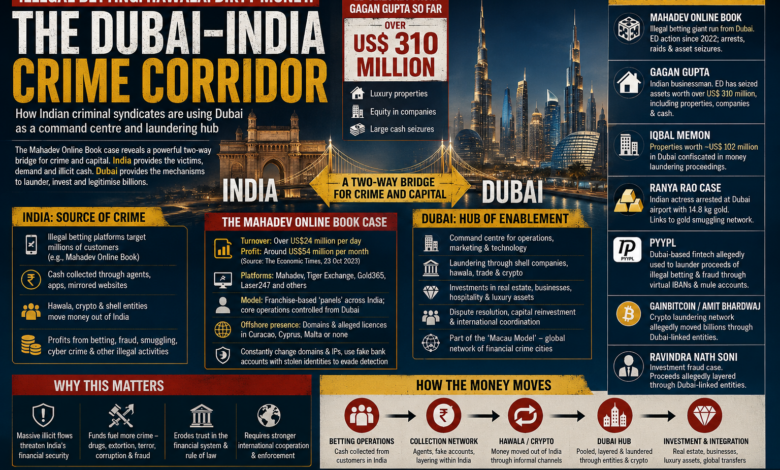
In early 2026, India’s Enforcement Directorate (ED) continued its aggressive crackdown on cross-border money laundering networks, with fresh seizures targeting Indian businessmen and hawala operators linked to massive illegal betting syndicates. One standout case involved Gagan Gupta, a Dubai-based hawala operator and close associate of key figures in the Mahadev Online Book and Skyexchange.com empires. By January 2026, the ED had attached assets worth over ₹91.82 crore (approximately US$11 million) linked to Gupta and his family—including high-value real estate and bank balances—allegedly purchased with proceeds from illegal betting. These actions formed part of a larger probe that has seen total attachments in the Mahadev case exceed ₹2,600 crore (over US$310 million) across multiple rounds, encompassing luxury properties, equity stakes, cash, and investments routed through shell companies, foreign portfolio investments (FPIs), and hawala channels.
Gupta and his network are accused of facilitating the movement of betting proceeds from India to Dubai, where funds were layered, invested in prime real estate, and sometimes recycled back via disguised “cashback” schemes in the Indian stock market. This is far from an isolated incident. It exemplifies a deeply entrenched Dubai–India crime corridor—a sophisticated, two-way infrastructure that Indian organised crime syndicates have built over decades. India serves as the primary “on-ramp”: the site of predicate crimes like illegal betting, gold smuggling, cyber fraud, and Ponzi schemes, where cash is generated from millions of domestic victims. Dubai functions as the “off-ramp” and command hub: a safe haven for coordination, dispute resolution, corporate fronts, property investment, hawala operations, and crypto on/off-ramps that legitimise and internationalise illicit capital.
This corridor mirrors the “Macau Model” that once served Chinese junket operators—embedding criminal proceeds into globalised commercial systems (real estate, fintech, free-zone companies) without hosting the street-level crime itself. Dubai has evolved into a logistics, finance, and safe-haven node for networks historically tied to groups like D-Company, while expanding into newer revenue streams such as online betting and cyber-enabled fraud. The scale is staggering: India’s illegal sports betting market alone is estimated at around US$100 billion annually, driven largely by cricket mania around events like the IPL.
The Mahadev Online Book Case: A Blueprint for the Corridor
The Mahadev Online Book syndicate stands as the clearest, most recent illustration of this architecture. Launched as one of India’s largest illegal betting platforms, Mahadev (and linked apps like Skyexchange.com, Tiger Exchange, Gold365, and Laser247) targeted Indian customers with sports betting, particularly IPL cricket matches. Operations followed a franchise “panel” model: local agents across India acquired customers, collected cash bets via complex on-ground networks, and credited user accounts through apps and mirrored websites that constantly changed domains and IP addresses to evade blocks.
Funds generated inside India were consolidated via hawala and informal remittances, then routed outward—primarily to Dubai—for layering and reinvestment. Core promoters Sourabh Chandrakar and Ravi Uppal allegedly directed operations from Dubai, running the syndicate as an “umbrella” platform that provided back-end services to multiple betting sites on a profit-sharing basis (often 70:30). The ED’s investigations since 2022 have uncovered a web of benami bank accounts opened with stolen or fabricated KYC documents, fraudulent entities, and sophisticated laundering loops involving hawala, trade-based mis-invoicing, FPIs (with secret “cashback” returns to promoters), and cryptocurrencies.
Real-world enforcement actions paint a vivid picture of the scale. In January 2026, the ED provisionally attached ₹91.82 crore in movable and immovable assets, including properties linked directly to Gagan Gupta (a Dubai-based hawala operator tied to the syndicate) and bank balances routed through entities like Perfect Plan Investment LLC and Exim General Trading. By March 2026, the agency struck harder: it attached 20 immovable properties worth nearly ₹1,700 crore (US$200 million+), including 18 luxury assets in Dubai (high-end villas and apartments in Dubai Hills Estate, Business Bay, SLS Hotel & Residences, and even apartments in the iconic Burj Khalifa) plus two in New Delhi. These were held in the names of entities controlled by Chandrakar and associates.
Total attachments in the Mahadev case now surpass ₹2,600–3,000 crore, with over 170 searches, 13 arrests, and 74 entities charged. Similar syndicates—Lotus365, AmbaniBook, ThirupathiBook, and AnnaReddy—operate with nearly identical tactics: offshore “licences” from Curacao, Cyprus, or Malta (often nominal or fake), mirrored sites, agent networks for cash collection, and rapid domain/IP hopping. The proceeds fund further betting tech, sponsorships, property buys, and international layering. As one ED officer noted, the operations are run like a legitimate business from Dubai, outside Indian law enforcement’s immediate reach, while the cash generation and customer base remain firmly in India.
The Poly-Crime Nature of the Corridor
Illegal betting is only the latest high-margin stream. The Dubai–India corridor has long supported a diversified portfolio of organised crime, with Dubai acting as the neutral intermediary hub for aggregation, laundering, reinvestment, and coordination.
Hawala and Underground Banking form the financial backbone. Dubai’s role as a global fund-movement centre makes it ideal for Indian syndicates moving proceeds from betting, drugs, fraud, or extortion. Hawala operators like Gagan Gupta and Hari Shankar Tibrewal have been repeatedly linked in ED probes to converting betting cash into legitimate-looking investments.
Gold Smuggling remains one of the oldest and most persistent lines. Gold is bought in low-tax Dubai and smuggled into high-duty India, often by air passengers concealing bars in clothing or luggage. The arbitrage is massive, and overlaps with hawala for payments. A high-profile 2025 case involved Kannada actress Ranya Rao (stepdaughter of a senior Karnataka IPS officer). In March 2025, she was arrested at Bengaluru airport with 14.2 kg of gold (worth over ₹1 crore) concealed on her person after multiple Dubai flights. Investigations revealed she and associates made over 26 trips, smuggling at least 127–324 kg total (estimates vary by agency), using hawala for payments and even arranging police escorts at the airport. The DRI imposed penalties exceeding ₹100 crore on Rao alone, with total fines across the network reaching ₹271 crore. This case highlighted how personal connections and frequent travel mask large-scale operations, with gold sometimes traced to African origins before Dubai routing.
Trade-Based Money Laundering (TBML) exploits legitimate-looking imports/exports. Fake invoices for electronics, textiles, gems, or precious metals allow over- or under-invoicing to move value. Recent ED and DRI actions have seized undervalued jewellery and gems parcels from Dubai, with discrepancies running into millions.
Cyber Fraud and Investment Scams represent the fastest-growing threat, with Dubai as coordination centre and financial routing hub. Operators pose as police or investment advisers, using phishing, QR-code scams, fake job schemes, or impersonation calls from overseas call centres. Proceeds flow through hundreds of mule accounts, shell entities, and fintech platforms before hitting Dubai.
A striking February 2026 ED case involved two men arrested for a ₹640 crore+ (US$77 million) digital fraud ring. Victims were lured via investment or part-time job ruses; funds went into mule accounts managed via Telegram groups, layered through dummy Indian entities, and transferred to the UAE-based fintech platform PYYPL. From Dubai, money was withdrawn via ATMs/POS or converted to virtual digital assets (VDAs) on exchanges like Binance, then routed through complex custodial and non-custodial wallets. Similar patterns appear in other probes, including Delhi-based networks routing hundreds of crores in scams through Dubai fintech and crypto.
Cryptocurrency: The Accelerator and Obfuscator
Crypto has supercharged the corridor. It offers near-instant cross-border transfers, reduced visibility, and independence from traditional banks. India provides the “on-ramp” (victim funds and predicate proceeds); Dubai the “off-ramp” (brokers, conversion to assets).
The GainBitcoin Ponzi (2015–2018) is a textbook example. Promoter Amit Bhardwaj promised 10% monthly returns on Bitcoin “mining” investments. After the scheme collapsed, he relocated to Dubai, continued operations through promoters in India, and used proceeds to buy prime Dubai office properties and register global shell companies. The scam, now valued at ₹16,000–20,000 crore due to Bitcoin appreciation, involved 29,000+ bitcoins and led to CBI/ED probes with 2025–2026 arrests and Dubai-linked searches.
More recently, in December 2025, Delhi police arrested Ravindra Nath Soni for a US$117 million forex investment fraud. Soni had shifted to Dubai years earlier, set up 12 shell companies, and funnelled proceeds into crypto for wide distribution.
Conclusion: Systemic Threat and the Macau Parallel
Cases like Mahadev (and its Gagan Gupta/Sourabh Chandrakar extensions), the Ranya Rao gold racket, Iqbal Mirchi’s family’s ₹700 crore Dubai properties (15 luxury units in Business Bay, DEC Towers, and Hotel Midwest, attached/seized in 2026 actions under the Fugitive Economic Offenders Act), GainBitcoin, the PYYPL fintech chain, and countless cyber-fraud rings all follow the same blueprint. India supplies demand, victims, and raw cash generation; Dubai supplies the operational sanctuary, corporate veils, high-end property absorption, hawala/crypto pipelines, and global connectivity.
This poly-crime corridor now poses a clear threat to India’s financial stability and national security. The sheer volume of illicit flows—especially from betting—can distort markets, undermine the formal banking system, and finance further crimes ranging from drugs to terrorism-linked activities. While Indian agencies have scored major wins through raids, attachments, arrests, and international cooperation (Interpol Red Notices leading to Dubai detentions), the corridor’s resilience stems from Dubai’s legitimate business environment and the speed of crypto/hawala.
As with Macau’s junket crackdown in 2023, sustained pressure—through stronger bilateral ties with the UAE, tighter crypto regulation, and disruption of hawala nodes—will be essential. The Dubai–India crime corridor is not just a laundering route; it is organised crime’s most efficient infrastructure in South Asia, and countering it demands equally sophisticated, multi-jurisdictional enforcement. The real-life cases above show both the problem’s depth and the growing enforcement response—but the architecture remains intact and adaptable.