BPTP Targets 5000 Crore In Annual Sales; But What About The Homebuyers Still Waiting For Delivery, Occupancy Certificates And Justice?
BPTP is targeting annual sales of ₹3,000–5,000 crore and wants to multiply rental income to ₹1,000 crore within five to seven years. The ambition sounds impressive. But behind the numbers lies a far more uncomfortable public-interest question: what happens to the thousands of buyers who have already paid for homes, plots and promised infrastructure yet continue to face delays, disputed charges, incomplete development, litigation and regulatory scrutiny? With an ED investigation, a CBI chargesheet against the company directors, another CBI case linked to the wider builder-bank probe, consumer disputes and prolonged handover controversies already surrounding the developer, should future sales be measured only in crores, or also in completed homes, lawful documents, transparent accounts and actual accountability?

BPTP WANTS ₹5,000 CRORE IN SALES. BUT WHO IS ANSWERING FOR THE OLD HOMES?
There are numbers that excite the real-estate industry. ₹3,000 crore, 5,000 crore, 1,000 crore, and manymore. For a builder, or a property developer, these numbers represent scale, ambition, expansion and market confidence.
But, there is a whole, comparatively not so good story for a homebuyer; for whom, another set of numbers matters far more. They include questions like ‘How many homes were actually delivered?, How many projects received the required completion and occupancy documentation?, How many buyers obtained conveyance?, How many colonies received the infrastructure they were promised?, How many disputes remain pending?, How many buyers are still paying rent and EMIs simultaneously?, How many complaints reached RERA and consumer forums, And the most important and concerning of all, how many years should a family have to wait before the house it paid for becomes the home it was promised?
These questions acquire a particular urgency in the case of BPTP.
Recently, it is reported that BPTP is targeting annual sales of around ₹3,000–5,000 crore and seeking to increase annual rental income from approximately ₹100 crore currently to around ₹1,000 crore over the next 5-7 years. BPTP President and CEO Manik Malik reportedly said the company intended to pursue measured growth rather than simply chase sales through aggressive capital deployment. The company also said it had limited debt, existing land parcels and plans to expand its commercial and residential portfolio.
This sales ambition is therefore not a rumour. It is the company’s stated growth strategy. And that is precisely why the question becomes uncomfortable. Before BPTP sells ₹3,000 crore worth of new inventory, and potentially ₹5,000 crore a year, what happens to the obligations created by the inventory it has already sold?
That is not an anti-business question. It is a consumer question. It is a regulatory question. It is a governance question. And ultimately, it is a public-interest question. Because every new property sale creates another contractual relationship between a powerful developer and an individual buyer. If the old relationships remain unresolved, should the system simply allow the volume of new relationships to multiply?
THE ₹5,000-CRORE AMBITION DESERVES A ₹5,000-CRORE ACCOUNTABILITY QUESTION
BPTP’s recent residential strategy includes group housing and plotted developments. The company has launched Skynest in Faridabad and a Japanese-themed plotted development with an estimated topline potential of around ₹700–800 crore, while evaluating further projects. The company’s own growth arithmetic suggests that generating ₹3,000–5,000 crore in annual residential profit over the project cycle could require launches worth around ₹10,000 crore of inventory a year, assuming roughly 30% sales conversion.
That sounds like a conventional real-estate growth story. But there is a fundamental difference between selling inventory and delivering homes. A booking is not a building. A launch is not possession. A sale is not an occupancy certificate. A payment schedule is not infrastructure. And a brochure is certainly not a completed colony (if only the builder builds as per the brochure). This distinction is precisely where the BPTP story becomes important (and controversial).
Over the years, BPTP has faced consumer disputes, RERA proceedings, buyer protests, litigation concerning delayed possession, disputes over maintenance and infrastructure, and scrutiny from enforcement agencies. None of these developments, individually, establishes that every BPTP project has failed or that every transaction was unlawful. But together, they form a public record that cannot simply disappear because a new sales target has been announced.
So the question for BPTP is not merely:
“How much can BPTP sell?” The more important question is:
“How much can BPTP deliver, and how quickly can you resolve the obligations already outstanding?”
THE BPTP HANDOVER PROBLEM DID NOT BEGIN IN 2026
BPTP was incorporated in August 2003. More than two decades later, the company’s name continues to appear in disputes involving possession, infrastructure, maintenance, buyer refunds and regulatory proceedings. That chronology matters. A developer that has operated for more than 20 years cannot reasonably be examined only through its latest launch pipeline. The relevant public-interest question is cumulative.
What happened to the people who bought from the company 15 years ago? What happened to the people who paid 90%, 95% or even 100% of their consideration? What happened to the projects that were promised within specified timelines? What happened to the infrastructure that was supposed to accompany those projects? And what happens when a buyer has already exhausted the patience that a salaried family can reasonably afford? This shows that the buyer relationship has repeatedly entered legal and regulatory forums.
That is why the latest ₹3,000–5,000 crore sales target cannot be viewed in isolation. A company can legitimately grow. But growth creates new obligations. And when old obligations remain contested, growth magnifies the consequences of any future failure.
GREATER FARIDABAD: WHEN POSSESSION DOES NOT MEAN A FINISHED COMMUNITY
BPTP’s plotted developments across Greater Faridabad cover large stretches of the region. BPTP launched major Parklands and plotted developments across sectors in the mid-2000s, with possession beginning to trickle in from around 2012. The developments span hundreds of acres, with thousands of families living across the affected sectors. But years after possession began, residents have continued to complain about roads, sewerage, water supply, drainage, street lighting and other infrastructure.
That creates a remarkable contradiction, where the buyer has paid, the house exists, the family lives there; but the promised ecosystem around the house remains incomplete. In September 2025, residents of BPTP launched protests demanding that the colonies be handed over to the Municipal Corporation of Faridabad. One year later, the dispute was still unresolved according to reporting in September 2026. Residents have alleged that sewage problems continue, water supply remains unreliable and roads and other development works remain incomplete.
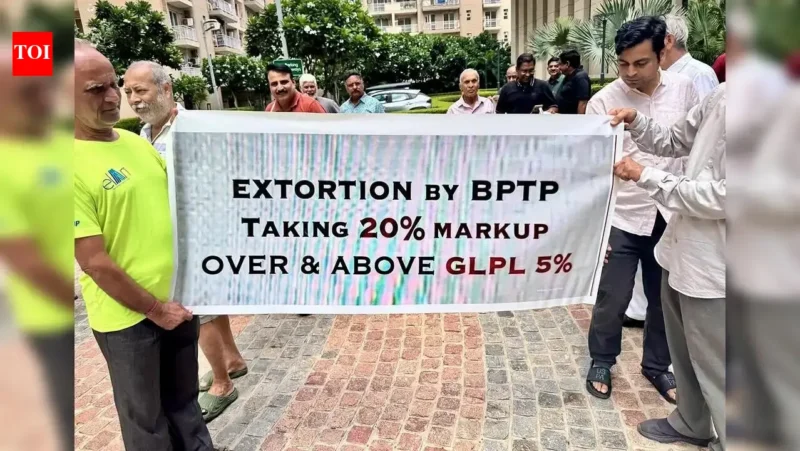
Maintenance charges have also become a major point of contention. Residents have complained about increases in common-area maintenance charges and additional demands for water, sewerage and road repairs. In some areas, residents alleged that they were being asked to pay substantial sums towards external road work. The question is devastatingly simple, that if a buyer purchases a plot inside a licensed residential development, who is ultimately responsible for ensuring that the promised infrastructure actually exists? And if the buyer has already paid for the property, why should the burden of unfinished infrastructure repeatedly return to the buyer?
This is where the economics of real estate become deeply asymmetric. A developer can move towards its next project. The resident cannot move away from an unfinished road. A developer can advertise the next township. A resident still has to travel through the existing potholes. A developer can announce a new sales target. The resident still has to turn on the tap and ask whether water will come. That is the difference between corporate growth and lived reality.
THE PARK SERENE QUESTION: WHEN DOES A BUILDER ACTUALLY HAND OVER CONTROL?
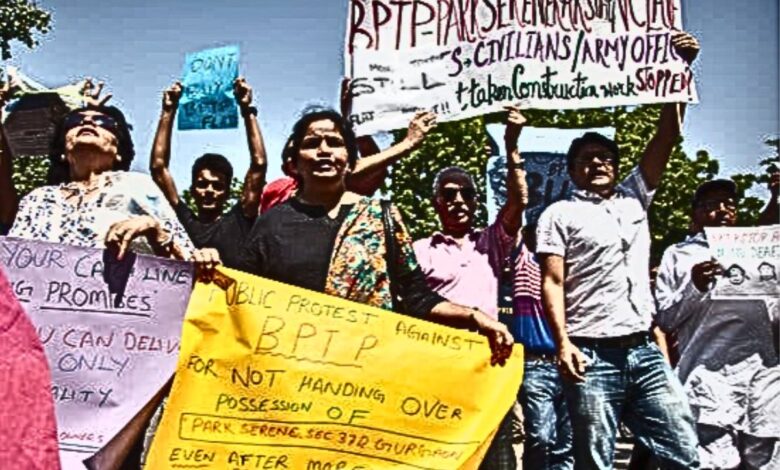
The BPTP Park Serene dispute in Gurugram is another example. Residents of BPTP Park Serene, Park Generations and Spacio have raised disputes over maintenance, financial transparency and the formal transfer of management responsibilities.
According to the residents’ association, disputed management and dewatering charges impose a financial burden of approximately ₹2 crore a year. Residents have demanded greater transparency concerning income statements, bank transactions, vendor payments and other financial records. BPTP’s maintenance arm, BPMS, has rejected the allegations as false and said that supporting documentation and actual-expense details have been shared. It has also said that discussions regarding handover have continued for more than four years and that changing requirements have prevented closure.
If the handover process has continued for more than four years, why has it not been completed? What exactly remains unresolved? Which clauses of the proposed memorandum of understanding are disputed? How much money has been collected? How much has actually been spent? Who are the vendors? What are the underlying contracts? Are there related-party transactions? What are the bank statements? Where are the invoices? Where is the complete audit trail?
These are not accusations. They are documentary questions. And documentary questions are precisely how a dispute involving money should be resolved. The Supreme Court’s record also shows that Park Serene’s buyer community has already been involved in litigation concerning non-delivery and insolvency-related proceedings. In February 2023, the Court recorded the position of the BPTP Spacio Park Serene Flat Allottees Welfare Association and noted earlier consumer proceedings and the insolvency litigation surrounding BPTP.
That history matters. Because the same community that once fought for delivery is now dealing with questions about maintenance handover and financial transparency. The dispute does not disappear merely because possession eventually occurs. For a homebuyer, the journey can move from, “Where is my home?” to “Why is my infrastructure incomplete?” to “Why am I being charged this amount?” to “Where are the accounts?” to “When will BPTP finally hand over control?” This is the longer version of the homebuyer problem.
THE OCCUPANCY CERTIFICATE QUESTION IS NOT A TECHNICAL FOOTNOTE
Real estate buyers are often told that the most important moment is possession. Legally and practically, that is far more complicated. Completion certificates and occupancy certificates are critical because they establish whether the relevant project or building has met the applicable conditions for completion and occupation. BPTP itself tells prospective buyers that a Completion Certificate confirms compliance with approved plans, while an Occupancy Certificate confirms that a project is ready for habitation.
Yet disputes involving BPTP have repeatedly brought possession and certification issues into the legal record. In one Haryana RERA proceeding involving BPTP Park Elite Floors, a complainant sought possession only after receipt of the required occupancy/completion certificate and alleged that an earlier offer of possession was legally invalid without it.
In another 2026 consumer proceeding concerning BPTP Resort, the commission examined the distinction between an offer for fit-outs and legally valid possession, and recorded that an occupation certificate and completion certificate serve distinct purposes. The proceeding also referred to deficiencies found during inspection.
This is why occupancy documentation cannot be dismissed as paperwork. For a family that has borrowed several million rupees to buy a home, the difference between a flat that physically exists and a legally occupiable property can be enormous. And this is precisely where the proposed expansion of BPTP deserves scrutiny. If the company intends to dramatically increase sales, can its regulatory and delivery machinery scale at the same speed?
Can approvals keep pace? Can infrastructure keep pace? Can occupancy and completion certification keep pace? Can conveyance documentation keep pace? Can customer grievance resolution keep pace? Because selling faster than the legal and physical delivery system can handle creates a dangerous gap. And that gap is ultimately paid for by the buyer.
The occupancy-certificate (OC) problem exposes another uncomfortable layer of India’s real-estate crisis. An OC is supposed to establish that a project is legally fit for occupation, yet prolonged delays, partial approvals, disputed documentation and technical loopholes can leave buyers occupying homes without the legal certainty they were promised. This creates a dangerous grey zone where developers may claim possession while buyers remain exposed to regulatory and documentation problems. The absence or delay of an OC can become another mechanism through which the burden is shifted onto homebuyers. What is meant to protect buyers can, in practice, become another battlefield between builders and homebuyers.

THEN CAME THE ED: ₹537.5 CRORE OF FOREIGN INVESTMENT UNDER INVESTIGATION
The BPTP story becomes even more consequential when the Enforcement Directorate enters the picture. On August 29, 2025, the ED officially stated that its Gurugram office had conducted searches at multiple locations in Delhi-NCR and Noida in connection with a FEMA investigation involving BPTP. The searches were conducted at BPTP offices and at the residences of Chairman and Managing Director Kabul Chawla and Whole-Time Director Sudhanshu Tripathi.
The agency said the investigation concerned foreign direct investment exceeding ₹500 crore. More specifically, the ED said BPTP had received ₹322.5 crore from CPI India I Ltd., Mauritius, and ₹215 crore from Harbour Victoria Investment Holding Ltd., Mauritius, a combined ₹537.5 crore.
The ED alleged that these investments, made during FY 2007–08 under the automatic route, contained “put/swap” options that provided foreign investors with guaranteed returns on exit, which the agency said violated the FEMA framework applicable at the time. It also stated that RBI had directed amendment of the shareholders’ agreement to remove the impermissible put option and that the agency had recovered documents and digital evidence during the searches.
The ED further stated that Kabul Chawla was the beneficial owner of multiple foreign entities and that one had previously been used to acquire an expensive immovable property in New York. The agency said those foreign entities, the overseas property and the source of funds remained under examination. That final phrase is crucial. Under examination does not mean proved. An investigation is not a conviction. An allegation is not a judicial finding. But an official investigation involving more than ₹500 crore of foreign investment cannot simply be treated as irrelevant to a discussion about corporate governance.
And the ED’s release contained another particularly significant statement. It said that multiple FIRs had been registered against BPTP and its directors across Delhi-NCR concerning prolonged non-completion of projects and alleged diversion of funds, and that these matters were also under investigation. That takes the discussion beyond isolated buyer complaints. It creates a question about the financial architecture surrounding a developer whose business model depends on collecting money today for assets that may take years to complete.
THEN CAME THE CBI
If the ED investigation raised questions about foreign investment and financial structures, the CBI investigation created an entirely different layer of scrutiny. On April 8, 2026, the CBI registered FIR RC2192026E0001 against BPTP Limited, unknown directors/promoters and unknown HDFC Bank officials in connection with the wider Supreme Court-monitored investigation into alleged builder-financial institution arrangements.
The case relates to BPTP’s Pedestal Floors project in Sector 70-A, Gurugram. According to the public record, the case arose in the context of allegations surrounding subvention arrangements, including a scheme represented as “No Pre-EMI till delivery of possession of residential unit.” The Supreme Court proceedings recorded BPTP’s position that the project had 180 completed units and that, apart from two respondents, no other homebuyer had complained against it in that matter. BPTP was permitted to place relevant material before the CBI while the investigation continued.
The fact that BPTP became part of a CBI investigation ordered in the context of a nationwide builder-bank/homebuyer controversy is undeniably significant. Because the alleged mechanism is particularly troubling. A buyer is persuaded to purchase a property. A bank finances the transaction. The buyer is told that pre-EMI payments will not begin until possession. The project does not progress as expected. The buyer’s financial obligations nonetheless remain. The bank remains a creditor. The developer has received money. And the homebuyer is left with the property that may not yet exist in the form promised. This is why the Supreme Court-monitored CBI investigation matters.
THE BUILDER-BANK NEXUS IS BIGGER THAN BPTP
The BPTP case cannot be understood without understanding the larger investigation. The Supreme Court has been monitoring a batch of homebuyer petitions concerning alleged systemic failures and alleged circumvention of the regulatory framework by builders, banks and housing finance companies.
In its August 6, 2026 order, the Supreme Court recorded that the CBI had registered 56 FIRs in the broader investigation, with final reports filed in 18 cases, 17 chargesheets and one closure report. The Court also recorded that cognizance had been taken in three chargesheeted cases and that officials of financial institutions had been chargesheeted in five cases under the Prevention of Corruption Act.
But the investigation did not stop there. On September 10, 2026, the CBI registered five additional cases, taking the total number of cases in the Supreme Court-directed investigation to 55 according to contemporary reporting, and conducted searches at 12 locations across Bengaluru, Mumbai and Pune. The same day, CBI filed its 20th chargesheet in the wider homebuyer fraud investigation, relating to Ajnara Ambrosia in Noida. 15 officials associated with ICICI Bank, HDFC Bank, PNB Housing Finance were named as accused in that chargesheet.
This apparent difference in numbers is itself a reminder of why dates matter in reporting. The Supreme Court’s August 6 order recorded 56 FIRs and 17 chargesheets. The CBI’s September 10 action was reported as bringing the total cases to 55 while simultaneously taking the chargesheet count to 20. The numbers are therefore not necessarily contradictory; they reflect different stages and updates in a rapidly evolving investigation.
What is not in dispute is the scale, that include dozens of FIRs, 20 chargesheets, multiple builders, multiple financial institutions, multiple cities, and thousands of homebuyers caught in the middle.
WHAT DOES THE CBI ALLEGE IN THESE CASES?
One of the most revealing chargesheets concerns Rudra Buildwell. According to reporting on the CBI chargesheet, 672 flats were allegedly sold after possession promises were made; some properties allegedly already had owners and were subsequently resold; previous sales were allegedly concealed; and some buyers who cancelled bookings allegedly did not receive refunds.
These are allegations contained in an investigation and chargesheet, not convictions. But they demonstrate why the builder-bank question has become so important. The problem is not merely that a builder might fail to construct. The more complicated possibility is that a financial ecosystem can continue functioning even when the underlying project is failing.
The buyer receives a loan. The bank receives EMI obligations. The developer receives funds. The project may stall. And the individual buyer is left carrying the financial consequences. The CBI’s wider investigation has therefore focused on allegations involving criminal conspiracy, cheating, breach of trust, misuse of official position and financial irregularities. The Supreme Court has also demanded speed. It has warned that investigations must reach a logical conclusion and that prolonged investigations cause further detriment to homebuyers.
That warning should concern everyone. Because justice delayed in a real-estate case has a unique characteristic. The asset does not wait. The EMI does not wait. Rent does not wait. Inflation does not wait. School fees do not wait. Retirement does not wait. Life does not wait. Only the case waits, where homebuyers pay for the flats that were never delivered, and the company founder is sitting in his 5 BHK villa in New York.

AND THAT IS WHERE THE BPTP SALES TARGET BECOMES A PUBLIC-INTEREST ISSUE
Return to the original number. ₹3,000–5,000 crore. Imagine a company with unresolved disputes, regulatory scrutiny and a continuing legal record announcing that it intends to sell several thousand crore rupees of additional real estate every year. “What safeguards exist to ensure that the next ₹5,000 crore does not create another generation of unresolved homebuyers?” That is the question regulators should answer. That is the question lenders should answer. That is the question policymakers should answer. And that is the question BPTP should answer.
What systems have changed? What has been completed? How many historical buyer disputes remain unresolved? How many projects still have outstanding documentation? How many infrastructure works remain incomplete? How much money remains tied up in contested buyer claims? How many consumer and RERA cases remain pending? What is the current status of the CBI investigation? What documents has BPTP supplied? What has the company changed in its internal governance? How will new project money be ring-fenced? What mechanisms will ensure that construction cash flows cannot be diverted from one project to another? What protections will new buyers receive?
And most importantly:
Why should a buyer today assume that tomorrow’s experience will be different from yesterday’s?
IT’S NOT ONLY THE BPTP CASE. ANOTHER POWERFUL BUILDER GODREJ PROPERTIES SHOWS WHY SALES NUMBERS ALONE CANNOT BE THE METRIC
Sales are not the same thing as delivery. Godrej Properties recorded an extraordinary ₹34,171 crore booking value in FY2025–26, according to its annual report, selling 17,513 units covering 27 million square feet. The company also reported delivery of 12.1 million square feet during FY26. At the same time, Godrej Properties is pursuing an aggressive expansion strategy in Haryana. Godrej Industries Group announced a ₹20,000 crore Haryana investment plan, with Godrej Properties expected to invest an additional ₹16,000 crore by FY28.
Yet recent reporting has also brought regulatory and project-level questions involving Godrej Properties into public discussion. Our earlier articles points to the company’s delivery record pointed to RERA interventions and buyer complaints, while a separate report examined the CBI FIR involving Godrej Eternia in Chandigarh. The lesson is not that Godrej’s sales figures are illegitimate. Nor does the existence of project-level disputes mean the entire company has failed.
The lesson is simpler. A developer can have enormous sales and still face questions about delivery at individual projects. Therefore, sales cannot be the only measure of success. That lesson is directly relevant to BPTP. If ₹5,000 crore becomes the headline number, the public should ask for another number alongside it- How many homes were delivered? And then another- How many received all required certificates?, How many buyers received complete documentation?, How many old disputes were resolved? That is how real-estate performance should ultimately be understood.
THE REAL QUESTION IS NOT WHETHER BPTP CAN SELL. IT IS WHETHER THE SYSTEM CAN PROTECT THE BUYER
The real-estate ecosystem has multiple actors, where the builder sells, the bank finances, the regulator approves, the authority grants permissions, architects certify; government departments monitor, RERA adjudicates, consumer commissions decide, high Courts hear appeals.
The Supreme Court intervenes in exceptional cases. The CBI investigates criminal allegations. The ED investigates money and foreign-exchange issues within its statutory remit. And yet the buyer remains the person carrying the immediate financial risk. That is the structural problem.
If a developer delays, the buyer pays rent. If a bank continues the loan obligation, the buyer pays EMI. If the project requires litigation, the buyer pays legal costs. If the matter takes years, the buyer loses years. If the property value changes, the buyer bears the uncertainty. If the project is incomplete, the buyer cannot simply return the past decade. That is why regulatory accountability must be faster than the economic damage caused by delay.
THE TAXPAYER’S QUESTION: WHY DOES JUSTICE HAVE TO BE SO EXPENSIVE?
There is another dimension that rarely receives sufficient attention. Courts and investigative agencies are public institutions. CBI investigations require public resources. Police investigations require public resources. Government regulatory authorities require public resources. Courts require public resources. Every prolonged litigation process therefore has a public cost.
The taxpayer may not have paid for the apartment. But taxpayers fund the institutional machinery through which the dispute is investigated and adjudicated. That creates an entirely legitimate public-interest question-
How many years should a buyer have to litigate before a regulatory system produces a final answer? How many FIRs must be registered before a systemic problem is actually fixed? How many chargesheets must be filed before convictions, recoveries or other legally final consequences follow? How many homebuyers have to approach the Supreme Court before the underlying regulatory weaknesses are corrected?
The Supreme Court’s monitoring of the builder-bank cases itself demonstrates the seriousness of the problem. The Court did not merely ask for paperwork. It directed investigation. It sought progress reports. It required additional personnel. It pushed for prosecution sanctions. It demanded that investigations move towards logical conclusions. That is institutional intervention at an extraordinary scale. But the ultimate test is not the number of orders. It is whether ordinary people get their homes, refunds, documents and lawful remedies.
WHAT SHOULD BPTP ANSWER?
BPTP’s latest sales ambition makes a public disclosure exercise increasingly important. The company should be able to explain, project by project, what its delivery obligations are.
- How many BPTP projects are currently under construction?
- How many BPTP projects have received completion certificates?
- How many BPTP projects have received occupancy certificates?
- How many BPTP projects projects have outstanding infrastructure works?
- How many BPTP projects have homebuyer cases remain pending?
- How much BPTP has been paid pursuant to judicial or regulatory orders?
- How many refund claims remain unresolved in BPTP projects?
- What is the current status of the ED investigation in BPTP projects?
- What is the current status of the CBI FIR in BPTP projects?
- What changes have been made to financing and project-level cash management after the regulatory scrutiny in BPTP projects?
- How will future buyers of BPTP projects be protected?
And if BPTP believes that allegations against it are incorrect, the company has an obvious opportunity:
- Publish the documents.
- Publish the timelines.
- Publish the project-level delivery record.
- Publish the certificates.
- Publish the handover schedules.
- Publish the status of litigation.
- Publish the corrective measures.
- Transparency is not a punishment.
For a company seeking to dramatically expand sales, transparency is arguably one of the most powerful ways to establish credibility.
WHAT SHOULD THE JUDICIAL AND REGULATORY SYSTEM ANSWER?
The questions are equally applicable to the institutions.
-
Why do consumer disputes involving homes take years?
-
Why can a project remain incomplete long after the promised delivery date?
-
Why can infrastructure disputes survive for years after possession?
-
Why does the handover between developers and residents become a prolonged negotiation?
-
Why do buyers have to approach multiple forums for relief?
-
Why do investigative proceedings take years?
-
Why do chargesheets not automatically translate into timely trials?
-
Why can a buyer remain financially trapped while the legal system moves at institutional speed?
And perhaps the most important question:
Can India build a real-estate regulatory system in which the buyer does not have to become an investigator, litigant, campaigner and activist simply to obtain the home already paid for?
BPTP’S NEXT CHAPTER SHOULD NOT BE MEASURED ONLY IN SALES
BPTP has every right to pursue growth. It has every right to develop its land bank. It has every right to enter new markets and launch new projects. But the public has an equal right to ask whether expansion is accompanied by accountability.
The company’s stated ambition of ₹3,000–5,000 crore in annual sales is therefore not the end of the story. It is the beginning of a much larger question.
Can BPTP deliver ₹5,000 crore worth of homes and projects without reproducing the problems that have followed portions of its earlier portfolio?
- Can BPTP close old buyer disputes while opening new projects?
- Can BPTP complete infrastructure before moving on to the next launch?
- Can BPTP provide transparent maintenance accounts?
- Can BPTP ensure timely handovers?
- Can BPTP ensure lawful occupation documentation?
- Can BPTP demonstrate that project-level funds are being used for the projects for which buyers paid them?
- Can BPTP give regulators and buyers confidence through documents rather than advertising?
These are not unreasonable demands. They are the minimum questions that arise when a developer seeks to multiply its business.
THE MOST IMPORTANT NUMBER IS STILL ZERO
There is one final number that should matter more than ₹5,000 crore.
Zero.
- Zero families waiting unnecessarily for a home they have already paid for.
- Zero years of avoidable delay.
- Zero unexplained charges.
- Zero infrastructure gaps after promised completion.
- Zero unresolved documentation issues.
- Zero ambiguity over occupancy certificates.
- Zero unexplained financial movements.
- Zero regulatory complaints that remain unresolved simply because the complainant cannot afford another five years of litigation.
That is the real ambition that the Indian real-estate sector should eventually be judged against.
- Not the number of crores sold.
- Not the number of launches announced.
- Not the size of the land bank.
- Not the number of brochures distributed.
- Not the number of awards received.
But the number of families that actually received what they paid for.
BPTP’s ₹3,000–5,000 crore sales target may eventually become reality. Its ₹1,000 crore rental-income ambition may also become reality. But before the next chapter is written, the previous chapters still require answers. The ED’s investigation requires its legal conclusion. The CBI’s investigation requires evidence-based determination. The buyer disputes require resolution. The infrastructure complaints require completion. The maintenance disputes require transparent accounts. The courts require speed. The regulators require enforcement.
And BPTP should answer every allegation through documents and lawful proceedings. Because the real issue is no longer whether India needs more homes. The issue is whether India can afford a real-estate model in which selling the home is faster than delivering it, collecting the money is easier than resolving the complaint, and obtaining a legal remedy takes longer than the original construction promise.
The homebuyer cannot afford that model. The taxpayer cannot afford endless institutional expenditure around that model. And the credibility of India’s real-estate regulatory system cannot afford to normalise it.
The question, therefore, is not simply:
“Can BPTP sell ₹5,000 crore a year?”
The question that deserves to follow is far more uncomfortable:
“Before BPTP sells another ₹5,000 crore, who will answer for everything it has already sold?”
And perhaps the most important question of all:
“When will the Indian homebuyer finally become the first stakeholder that the real-estate system protects, rather than the last stakeholder that the system asks to wait?”