Why The TDI Directors’ Jail Order Is The Tip Of A Decade-Long Iceberg!
How HRERA's civil-imprisonment ruling against the Taneja family fits into a sprawling web of ED attachments, PMLA prosecution, Delhi Police FIRs, environmental cases and the Supreme Court-monitored CBI crackdown on NCR builders


TDI Infrastructure Key Management Into Jail- The order that grabbed the headlines
On 15 May 2026, the Haryana Real Estate Regulatory Authority (HRERA), Panchkula, did something Indian real-estate regulators rarely do: it ordered the civil imprisonment of five directors of a major builder.
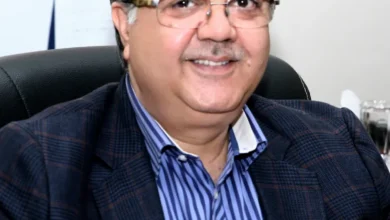
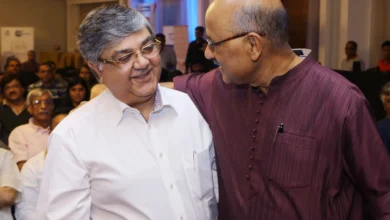
The directors of TDI Infrastructure Limited named in the order are:
- Kamal Taneja, Managing Director
- Devki Nandan Taneja, Director
- Ravinder Kumar Taneja, Director
- Renu Taneja, Director
- Ved Prakash, Director
The order was passed by HRERA Panchkula Member Chander Shekhar in Execution No. 1208 of 2024, arising out of Complaint No. 2950 of 2019 filed by homebuyer Narender Kumar. Each director has been awarded three months’ civil imprisonment, with arrest warrants to issue once the decree holder deposits the subsistence allowance prescribed under prison rules — unless TDI satisfies the order before warrants are executed.
HRERA found that the company and its directors had neither filed personal replies to repeated show-cause notices nor complied with payment directions during execution proceedings, characterising this conduct as deliberate “delay tactics.” The authority observed that the directors had failed to respect the judicial process by not appearing personally despite service of notices, and that accepting repeated assurances of settlement without actual payment would create an unfair advantage for errant entities and weaken the enforcement architecture under the Real Estate (Regulation and Development) Act, 2016.
The legal hook was Order XXI Rule 41(3) of the Code of Civil Procedure, which permits an executing authority to compel disclosure of assets from a judgment debtor and, on continued non-compliance, to commit the debtor to civil prison. Civil imprisonment is not a criminal sentence — it is a coercive tool to enforce a money decree or a quasi-judicial direction. The directors are not being punished for a crime; they are being detained until they obey an order.
But to read the HRERA ruling in isolation is to miss the story. The Panchkula order is only the latest and most visible action in a decade-long enforcement pile-up around TDI Infrastructure and the Taneja family — one that now involves the Enforcement Directorate, Delhi Police, the Economic Offences Wing, the Haryana State Pollution Control Board, a Special PMLA Court, and the broader Supreme Court-monitored CBI investigation into the builder-banker nexus in the NCR.
The scale of the underlying grievance
Before turning to the agencies, the numbers from the ED’s investigation are worth absorbing because they explain why the response has been so layered.
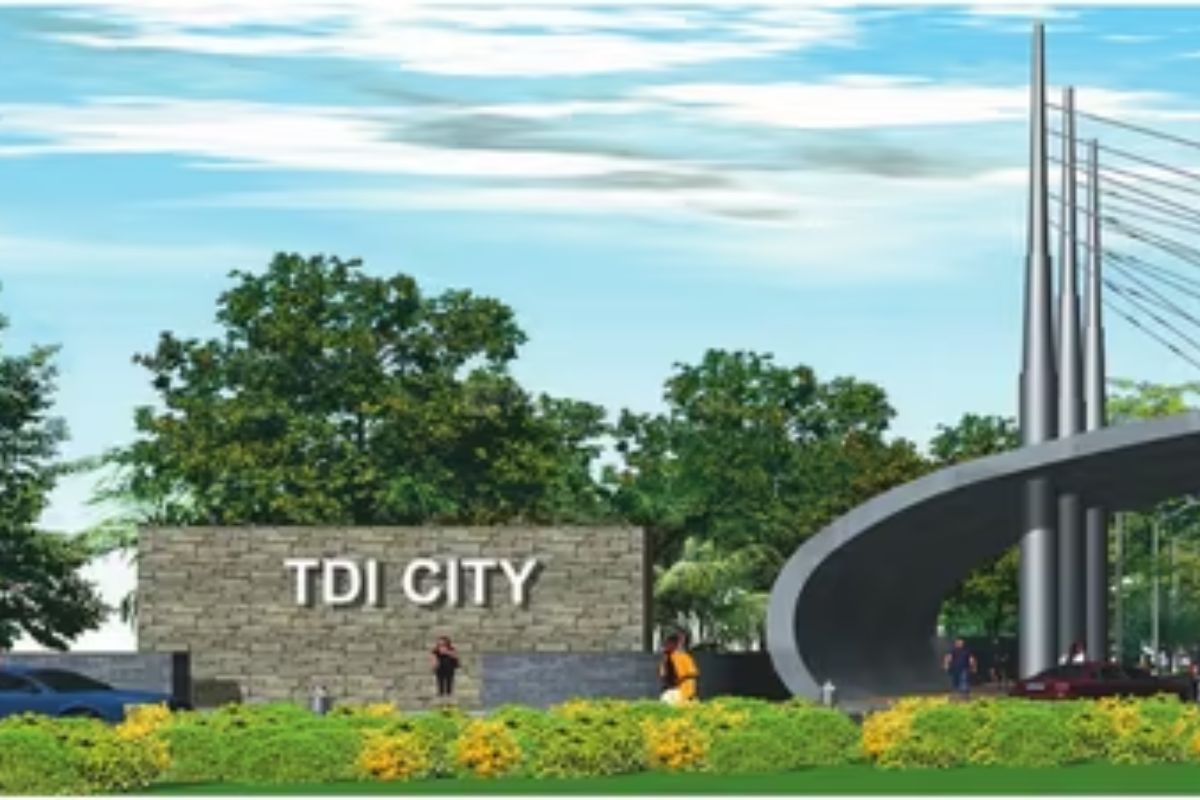
According to the Enforcement Directorate’s own findings, between 2005 and 2014 TDI Infrastructure launched several commercial and residential projects in Kundli, Sonipat, Haryana, and collected approximately Rs 4,619.43 crore as advance booking amounts from 14,105 customers across 26 projects. The agency’s prosecution complaint, and a separate March 2026 attachment statement, indicate that occupation certificates for four projects remain pending, and one project, “Park Street”, is still incomplete.
In the worst affected projects, possession delays have stretched to 16–18 years. The ED has alleged that funds collected from homebuyers were diverted to subsidiaries, erstwhile subsidiaries and land-owning companies as advances for land acquisition and other purposes, and were also used to repay loans and make investments, instead of being deployed to complete the projects.
That single sentence — money raised from buyers being routed elsewhere instead of being spent on the buildings those buyers paid for — is the spine of every other proceeding listed below.
The Delhi Police and EOW FIRs: the foundation layer
All of the federal action against TDI is built on top of state-level criminal complaints filed by individual homebuyers and clubbed by the Delhi Police’s Economic Offences Wing.
The ED’s investigation was launched on the strength of 26 FIRs registered and chargesheets filed by Delhi Police and the Economic Offences Wing (EOW), Delhi. These FIRs charge TDI Infrastructure Ltd., its promoters and key managerial personnel with cheating and defrauding homebuyers across multiple Sonipat projects.
This is the building block: without the criminal FIRs and the EOW’s chargesheets, none of the PMLA scheduled-offence machinery against TDI could have moved.
The ED attachments: from Rs 45 crore to Rs 349 crore
The Enforcement Directorate’s actions against TDI have escalated in clear steps.
2024 — First attachment (~ Rs 45 crore). In the first round of action under PMLA, 2002, the ED provisionally attached properties worth Rs 45.49 crore belonging to TDI Infrastructure and related entities. This was the agency’s opening salvo, identifying a defined tranche of “proceeds of crime” traceable to the diverted homebuyer funds.
March 2025 — Environmental PAO (~ Rs 5.6 crore). In a less-noticed but legally novel move, the ED in March 2025 provisionally attached TDI Mall properties under PMLA on the basis of a scheduled offence flowing from environmental violations. The predicate complaint was filed by the Haryana State Pollution Control Board before the Special Environment Court, Kurukshetra, against M/s TDI Infrastructure Ltd. and its Directors Ravinder Kumar Taneja, Kamal Taneja and Devki Nandan Taneja, for violation of provisions of the Water (Prevention & Control of Pollution) Act, 1974 and the Air (Prevention & Control of Pollution) Act, 1981 in its developed residential townships “Kingsburry Apartments”, “My Floor 2” and “Tuscan City” located at Kundli, Sonipat.
The HSPCB had found that TDI failed to install standardised sewage treatment plants and to operate them after obtaining a Consent to Operate. Untreated sewage discharged into open land became the basis for the ED to identify “proceeds of crime” in the form of compensation evaded by not complying with environmental law — a creative deployment of PMLA against a builder.
March 2026 — Kamaspur attachment (Rs 206.40 crore). On 6 March 2026, the ED’s Gurugram Zonal Office provisionally attached immovable properties worth around Rs 206.40 crore — about 8.3 acres of land and commercial units located in Kamaspur, Sonipat — owned by TDI Infrastructure Ltd. (formerly known as Intime Promoters Private Limited) and its affiliated entities. With this round, the cumulative attachment in the case crossed Rs 251 crore.
Cumulative position (May 2026). As of the filing of the prosecution complaint, the ED has stated that the total proceeds of crime identified in the case now stand at Rs 349.55 crore, and it has sought confiscation of these assets under PMLA.
The PMLA prosecution complaint: the criminal trial begins
The decisive escalation came in April–May 2026.
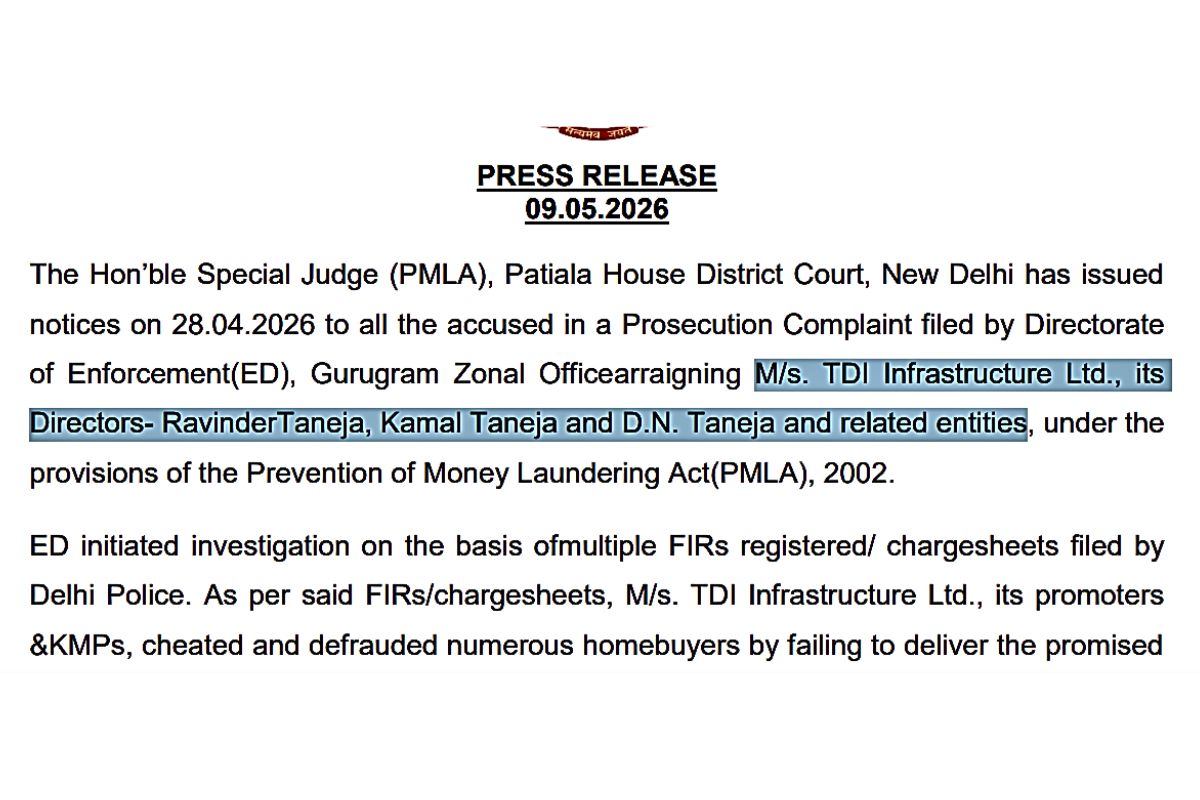
On 28 April 2026, the Special PMLA Judge, Patiala House District Court, issued notices to all the accused in a Prosecution Complaint filed by the Directorate of Enforcement (ED), Gurugram Zonal Office arraigning M/s TDI Infrastructure Ltd. and its directors — Ravinder Taneja, Kamal Taneja and D.N. Taneja — along with related entities.
A prosecution complaint under PMLA is the equivalent of a chargesheet in a criminal case. Once cognisance is taken and notices are issued, the accused are formally on trial for the offence of money laundering. The Special PMLA Court is now the principal criminal forum where the alleged diversion of approximately Rs 4,619 crore of homebuyer money will be litigated.
This is materially distinct from civil imprisonment under RERA execution. Where HRERA’s three-month civil jail order is a coercive measure to extract compliance, the PMLA trial carries the possibility of substantive criminal punishment — including imprisonment ranging up to seven years and substantive fines — and permanent confiscation of attached assets.
The CBI angle: the Supreme Court-directed builder-banker investigation
While TDI is not on the list of builders explicitly named in the first wave of CBI FIRs registered in July 2025, the broader investigative climate it is operating in is essential context.
Acting on Special Leave Petitions filed by distressed NCR homebuyers, the Supreme Court of India in July 2025 directed the Central Bureau of Investigation to investigate the alleged nexus between builders and financial institutions in the NCR. Pursuant to that order, the CBI registered 22 FIRs and conducted raids at 47 locations across Delhi-NCR — including Delhi, Gurugram and Noida — seizing documents and digital evidence. The builders explicitly named in the first wave include Supertech Ltd., Jaypee Infratech Ltd., Ajnara India Ltd., Vatika Ltd., and CHD Developers Ltd., among others.
In September 2025, the Supreme Court permitted six more FIRs for projects in Mumbai, Bengaluru, Kolkata, Mohali and Prayagraj after preliminary enquiries revealed cognizable offences, and restrained banks from executing recovery certificates against affected homebuyers until further orders.
The investigative pattern the CBI is pursuing — collusion between builders and bankers around the so-called tripartite subvention scheme, with full disbursal of loan amounts to builders against partial construction, in defiance of the RBI’s 2013 circular requiring stage-wise verification — fits the kind of fund-diversion that the ED has already alleged against TDI. Even where TDI is not yet a CBI target, the legal environment is one in which the appetite for personal liability of builder-directors and their banking counterparts has visibly hardened, and the HRERA Panchkula order needs to be read against that backdrop.
The family-corporate map: the Taneja–Chawla axis
The HRERA order names five Taneja-family directors, which underlines a recurring feature of these proceedings: the alleged misconduct is being attributed to a tight family-run business with overlapping interests in multiple real-estate entities.
Reporting around the ED’s parallel investigation into BPTP Limited has highlighted that Kabul Chawla, BPTP’s chairman, and Ravinder Kumar Taneja, TDI’s managing director, are bound by marriage, with Chawla being son-in-law to the Taneja clan. The ED separately raided BPTP in August 2025 over alleged FEMA violations involving foreign investments running into hundreds of crores.
The relevance for the TDI case is structural rather than incriminating in itself: when promoters of two of NCR’s most-troubled real-estate names are connected by family, regulators tracing inter-group fund flows naturally widen their gaze.
What is civil imprisonment, and why does it matter here?
The Tribune’s original explainer rightly flagged that civil imprisonment is conceptually different from criminal imprisonment. It bears restating in this fuller context.
Civil imprisonment is a detention ordered by a court or a competent quasi-judicial authority against a person who has the means to comply with a legal obligation — typically a money decree — but who deliberately refuses to do so. It is not a punishment for an offence; it is a coercion to extract compliance. Civil prisoners are held under rules distinct from those applying to convicts; the decree-holder must usually deposit a subsistence allowance to keep the debtor in custody; and the debtor can secure release by complying with the underlying order.
Under the Code of Civil Procedure — and by extension under Section 40 of the RERA Act, which incorporates the CPC’s execution machinery — Order XXI Rule 41(3) lets an executing authority demand asset disclosure from a judgment debtor and, on continued refusal, order the debtor’s detention.
What makes the HRERA Panchkula order striking is not the legal novelty of using Order XXI Rule 41(3) — it is the fact that the authority pierced through the corporate veil to apply this coercive measure to five individuals at the apex of TDI’s management, not just the company in its impersonal form. For an industry long accustomed to absorbing penalties at the corporate level and treating regulatory orders, in one observer’s words, as functionally optional, this is a real shift in the calculus of personal risk.
How the layers fit together
It helps to lay out the layers as a single picture:
- Homebuyers file individual consumer/criminal complaints, including in the Delhi Police EOW.
- Delhi Police / EOW clubs these complaints into 26 FIRs and chargesheets against TDI and its directors.
- The ED treats the IPC offences as PMLA scheduled offences, opens its own investigation, and provisionally attaches assets in three rounds — Rs 45.49 crore (2024), Rs 5.6 crore in TDI Mall (March 2025, environmental hook), Rs 206.40 crore (March 2026), with the cumulative figure rising to Rs 349.55 crore.
- The Special PMLA Court at Patiala House issues notices on a prosecution complaint dated 28 April 2026 to TDI, Ravinder Taneja, Kamal Taneja, D.N. Taneja and related entities.
- The Haryana State Pollution Control Board independently prosecutes TDI and three Taneja directors in the Special Environment Court, Kurukshetra, for violations of the Water Act, 1974 and the Air Act, 1981.
- Individual aggrieved buyers continue to pursue HRERA for refunds, delayed-possession interest and execution of sale deeds; one such execution (Narender Kumar’s) yields the 15 May 2026 civil-imprisonment order against five Taneja-family directors.
- In parallel, the Supreme Court and the CBI are pursuing the broader builder-banker nexus across NCR — a framework into which TDI’s pattern of conduct comfortably fits even where it is not yet a named target.
The HRERA jail order, in other words, is not a thunderbolt out of a clear sky. It is one corner of a coordinated and lengthening squeeze.
Why this matters for homebuyers
For aggrieved homebuyers, the significance of the HRERA Panchkula ruling lies less in the three months than in the principle. RERA orders, secured at considerable cost in time and lawyering, have for years suffered from a familiar disease: builders simply ignore them, banking on the regulator’s reluctance to use coercive measures and on the appellate process to grind out delay.
By ordering directors personally to civil prison, HRERA has signalled that the personal-liability calculus is changing. For a litigant who has waited a decade for possession of a Sonipat flat, the difference between an unenforced order against a corporation and a warrant of arrest against five named individuals is not abstract — it is the difference between paper and consequence.
It also strengthens the negotiating position of other allottees pursuing similar recovery proceedings against defaulting builders. An executing authority that has used Order XXI Rule 41(3) once is much likelier to use it again.
Why this matters for builders
For the wider industry, the message is unambiguous: directors of companies that have wilfully disobeyed regulatory orders can no longer treat litigation as a costless delay strategy. Civil imprisonment is rarely used, but the moment a precedent like this exists in a regulator’s repertoire, every subsequent execution petition becomes a credible threat.
Combined with the ED’s prosecution complaint, the cumulative Rs 349-crore attachment, the Special PMLA Court’s notices, and the parallel HSPCB prosecution in the Special Environment Court, Kurukshetra, the TDI episode now functions as a kind of consolidated case study in personal-liability exposure for builder-directors who treat regulatory and judicial directions as suggestions.
What to watch next
Several threads merit close monitoring.
The first is whether the warrants under the HRERA order are actually executed, or whether TDI satisfies the underlying decree before the decree holder deposits subsistence allowance. The second is the trajectory of the PMLA trial at Patiala House: charges, framing of charges, and any orders on attached assets. The third is whether the Supreme Court-monitored CBI investigation, currently focused on a defined set of builders, expands to cover others — including TDI — given the publicly available record of FIRs, ED attachments and a prosecution complaint. The fourth is whether any of the affected projects make it into resolution under the Insolvency and Bankruptcy Code, given how IBC’s intersection with stalled real-estate projects has evolved post-Pioneer.
For now, the simplest summary is this: a builder that for two decades was one of the most recognisable names in Punjab, Haryana and NCR is now simultaneously facing civil imprisonment of its directors, a PMLA criminal trial, asset attachments exceeding Rs 349 crore, an environmental prosecution, and a criminal docket built on 26 FIRs and EOW chargesheets. The HRERA Panchkula order is the headline. The story behind it is considerably longer.