India’s Economy Is Flashing Warning Signs, Foreign Investors Are Pulling Out, The Rupee Is Under Pressure And Yet The IPO Queue Keeps Growing. What Are Markets Seeing That Others Aren’t?
If there are genuine economic pressures building beneath the surface, why are markets holding up and why are startups preparing for one of the biggest IPO waves in Indian history? To answer that question, it is important to look beyond stock market indices and headline GDP numbers. From India's growth story and slipping global economic ranking to the weakening rupee, foreign investor outflows, geopolitical risks and the country's rapidly expanding IPO pipeline, the picture is far more complex than it first appears.

For much of the past decade, India has occupied a unique position in the global economy. While developed economies have increasingly struggled with slowing growth, high inflation, ageing populations and political uncertainty, India has consistently stood out as one of the few large economies capable of sustaining a relatively high growth trajectory.
| Indicator | Latest Situation |
| GDP Growth | ~6.5% |
| Global GDP Ranking | 6th |
| Rupee | ₹94-95/$ |
| FII Flows | ₹2.2 lakh crore (₹220,000 crore) |
| Oil Dependency | ~85% Imported |
| Startup IPO Pipeline | 25+ Companies |
| 2025 Startup IPO Raise | ₹41,248 Cr |
Despite a volatile global backdrop marked by trade disputes, geopolitical tensions and slowing economic activity across several major regions, India continues to be projected as the world’s fastest-growing major economy. The International Monetary Fund (IMF) expects India’s economy to grow by around 6.5 per cent in FY27, a pace that remains significantly ahead of most advanced economies and many emerging market peers.
The optimism surrounding India is not difficult to understand. Unlike many export-dependent economies, India’s growth is largely driven by domestic demand, supported by a population of more than 1.4 billion people, rising urbanisation, increasing digital adoption and a growing middle class. Government-led investments in infrastructure, coupled with initiatives such as the Production Linked Incentive (PLI) scheme, have also helped strengthen India’s manufacturing ambitions.
The confidence is visible in financial markets as well. Domestic investors continue to channel record sums into mutual funds through SIPs, while startup founders and venture capital firms are preparing for what could become one of the busiest IPO periods in India’s history. Such enthusiasm would be difficult to justify if investors believed the country’s long-term growth story was fundamentally broken.
Yet beneath these encouraging indicators, there are signs that the picture may not be as straightforward as headline GDP numbers suggest.
Economic growth remains strong, but growth alone does not tell the entire story. A country’s economic health is also reflected in the strength of its currency, the confidence of foreign investors, the stability of its external accounts and its ability to withstand global shocks. On several of these fronts, India has faced increasing pressure over the past year.
Perhaps the clearest indication of this emerging contradiction lies in a development that received far less attention than it deserved. At a time when India was being celebrated as the world’s fastest-growing major economy, it unexpectedly slipped from a projected position as the world’s fourth-largest economy to sixth place in the latest global rankings.
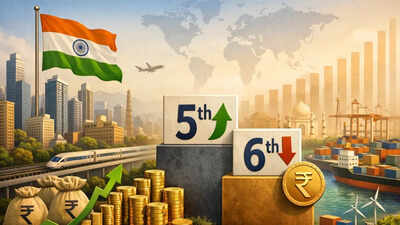
How India Went From A Future Fourth-Largest Economy To The World’s Sixth-Largest Economy
Just a year ago, the conversation around India’s economic rise appeared almost settled.
In April 2025, projections from the International Monetary Fund (IMF) suggested that India was on track to overtake Japan and become the world’s fourth-largest economy by the end of FY26. The milestone was widely celebrated as symbolic confirmation of India’s emergence as a major economic power. After decades of being described as a country with enormous potential, India finally seemed ready to convert that potential into global economic heft.
But a year later, the picture looks rather different.
According to the IMF’s latest World Economic Outlook, India is now projected to rank as the world’s sixth-largest economy in FY27, behind not only the United States, China and Germany, but also Japan and the United Kingdom. Instead of moving up the rankings, India has effectively slipped two positions from where many expected it to be.
At first glance, the development appears puzzling.
After all, India has not entered a recession. Growth has not collapsed. In fact, the country is still expected to remain the fastest-growing major economy in the world. Most economic forecasters continue to project GDP growth in excess of 6 per cent, a figure that many developed economies would envy.
So what exactly happened?
The answer reveals one of the most important realities of modern economic rankings: size and growth are not always the same thing.
When economists compare the size of national economies, they typically do so in US dollar terms. This means that even if an economy grows strongly in its domestic currency, its position in the global rankings can be affected significantly by movements in exchange rates.
This is precisely where India encountered a problem.
Over the past year, the Indian rupee weakened far more than many analysts had anticipated. A combination of foreign capital outflows, elevated oil prices, geopolitical uncertainty and a strengthening US dollar placed sustained pressure on the currency. As the rupee depreciated, India’s GDP, when converted into dollars, appeared smaller than earlier projections had suggested.
The effect can be substantial. Imagine two countries growing at similar rates in their domestic currencies. If one country’s currency weakens sharply against the dollar while the other’s remains relatively stable, the first country can appear to be growing more slowly in global rankings despite generating robust domestic growth.
That is exactly what happened in India’s case.
The United Kingdom, meanwhile, benefited from a relatively stronger currency performance and somewhat better-than-expected economic outcomes. Japan, despite its long-standing structural challenges, maintained a larger nominal GDP base. The result was a reshuffling of the rankings that pushed India down to sixth place despite continued expansion at home.
The rupee, however, was not the only factor.
India also introduced a revised GDP series with a new base year and updated methodology. While the revision was aimed at presenting a more accurate picture of the economy, it resulted in a lower nominal GDP estimate compared to the previous calculation framework. The revision did not mean economic activity had suddenly disappeared; rather, it reflected a different way of measuring it. Nevertheless, because global rankings rely on nominal GDP figures, the statistical adjustment further contributed to India’s lower position.
Taken together, the currency effect and the GDP revision created a situation where India’s economy continued to grow rapidly while simultaneously appearing smaller in global comparisons.
There is an important lesson here.
Economic rankings often generate headlines because they are easy to understand. Moving from fifth to fourth sounds like progress. Falling from fourth to sixth sounds like decline. Reality is usually more nuanced.
India’s slip in the rankings does not mean the country’s economic fundamentals have suddenly deteriorated. Nor does it invalidate the broader growth story. However, it does expose vulnerabilities that are sometimes overlooked amid the celebration of headline GDP numbers.
The strength of a currency, the stability of external accounts, the confidence of foreign investors and a country’s resilience to global shocks all play a crucial role in determining how economic success is ultimately measured.
And that brings us to perhaps the most important variable in this entire discussion.
Because if India’s fall in the rankings was driven largely by currency weakness, then understanding the state of the rupee becomes essential to understanding the state of the economy itself.
The Rupee’s Fall And Why It Matters More Than Ever
Currencies rarely dominate public debate in the way stock markets, inflation or GDP growth do. Most people do not wake up wondering whether the rupee has moved by a few paise against the dollar. Yet few economic indicators reveal as much about a country’s strengths and vulnerabilities as its currency.
And right now, the rupee is sending a message that policymakers, investors and businesses cannot afford to ignore.
Over the past decade, the Indian rupee has steadily weakened against the US dollar. Since 2014, when the currency traded at around ₹60 to the dollar, it has depreciated by roughly 40 per cent, recently touching levels near ₹94-95 against the greenback. What is perhaps more striking is not the decline itself but the pattern. Every major bout of weakness has been followed by a period of stabilisation at a new, lower level rather than a meaningful recovery.
In other words, the rupee has not merely fluctuated; it has gradually reset itself downward over time. To be fair, India is hardly alone. Several emerging market currencies have struggled against a dollar that has remained remarkably resilient over the past decade.
However, India’s situation is unique because of the structure of its economy.
The country imports nearly 85 per cent of its crude oil requirements. It is also heavily dependent on imported electronics, industrial inputs, machinery and several critical raw materials. As a result, every meaningful decline in the rupee immediately increases the cost of buying these goods from abroad.
The consequences are far-reaching.
For consumers, a weaker rupee eventually translates into higher prices. Whether it is fuel, cooking gas, imported goods or products that depend on imported inputs, costs tend to rise across the economy. This imported inflation then creates a challenge for policymakers, who must balance growth concerns with the need to keep prices under control.
For businesses and policymakers alike, a weaker rupee creates significant challenges. Companies that depend on imported raw materials face rising costs and margin pressures, while the government’s import bill, particularly for crude oil, increases substantially. This widens the current account deficit, strains public finances and complicates efforts to attract long-term capital and position India as a global manufacturing hub.
The rupee’s decline also reflects changing foreign investor sentiment. As foreign institutional investors have reduced exposure to Indian equities amid valuation concerns, global uncertainty and opportunities elsewhere, particularly in AI-linked markets, capital outflows have added further pressure on the currency. While the Reserve Bank of India has periodically intervened to curb excessive volatility, it has been unable to reverse the broader trend.
And nowhere are those vulnerabilities more visible than in India’s relationship with crude oil, a single variable capable of influencing inflation, the currency, government finances and investor sentiment all at once.
The Iran Conflict, Oil Prices And India’s Biggest Economic Vulnerability
If the rupee is the symptom, oil is often the cause.
For all the talk of India’s rise as a global economic powerhouse, the country continues to have one weakness that policymakers have struggled to overcome for decades:
a deep dependence on imported energy. India imports roughly 85 per cent of its crude oil requirements, making it one of the world’s most vulnerable major economies whenever geopolitical tensions threaten global energy supplies.
That vulnerability was once again exposed by the recent conflict involving Iran.
Whenever tensions escalate in West Asia, investors immediately begin looking at one critical chokepoint: the Strait of Hormuz. Barely 33 kilometres wide at its narrowest point, the waterway carries nearly a fifth of the world’s oil supply and a significant portion of global liquefied natural gas shipments. Any disruption, or even the threat of disruption, sends shockwaves through energy markets.
For India, the implications are immediate and severe.
Unlike countries that are energy self-sufficient or possess vast strategic reserves, India remains heavily dependent on imported crude. When oil prices rise sharply, the country finds itself paying more dollars for the same quantity of energy imports. This widens the trade deficit, increases pressure on the rupee and eventually feeds into domestic inflation.
The chain reaction is remarkably straightforward.
Higher crude prices lead to a larger import bill. A larger import bill increases demand for dollars. Greater demand for dollars weakens the rupee. A weaker rupee makes imports even more expensive.
The result is a vicious cycle that policymakers have repeatedly been forced to confront.
Oil occupies a unique place in India’s economic story because few variables influence as many aspects of the economy simultaneously. Beyond petrol and diesel prices, higher crude prices affect transportation, logistics, manufacturing, agriculture and consumer goods, eventually feeding into inflation across the economy. For policymakers, the challenge is equally difficult: they can either allow higher costs to pass through to consumers and risk inflation, or absorb part of the burden through subsidies and tax adjustments, both of which carry economic costs.
This explains why markets reacted positively whenever signs emerged that tensions between the United States and Iran might ease. Lower oil prices would reduce India’s import bill, support the rupee, ease inflationary pressures and improve investor sentiment. A more stable West Asia could therefore become one of the biggest external tailwinds for the Indian economy.
At the same time, the episode shows a structural vulnerability that India has yet to overcome. Despite its growing economic strength, the country’s fortunes remain closely linked to developments in global energy markets. And that is a risk investors have increasingly begun to price in.
Over the past two years, foreign institutional investors have steadily reduced their exposure to Indian equities. Their caution raises an important question: if India’s long-term growth story remains intact, why is foreign capital becoming more hesitant?

India’s Warning Signs Vs Signs Of Optimism
- Rupee Weakness Record SIP Inflows
- FII Outflows Strong DII Buying
- Oil Dependence 6.5% GDP Growth
- GDP Ranking Slip Massive IPO Pipeline
- Global Uncertainty Startup Ecosystem Maturing
Today, those alarm bells are ringing once again.
After recording substantial outflows in 2025, foreign investors have continued pulling money out of Indian equities in 2026. The scale of the withdrawals has surprised many observers, particularly because the selling has occurred at a time when India continues to be projected as the world’s fastest-growing major economy.
At first glance, the contradiction seems difficult to explain.
Why would foreign investors reduce exposure to one of the few large economies still capable of delivering growth rates above 6 per cent?
The answer lies in the fact that investors do not buy economies; they buy opportunities.
And increasingly, many foreign investors appear to believe that India’s opportunities may not be as attractive as they once were relative to alternatives elsewhere.
One of the biggest concerns is valuation.
There are several reasons behind the recent wave of foreign selling. Indian markets have delivered strong returns over the past few years, pushing valuations to levels that many global fund managers consider expensive. While investors remain positive on India’s long-term prospects, some are questioning whether current prices adequately reflect the risks.
At the same time, global capital has increasingly shifted towards markets viewed as direct beneficiaries of the artificial intelligence boom, particularly the United States, Taiwan and South Korea. Geopolitical risks, including India’s dependence on imported oil and instability in West Asia, have also added to investor caution.
The rupee has become another concern. For foreign investors, returns depend not only on stock performance but also on currency movements. A weakening rupee can erode gains and often creates a feedback loop, with capital outflows putting further pressure on the currency.
Importantly, this appears to be more of a reassessment than a rejection of the India story. Foreign investors are not necessarily questioning India’s long-term growth potential; rather, they are becoming more selective about the price they are willing to pay for it.
Yet perhaps the most surprising development is what has happened next. Historically, sustained foreign selling would have triggered significant market corrections. This time, however, Indian markets have remained remarkably resilient.
Which raises an important question: if foreign investors are selling, who is buying?

If Foreign Investors Are Selling, Who Is Buying?
Not too long ago, sustained foreign selling would have been enough to trigger a sharp correction in Indian markets. FIIs controlled a significant share of market liquidity, while retail participation and domestic institutional flows remained relatively limited.
That India no longer exists.
Over the past decade, millions of Indians have entered financial markets through mutual funds, SIPs and direct equity investments. With more than 20 crore demat accounts and record SIP inflows, domestic capital has become a powerful force on Dalal Street.
As a result, domestic institutional investors, including mutual funds, insurance companies and pension funds, have increasingly offset foreign selling. In several recent months, DII purchases comfortably exceeded FII outflows, helping markets remain resilient despite concerns over the rupee, oil prices and geopolitical uncertainty.
This marks one of the most significant shifts in India’s financial markets. While foreign investors remain important for liquidity, capital flows and sentiment, Indian markets are becoming increasingly supported by domestic savings rather than overseas capital. It is a sign of a maturing market and helps explain why benchmark indices have remained surprisingly firm despite sustained foreign selling.
Yet this resilience raises an important question. Are domestic investors correctly identifying a long-term opportunity that foreign investors are underestimating, or are they becoming overly optimistic at a time when economic risks are beginning to accumulate?
The answer may lie in the behaviour of another group placing a significant bet on India’s future: startup founders. While foreign investors have been trimming exposure to Indian equities, some of the country’s biggest startups are preparing to enter the public markets, convinced that investor appetite for the India story remains very much alive.

India’s Biggest Startup IPO Wave Could Be Just Beginning
If foreign investors are becoming more cautious and the economy is facing visible pressure points, one would expect startup founders to delay listing plans until conditions improve.
Instead, the opposite appears to be happening. India is staring at what could become one of the largest startup IPO waves in its history.
The scale of activity is difficult to ignore. After a record-breaking 2025, dozens of startups are preparing draft papers, seeking regulatory approvals or actively working towards public listings. Some of India’s most recognisable technology companies are now preparing to test public market appetite despite a challenging backdrop marked by rupee weakness, foreign investor outflows, slowing global growth and geopolitical uncertainty.
Much of this confidence stems from the success of 2025, when 18 venture-backed companies raised more than ₹41,000 crore through public listings. More importantly, those IPOs demonstrated that investors were still willing to back technology-driven businesses, provided they could show a credible path to sustainable growth and profitability.
That lesson appears to have been absorbed across the ecosystem. Unlike the previous generation of startups that prioritised growth at any cost, many companies preparing to list today are entering public markets after years of restructuring, cost rationalisation and a greater focus on profitability, cash flows and capital efficiency.
The experiences of companies such as Paytm, Policybazaar, Nykaa, Delhivery and Zomato have fundamentally reshaped investor expectations. As a result, India’s startup ecosystem looks markedly different from the one that existed just a few years ago.
This year’s IPO pipeline reflects that transformation.
Quick commerce giant Zepto is among the most closely watched candidates. E-commerce major Flipkart is reportedly accelerating plans for an eventual Indian listing. Hospitality platform OYO continues to explore public market opportunities after multiple delays. Other high-profile names such as InMobi, Zetwerk, Pine Labs, Groww, Lenskart and Meesho are frequently mentioned among the companies expected to test investor appetite over the coming quarters.
Taken together, these companies represent tens of thousands of crores in potential fundraising activity.
In fact, some estimates suggest that startup IPOs planned or under consideration could collectively seek well over ₹50,000 crore from public markets over the next few years. If even a portion of that pipeline materialises, it would mark one of the most significant transfers of India’s startup economy into public ownership.
The implications extend far beyond founders and venture capital firms.

Have Indian Startups Finally Learnt The Lessons Of The Last IPO Cycle?
Successful IPOs provide liquidity to early investors, allow employees to monetise stock options and give public market investors access to sectors that were once confined to private markets. Yet there is an irony at the heart of India’s latest IPO wave. While many foreign investors who helped fuel the startup boom have become increasingly cautious about Indian equities, founders appear convinced that domestic investors will support the next listing cycle.
That confidence stems partly from the lessons of the previous cycle. For years, startups were rewarded for pursuing growth at any cost, often prioritising market share over profitability. The IPOs of companies such as Paytm, Policybazaar, Nykaa, Delhivery and Zomato changed that conversation. Public market investors demanded answers to more fundamental questions: Can the company generate profits? Are its unit economics sustainable? Can growth be achieved without constant infusions of capital?
The correction that followed forced a shift in priorities across the startup ecosystem. Founders focused on cost rationalisation, operational efficiency and stronger unit economics, while investors became far more selective in deploying capital. As a result, many companies preparing to list today look markedly different from their predecessors. Profitability, cash flows, governance and capital efficiency now matter almost as much as growth itself.
That does not mean risks have disappeared. Competition remains intense, several business models are still relatively young and valuations continue to be debated. Yet the defining characteristic of this IPO cycle is clear: investors are no longer buying growth stories alone; they are buying business models. Companies that can combine scale with sustainable profitability are likely to be rewarded, while those that cannot may face a far less forgiving market.
Which brings us back to the central contradiction of this article. The rupee remains under pressure, foreign capital is leaving and geopolitical risks continue to cloud the outlook. Yet domestic investors are pouring money into equities and startup founders are preparing to list. The question is no longer whether India faces challenges. It is why so many investors continue to believe that the opportunities outweigh them.
The Last Bit,
The real question is not whether India faces challenges. Every major economy does. The more important question is whether investors are right to believe that India’s long-term opportunities outweigh its short-term vulnerabilities.
Foreign investors appear uncertain. Domestic investors remain enthusiastic. Startup founders are preparing to ring the IPO bell. Somewhere between that caution and that confidence lies the true state of the Indian economy. The next few years may finally reveal which side has been reading the story correctly.