43,000 Crore FPI Outflow: India Is Not Losing Money; India Is Losing Global Trust

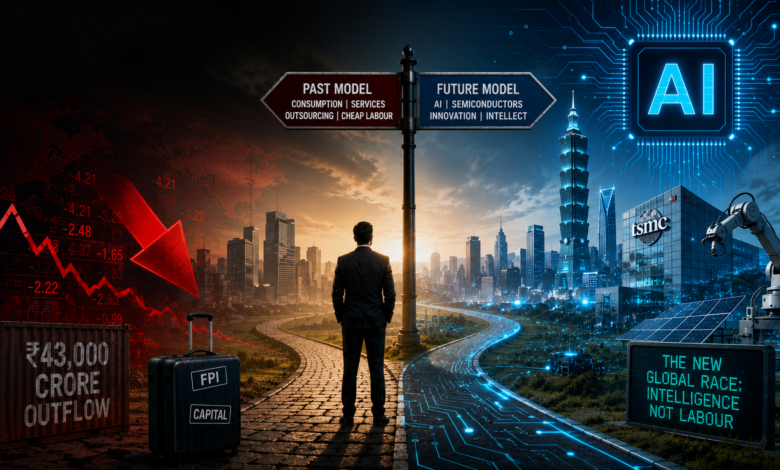
There is a certain ritual in how India processes bad financial news. The television panels assemble. The anchors furrow their brows. Senior economists speak in careful sentences. And somewhere in the background, a graphic flashes a number that is large enough to frighten but not large enough to be explained.
The number this time is around ₹2.5 lakh crore.
That is the approximate quantum of foreign portfolio investment that has exited Indian equities in 2026 alone, according to NSDL data- a figure that had already surpassed the entirety of the ₹1.66 lakh crore withdrawn across the full calendar year 2025 by the time May was barely half-done. In March 2026, a single month saw over ₹1.17 lakh crore walk out the door, which is the sharpest monthly outflow in recent memory, equivalent to roughly $13.6 billion.
Foreign investors were net sellers in every month of 2026 except February. The rupee, trading at around ₹83 to the dollar just two years ago, crossed ₹95 in early May 2026, hovering near ₹95.7 as recently as the first week of June; a depreciation of roughly 14% over two years and one of the steepest sustained slides since 2013.
And yet, here is the uncomfortable truth that the ritual fails to confront: the number itself is not the story.
Foreign money leaves markets all the time. It leaves because of interest rate differentials. It leaves because of geopolitical anxiety. It leaves because fund managers in London and New York are rebalancing their books, and India happens to be in the column labelled “reduce exposure.” These are ordinary occurrences in the life of any emerging market.
The real question- the question that is not being asked loudly enough in any finance ministry corridor or prime-time debate- is not how much money is leaving. It is where that money is going. Because capital, in the end, is a vote. And in 2026, global capital is voting in a very specific direction.
Part One: The Week That Should Worry India More Than a Market Crash
Every era has a magnet, a single dominant technological revolution around which global wealth concentrates before it is redistributed more broadly. In the 1990s, it was the internet. In the 2000s, it was China manufacturing. In the 2010s, it was smartphones and the platform economy. The 2020s have an answer too, and it is not subtle: artificial intelligence.
The wave of FPI departures from Indian equities in 2026 is happening in the context of a global capital rotation of historic proportions. Investors who are selling India are not burying the proceeds under a mattress. They are, broadly, chasing AI-linked opportunity — in American technology companies, in Taiwan’s semiconductor ecosystem, in South Korean memory chipmakers, in a constellation of AI infrastructure providers that did not meaningfully exist five years ago.
This is not speculation. The United States attracted $109.1 billion in private AI investment in 2024 alone- nearly 12 times China’s $9.3 billion and 24 times the United Kingdom’s $4.5 billion, according to the Stanford AI Index 2025. Nvidia’s market capitalisation has periodically approached or exceeded $3 trillion. Microsoft, Google, and Amazon have committed hundreds of billions of dollars to AI infrastructure. Even Saudi Arabia, not historically associated with technological vanguardism, has announced Project Transcendence — a $100 billion AI initiative — because even petrostates understand that the next century’s wealth will be minted in silicon, not crude.
Into this frenzy of intelligent capital allocation, India enters with $20 billion in total AI investment commitments as of 2025, a figure that includes everything from government pledges to private sector announcements, and one that sounds impressive until you notice that the United States and China’s investment. India’s government allocation to AI-related funding in the Union Budget 2025-26 was ₹4,349.8 crore, approximately $520 million, against a backdrop in which China launched a $47.5 billion semiconductor fund in 2024 alone.
This is the context in which India is losing foreign investors. Not because it is collapsing. But because it is not competing in the arena that now defines the future.
Part Two: Every Era Has a Magnet
To understand why this moment is historically consequential, one must appreciate how reliably global capital concentrates around technological revolutions.
The industrial revolution made Britain the centre of global wealth not because it had the most land or the most people, but because it mastered steam power, mechanised production, and the financing structures that supported both. The United States claimed the twentieth century not because of geography but because it dominated the oil economy, then the automobile, then the semiconductor, then the internet. Each time, the question was the same: which economy sits closest to the engine of the new era?
For nearly two decades, India made a convincing claim to be near that engine. The “India Story” was a compelling investment thesis: the world’s fastest-growing large economy, with a vast English-speaking workforce, a government committed to digital transformation, a demographic profile that promised decades of consumption growth, and the tailwind of China’s gradual political and economic complications. Foreign portfolio investors bought that story. They bought it in bulk.
The IMF projects India’s GDP growth at 6.6% for FY2025-26 and 6.4% for 2026 on a calendar year basis, making it the fastest-growing major economy in the world, ahead of China’s 4.8%. India became the world’s fourth-largest economy in 2025. It is poised to become the third-largest by the early 2030s. The growth numbers remain excellent by any reasonable standard.
But here is the problem: the investment thesis has shifted underneath India’s feet, and the country has not fully registered the movement.
Global investors are no longer asking: “Which emerging market should I buy for growth?” They are asking: “Which economy will generate the next trillion dollars of AI wealth?” Those are profoundly different questions, and India’s answer to the second one is substantially less convincing than its answer to the first.
Part Three: India Became the World’s Back Office. But AI Threatens the Back Office.
For three decades, India’s economic miracle was powered by a very specific bargain: the world needed armies of engineers, coders, data processors, and customer service agents, and India could supply them at a fraction of the cost of hiring in the West. This model created millions of middle-class jobs, built gleaming technology campuses in Bengaluru, Hyderabad, and Pune, and produced a generation of professionals whose children now study at IITs with ambitions that stretch from San Jose to Singapore.
The IT services industry became India’s pride. TCS, Infosys, Wipro, HCL Technologies- these companies grew into global institutions. Infosys alone delivered revenues of $19.277 billion in FY2025, with 300,000-plus employees and operations spanning dozens of countries.
But Infosys’s own forward guidance tells a story that deserves closer reading. The company’s FY2026 revenue guidance is 0%-3% growth in constant currency- effectively flat, by the standards of an industry that once routinely grew at 15%-20% per year. TCS has spoken publicly about delays in client decision-making. Wipro saw a large client pause a transformational deal. These are not companies in crisis. But they are companies in transition, and the transition is being driven by something their leadership teams discuss with careful optimism but cannot fully avoid: artificial intelligence is starting to do what Indian back-office workers used to do.
Goldman Sachs estimated in 2023 that AI could affect roughly 300 million full-time jobs globally, with the greatest impact on white-collar, routine cognitive tasks — precisely the category that India’s outsourcing industry built its success upon. More recent assessments suggest the timeline for disruption may be shorter than originally anticipated. AI coding assistants now write functional code at speeds that compress development timelines. AI customer service agents handle calls that were once routed to centres in Noida and Chennai. AI legal tools draft documents that once required junior attorneys. AI financial analysts process data that once employed hundreds of back-office workers in Mumbai.
Here is the cruel arithmetic: the more sophisticated AI becomes, the less valuable the human supply of standardised cognitive labour. And India built its economic middle class almost entirely on the international demand for standardised cognitive labour. Investors understand this risk before governments do. This is their function. They are not sentimental about the India Story. They are calculating the probability that India’s most successful economic model remains viable in a world where the marginal cost of intelligence approaches zero. The answer, apparently, is creating some anxiety.
Part Four: The Rupee Is Telling a Story Nobody Wants to Hear
Currency discussions are typically the preserve of central bankers and foreign exchange traders, the very people whose professional obligation is to discuss money in the language of money, which is to say, in a language specifically designed to avoid emotional clarity.
So let us speak about the rupee without that professional caution.
The rupee began 2024 at roughly ₹83 to the dollar. It began 2025 around ₹85.5. By March 2026, it had touched ₹94.71, a record low. By May 2026, it was crossing ₹95. In early June 2026, it was hovering near ₹95.7. This is a depreciation of roughly 14% in two years; one of the worst sustained slides the currency has seen since the 2013 taper tantrum episode.
The causes are well-documented: persistent oil import dependency, a widening current account deficit, FPI outflows that at their peak reached $17 to $18 billion in a single year, US tariff pressures on Indian exports (at 50%, the highest applied to any major trading partner), and a narrowed interest rate differential between India and the United States. But the psychology of currency is as important as the economics, and the psychology here is troubling.
Strong currencies attract confidence. They signal that global investors want to hold assets denominated in that currency, which means they want to own things inside that economy. Weak currencies, especially ones weakening persistently and structurally rather than cyclically, repel that confidence. They add a currency risk premium to every investment decision: even if an Indian stock rises 12%, a rupee that depreciates 8% converts that return into a meagre 4% in dollar terms for a foreign investor.
The rupee is not just a currency. It is a report card. And in 2025-26, it is reporting a grade that India’s official narrative has not caught up with. The Nominal Effective Exchange Rate, the rupee measured against 40 key trading partners, declined approximately 8% through 2025, meaning the weakness is broad, not merely a function of dollar strength.
None of this is catastrophic in isolation. India’s current account deficit remains in the manageable 1%-1.5% of GDP range. Foreign exchange reserves remain substantial. The RBI has intervened carefully to prevent disorderly moves while allowing the currency to find its market level. But intervention buys time, not confidence. And what India needs, in 2026, is not more time. It is a more convincing story about the future.
Part Five: India’s Growth Model Is Beginning to Age
There is a particular form of economic complacency that afflicts successful developing nations: the assumption that the model that produced growth will continue producing growth, simply because it has done so thus far. India’s current economic success rests on a set of pillars that were brilliantly assembled for the era between 1991 and 2020. Strong domestic consumption. A services-led export model. Government capital expenditure in infrastructure. A large and young workforce entering the labour market annually. A domestic financial sector increasingly able to channel savings into productive investment.
These pillars remain standing. India’s consumption story is real. Its infrastructure investment is visible and impressive. Its financial inclusion, powered by the JAM trinity of Jan Dhan, Aadhaar, and Mobile, is a genuine achievement that development economists study with admiration. But the next era, the one that global capital is now pricing in, rewards a different set of capabilities.
Deep technology development. Semiconductor design and manufacturing. AI model creation and deployment. Data centre infrastructure at scale. Advanced materials research. Quantum computing investment. Scientific publishing and patent generation in frontier fields.
India’s performance on these metrics invites scrutiny. The country’s R&D spending as a percentage of GDP hovers around 0.65%-0.70%, compared to 3.5% for South Korea, 3.3% for Israel, 2.4% for the United States, and 2.2% for China. In 2024, U.S. institutions produced 40 notable AI models, significantly outpacing China’s 15 and Europe’s three. While India has a massive, world-leading AI talent pool and ranks 3rd globally in the Global AI Vibrancy Index, it has not historically registered a high volume of ‘notable’ foundational models on these specific global benchmark leaderboards, though the launch of sovereign models like BharatGen and Sarvam AI is shifting this landscape
India has 74 newly-funded AI startups in 2024, bringing its total from 2013 to 2024 to 434 companies. The United States had 1,073 newly funded AI companies in 2024 alone. The UK, a country with one-twentieth of India’s population, had 116. The India AI Mission, the Semiconductor Mission, and the associated government initiatives are genuine efforts to shift course. They deserve acknowledgment. But acknowledging an effort and believing it sufficient are different intellectual acts, and conflating them is a mistake India’s commentariat makes with remarkable regularity.
Part Six: Why Taiwan Matters More Than Wall Street
Consider Taiwan. An island of 23 million people. No permanent seat on the UN Security Council. A complex and permanently contested sovereignty status. A government that cannot use its official name in most international forums. By the criteria that twentieth-century geopolitics used to measure national importance, population, military power, territorial extent, Taiwan is not a great power.
And yet, in June 2026, Taiwan is more strategically important to the global economy than almost any country its size in human history. TSMC, the Taiwan Semiconductor Manufacturing Company fabricates chips for Apple, Nvidia, AMD, Qualcomm, Broadcom, and dozens of other companies whose products constitute the nervous system of the modern world. TSMC’s quarterly revenues now routinely exceed $30 billion. In early 2025, the company announced it would expand its US investment to $165 billion described as the largest single foreign direct investment in American history- building three new fabrication plants and two advanced packaging facilities.
TSMC’s grip on advanced semiconductor manufacturing is so complete that the United States, China, Europe, and Japan have each launched dedicated programs to either replicate its capabilities domestically or secure access to its output. The American CHIPS Act committed $52 billion. The European Chips Act committed €43 billion. China launched a $47.5 billion semiconductor fund. All of this to either attract TSMC or build alternative capacity, because the world now understands that whoever controls advanced chip fabrication controls the material foundation of AI.
India, at roughly 56 times Taiwan’s population and a GDP approaching $4 trillion, may or may not be a significant participant in this conversation. Its semiconductor ambitions — genuine, nascent, and government-supported are measured in billions rather than tens or hundreds of billions. The country does not yet fabricate chips at any meaningful scale, let alone at the cutting-edge geometries that AI workloads demand.
The lesson of Taiwan is not that size determines relevance. It is the opposite: in the age of AI, strategic positioning matters more than size. A tiny island that mastered the one technology the world cannot function without became indispensable. A billion-person democracy that became the world’s back office is finding that the office may be automated.
Part Seven: The Dangerous Comfort of GDP Growth
Let us be honest about what GDP growth does and does not tell you. It tells you the economy is getting larger. It does not tell you how it is getting larger, or whether the sources of that growth are durable, or whether the economy is building the kind of institutional and technological capacity that translates into long-term strategic relevance.
Brazil’s economy grew. Russia’s economy grew. South Africa’s economy grew. Argentina, Indonesia, Turkey — all experienced significant periods of GDP expansion that attracted foreign investment, created a middle class, and generated optimism about their futures. And yet none of them became the defining economy of their era. None of them built institutions that changed the world. None of them created the companies, the technologies, or the ecosystems that became indispensable to global civilisation.
A country can grow and still become less important. This is one of the less comfortable insights in development economics, because it challenges the implicit assumption that growth is directional, that if you keep growing, you will eventually arrive somewhere significant. History suggests the path is more treacherous. Growth sustains you. But relevance requires a different kind of ambition.
India’s growth is real, but the quality of that growth is beginning to face questions from the global capital that it needs. The economy remains heavily weighted toward domestic consumption, government spending, and services. Manufacturing as a share of GDP has barely moved in two decades, hovering stubbornly around 14%-17% despite policy after policy aimed at improving it. The Production-Linked Incentive scheme has produced some wins in smartphones and pharmaceuticals, but India’s dream of becoming a manufacturing alternative to China has not yet materialised at the scale originally envisioned.
The more fundamental question is whether India is building the productive capacity that will allow it to participate in the wealth created by the AI revolution — not as a market for AI products sold by others, but as a generator of AI value. The honest answer, in mid-2026, is: not yet, and perhaps not fast enough.
One way to appreciate the difficulty is to think about what economists call “capability accumulation.” Building a semiconductor industry is not simply a matter of announcing a policy and writing a cheque. It requires decades of accumulated knowledge, supplier networks, specialised labour markets, ancillary industries, and institutional frameworks.
Taiwan did not build TSMC in a budget cycle. It took forty years of deliberate industrial policy, patient capital, and national-level focus to create an institution that now dominates global chip manufacturing. South Korea’s electronics industry was planted in the 1970s and did not flower fully until the 1990s. China began its serious semiconductor push in the early 2000s, and is still, despite enormous investment, unable to consistently manufacture at the most advanced nodes.
India, if it begins in earnest today, is looking at a fifteen-to-twenty-year horizon before it has meaningful capabilities in the hardest parts of the AI infrastructure stack. That is not an argument against beginning. It is an argument for beginning immediately, decisively, and with far greater resources than are currently allocated. And it is a caution against the comfortable belief that India’s software services heritage automatically confers an advantage in the AI era. It does not. Software services and AI infrastructure are related industries in the way that horse-drawn carriage manufacturing and automobile engineering are related industries: superficially similar, structurally different, and separated by a gap in technical requirements that is easy to underestimate from the outside.
Part Eight: The New Global Race Is Not for Jobs. It Is for Intelligence.
Every great technological revolution reorganises the hierarchy of nations. The Industrial Revolution made muscle power cheap and abundant, which rewarded those who could harness machines, and destroyed those who could not. Entire civilisations that had been globally dominant for centuries found themselves suddenly peripheral, because the new world ran on steam engines, not on agriculture or artisanal craft.
The AI revolution is doing something structurally similar, but in the cognitive domain. It is making certain forms of intelligence- routine, documented, rule-following, pattern-matching- cheap and abundant. Which means it rewards those who control the hardware that runs intelligence (semiconductors, data centres, energy), those who create the foundational models that express intelligence (large language models, multimodal systems, reasoning engines), and those who build the applications and systems that deploy intelligence at scale.
Where is India’s Nvidia? Where is its TSMC? Where is its OpenAI, its Anthropic, its DeepMind? These are not unfair questions. They are the questions global investors are asking, with the directional movement of capital as their way of expressing the answer.
The United States has all of the above. China has Huawei, DJI, Baidu, and a semiconductor ecosystem it is building with extraordinary urgency and state resources. South Korea has Samsung and SK Hynix, which produce the memory chips without which AI training is impossible. Japan has invested billions in next-generation chip fabrication through Rapidus. Even the Netherlands, a country of 18 million people is globally irreplaceable because it hosts ASML, the only company in the world that makes the extreme ultraviolet lithography machines required for cutting-edge chip manufacturing.
India has world-class software engineers. It has a large and talented pool of AI researchers, many of whom work for Anthropic, Google DeepMind, Meta AI, and OpenAI — which is to say, they work for American companies while living in America. India has a digitally literate population and a thriving fintech and consumer internet ecosystem. These are genuine assets.
But assets must be organised into institutions of global scale to generate the kind of strategic relevance that makes a country indispensable in any era. India has not yet done this in the AI domain. And the window to do so is not infinite, because the compounding effects of early investment in foundational AI infrastructure become increasingly difficult to overcome with time.
Part Nine: What India Must Stop Celebrating
India counts its unicorns with the enthusiasm of a child counting birthday presents. As of 2025, the country has over 100 unicorn startups, privately held companies valued at $1 billion or more. The number is cited in government speeches. It appears in investment pitch decks. It features in newspaper headlines as evidence of India’s technological prowess. It is not evidence of India’s technological prowess. It is evidence of India’s ability to build consumer-facing digital businesses that generate large revenues by serving a massive domestic market. That is genuinely valuable. But it is not the same thing.
The Indian startup ecosystem has produced remarkable companies in financial technology, e-commerce, edtech, health tech, and quick commerce. Zomato, Swiggy, Zepto, PhonePe, Meesho — these are real businesses with real revenues and real users. They have created value and employment and demonstrated that Indian entrepreneurs can build at scale.
But consider what they have not produced: a foundation model. A semiconductor design house. A quantum computing startup. A robotics company. A biosynthesis platform. A space propulsion technology. An advanced materials firm. The categories of deep technology that will define the next twenty years are almost entirely absent from India’s startup success stories.
This is not accidental. It reflects investment patterns, educational priorities, and a startup culture that rationally responds to the incentives it faces. Venture capital in India has followed consumer internet because consumer internet has delivered returns. But consumer internet in India, however impressive domestically does not make India strategically relevant to the global AI economy. It makes India a market. And there is a significant difference between being a market and being an origin.
The Indian government’s ₹76,000 crore Semiconductor Mission and ₹1.97 lakh crore Production-Linked Incentive (PLI) scheme represent major structural shifts toward localizing high-tech manufacturing, though these sovereign outlays remain modest relative to global ambitions. While France recently marshaled a €109 billion public-private investment package for AI and digital infrastructure, India’s federal AI budget allocation for the 2025–26 fiscal year is approximately ₹4,350 crore ($520 million).
There is also a deeper cultural conversation to be had about what India celebrates as technological achievement. When a food delivery company achieves a billion-dollar valuation, it is widely reported as a triumph of Indian entrepreneurship. When a fintech startup raises a large funding round, the Prime Minister’s Office occasionally weighs in with congratulations. The ecosystem of attention, celebration, and policy support has been almost entirely directed toward consumer-facing digital businesses — and almost entirely absent from fundamental research and hard technology.
Compare this to how South Korea treats Samsung or how Taiwan treats TSMC. These companies are not simply businesses. They are treated as matters of national security and civilisational priority. The government’s relationship with them is intimate and deliberate. Research into advanced manufacturing processes is partly funded by the state. Export controls protecting intellectual property are aggressively enforced. The entire educational and immigration system is partially oriented toward generating the specific talent these companies need.
India has no equivalent relationship with any technology company because India has no technology company operating at the frontier of any hard technology. The question worth sitting with is: is that absence a coincidence, or is it a consequence of the choices, about education, about R&D investment, about what the government celebrates and what it ignores is that the country has made consistently for thirty years?
Celebrating unicorn count while the foundations of the next technological revolution are being poured by others is a form of narrative inflation, mistaking the appearance of progress for the substance of it. It is the equivalent of a country celebrating its thriving hand-loom industry while its neighbours are building automated textile factories. Admirable. Culturally significant. And not, in the end, a competitive strategy for the era that is arriving.
Part Ten: The Real Warning Hidden Inside ₹2.2 Lakh Crore
Let us return to the number. ₹2.5 lakh crore in FPI outflows in the first five months of 2026. Record monthly exits. Persistent rupee weakness. A currency trading near 95 to the dollar, a level that, two years ago, would have been treated as a crisis rather than a market movement. An IT services sector guiding for near-zero growth. A gap between India’s domestic narrative and global investor perception that is growing rather than closing.
The interpretive instinct in India is to explain these developments as temporary, cyclical, and externally driven. And there is truth in that instinct. Global factors are real. US tariffs at 50% on Indian goods are a genuine external shock. Geopolitical tensions and energy price volatility are real headwinds. The FPI outflow is partly a global risk-off phenomenon that affects all emerging markets.
But there is a danger in leaning entirely on external explanations. It allows the more structural question to go unaddressed: is India building the kind of economy that will attract long-term, conviction-based investment in the AI century?
Long-term capital, the kind that builds institutions, not the kind that trades quarterly earnings is looking for something specific. It is looking for countries that have identified their place in the emerging technological order and are investing credibly in securing that place. Taiwan earned its strategic indispensability through decades of focused semiconductor investment. South Korea earned its position through aggressive support for companies like Samsung. China has earned whatever position it occupies through a state-directed mobilisation of capital toward AI and semiconductor self-sufficiency that has no real parallel in scale.
India’s government knows this. Its technocrats are not ignorant of the challenge. The India AI Mission, the Digital India initiative, the semiconductor ambitions — these reflect an understanding that the country must evolve its economic model. The question is whether the pace of that evolution matches the pace of the global transition, and whether the resources committed are commensurate with the scale of the competition. The evidence, so far, suggests the answer is: not quite.
Conclusion: Participation Is Not Enough
India spent thirty years proving it could participate in the global economy. It proved it with software exports that crossed $250 billion annually. It proved it with a stock market that became one of the world’s largest by capitalisation. It proved it with a startup ecosystem that attracted global venture capital. It proved it with a GDP that made it the fourth-largest economy in the world.
But participation and shaping are different achievements. Britain participated in the global economy of the twentieth century. So did Argentina. So did Egypt. The countries that shaped that century, the ones whose companies, institutions, and technologies became indispensable to how the world worked, are a much shorter list.
The AI century offers India a genuine, meaningful opportunity to move from the first list to the second. The talent base is there. The mathematical tradition is there. The engineering culture is there. Some of the infrastructure building blocks are beginning to appear. The government has articulated the ambition, even if it has not yet fully funded it.
But the window is not unlimited. Technological revolutions consolidate. The companies that dominate AI in 2030 are likely to be the companies that are winning in 2026, because data, compute, and model quality compound in ways that early leaders protect fiercely. Countries that build semiconductor ecosystems in 2024 will have a decade of manufacturing experience and supply chain relationships by 2034. Countries that begin in 2034 will be catching up forever.
The ₹2.5 lakh crore outflow is, in this reading, not primarily a financial story. It is a signal, imprecise, partial, and noisy, as market signals always are, that global capital is beginning to ask India a question it has not yet answered convincingly: where do you fit in the AI economy?
The question is not hostile. It is, in fact, the most important question India’s policymakers, entrepreneurs, educators, and citizens should be asking themselves. It is more important than any quarterly GDP number. It is more important than any stock market rally or FPI inflow reversal. Because the difference between a country that participates in the AI revolution and a country that shapes it may define India’s economic destiny for the next half-century — long after today’s outflows have been forgotten, and long after the rupee has stabilised at whatever number the market eventually decides is right.

India has never lacked ambition. What the AI century demands is something subtler and harder: the willingness to honestly audit the gap between ambition and investment, and then close it, relentlessly and at speed. The world is not waiting.