Skyroot’s Vikram-1 Is More Than A Rocket. It’s India’s Biggest Leap In The Global Space Race And A Milestone That Even Elon Musk’s SpaceX Missed On Its First Attempt
For over five decades, India's space story belonged almost entirely to ISRO. Vikram-1 has changed that. Skyroot Aerospace's successful launch of the country's first privately developed orbital rocket marks the arrival of a new era—one where private enterprise is set to play a defining role in India's ambitions to become a global space power.

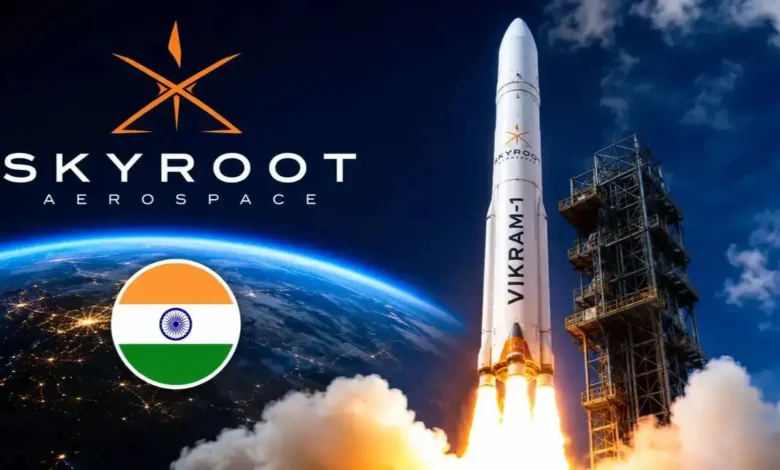
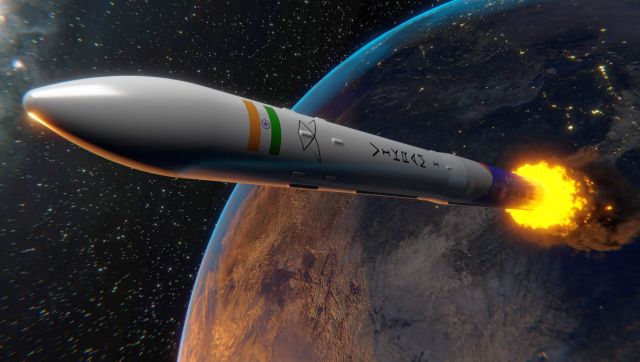
India’s private space ambitions crossed a historic threshold on Saturday as Hyderabad-based Skyroot Aerospace successfully launched Vikram-1, the country’s first privately developed orbital-class rocket, from the Satish Dhawan Space Centre in Sriharikota.
After a brief 35-minute hold before liftoff, the four-stage rocket completed its mission by injecting multiple payloads into a nearly 450-kilometre orbit, making India only the third country in the world where a private company has successfully achieved an orbital launch. The mission, aptly named Aagaman, marks far more than a successful rocket launch – it signals the arrival of a new chapter in India’s space journey.
India’s Biggest Private Space Moment Yet
Forty-six years after the Indian Space Research Organisation (ISRO) etched its name into history with the successful launch of the SLV-3, another milestone has now been added to the country’s growing space legacy. This time, however, the achievement belongs not to a government agency but to a private startup that was founded just eight years ago.
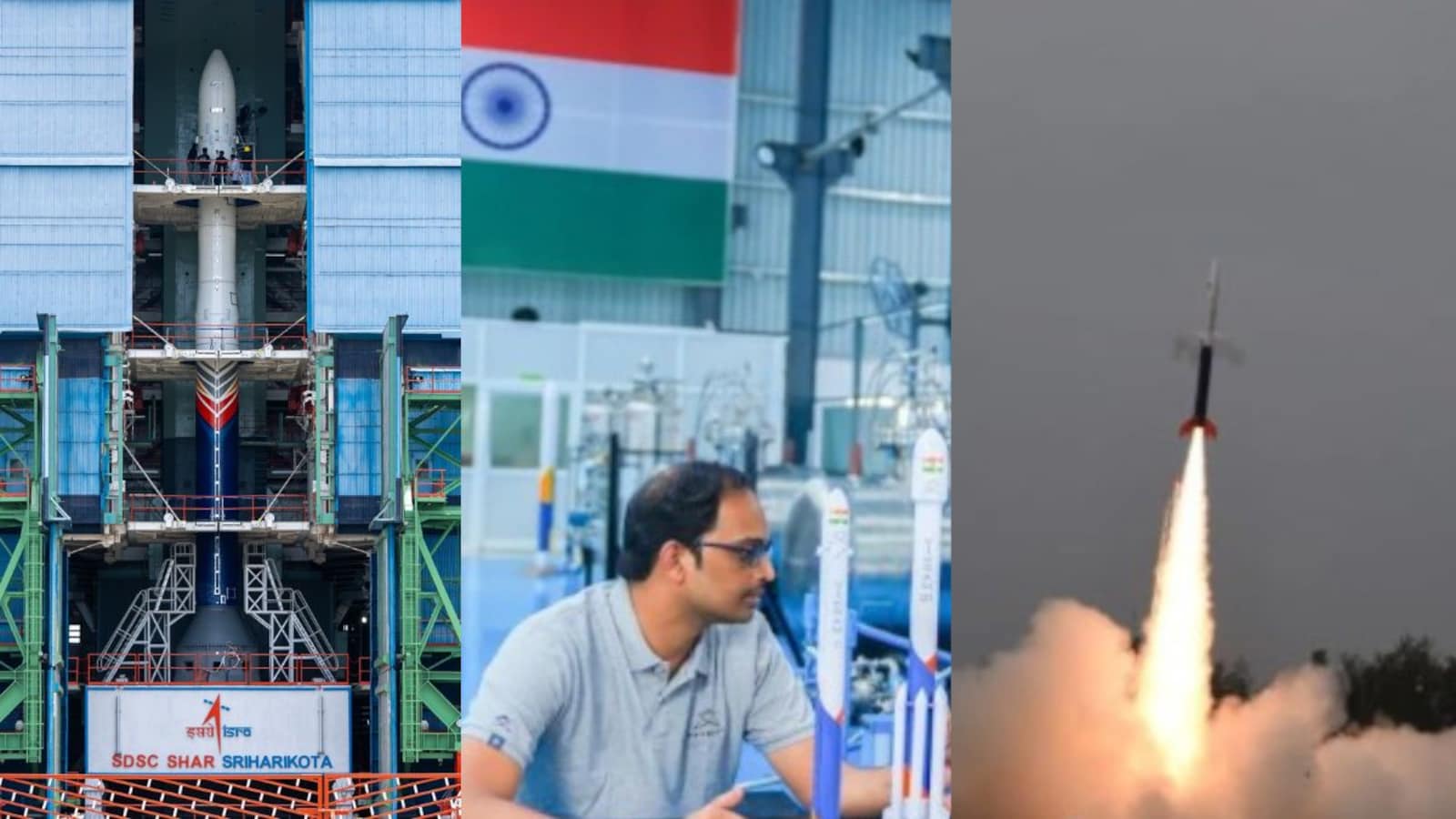
Skyroot Aerospace’s Vikram-1 lifted off from the First Launch Pad at the Satish Dhawan Space Centre after engineers completed a series of final system checks and a brief 35-minute planned hold. Once airborne, the rocket followed its planned trajectory through each of its four stages before successfully completing its final burn and deploying its payloads into a roughly 450-kilometre Low Earth Orbit, marking the company’s maiden orbital mission a success.
The achievement is historic for several reasons. Vikram-1 is the first orbital-class launch vehicle to be designed, developed and integrated entirely by a private Indian company. More significantly, the successful mission places India alongside a select group of nations with privately built rockets capable of reaching orbit, a milestone that reflects the rapid maturation of the country’s commercial space ecosystem.
Prime Minister Narendra Modi congratulated the Skyroot team following the successful mission, calling it another landmark in India’s expanding space journey. The launch also carried symbolic significance, with payloads including technology demonstrations, scientific experiments, a handwritten “Vande Mataram” postcard from the Prime Minister, and tributes to Indian space pioneers packed aboard the rocket.
Yet, impressive as the launch itself was, the real significance of Vikram-1 extends well beyond a flawless liftoff. The mission may well represent the moment India transformed from being a nation known primarily for government-led space missions into one emerging as a serious contender in the global commercial space race.
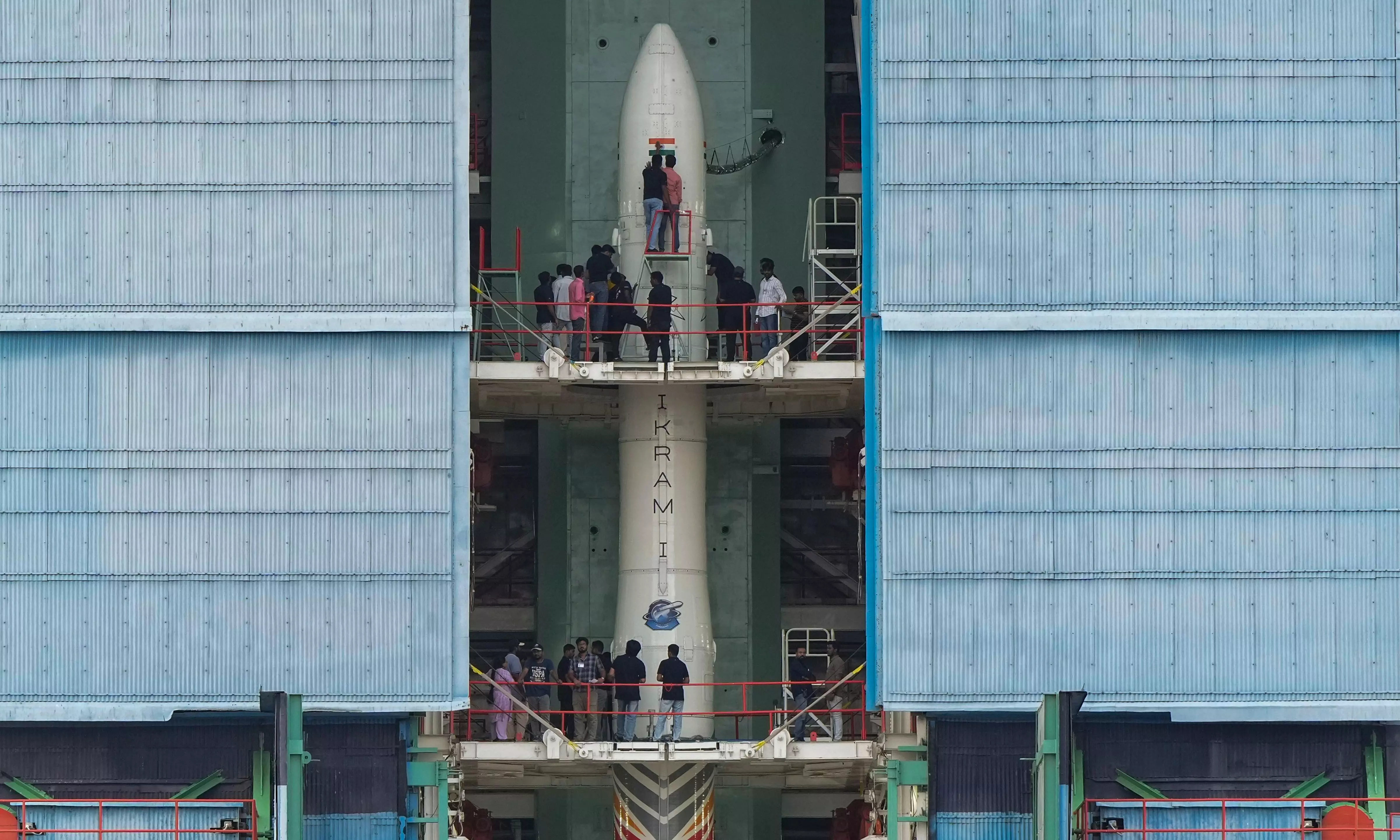
Why This Launch Changes Everything
At first glance, Vikram-1’s successful mission may appear to be another proud addition to India’s long list of space achievements. In reality, it represents something far more significant. For the first time, India has demonstrated that a private company (not just its national space agency) can design, build and launch an orbital rocket capable of placing payloads into space. That single achievement fundamentally changes how India will compete in the rapidly expanding global space economy.
Until recently, India’s space programme revolved almost entirely around ISRO. While the agency earned worldwide recognition for low-cost planetary missions, satellite launches and scientific breakthroughs, private participation remained limited. That began to change after a series of policy reforms, culminating in the Indian Space Policy 2023, which opened the country’s space value chain to private players, allowing startups to develop launch vehicles, build satellites and compete in commercial space services.
The transformation has been remarkably swift. According to government figures, India’s private space ecosystem has grown from just a single startup in 2014 to more than 400 companies today, working across launch systems, satellite manufacturing, Earth observation, communications and downstream applications. Vikram-1 is perhaps the most visible outcome of those reforms—a proof that Indian startups are no longer merely supplying components to ISRO but are capable of independently executing missions once considered the exclusive domain of national space agencies.
The commercial implications are equally significant. The global space economy is expected to expand rapidly over the coming decade, driven by the growing demand for small satellites supporting internet connectivity, navigation, climate monitoring, defence, agriculture and Earth observation. As hundreds of satellites are launched every year, operators increasingly seek dedicated launch services that can deploy payloads quickly rather than waiting months for space on larger shared missions.
That is precisely the opportunity Skyroot hopes to capture.
Instead of competing directly with heavy-lift launch providers, the company is positioning itself as an on-demand launch partner for small satellites – a model its founders have compared to a “cab service to space.” If successful, India could emerge not only as a country capable of launching its own missions, but as a preferred commercial launch destination for customers around the world.
Meet Vikram-1 — The Rocket Built To Compete Globally
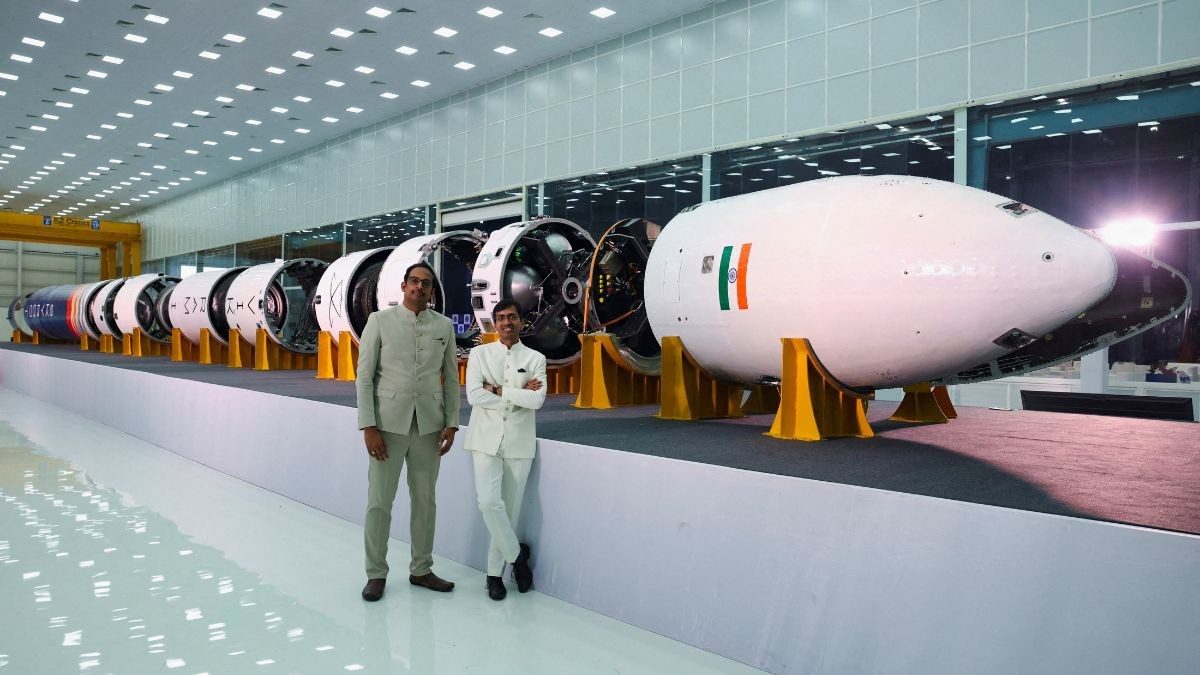
Behind the historic headlines is a rocket that reflects years of engineering, innovation and a clear commercial vision. Developed entirely by Hyderabad-based Skyroot Aerospace, Vikram-1 is the company’s first orbital launch vehicle and its second successful mission after Vikram-S, the suborbital rocket that became India’s first privately built rocket to reach space in 2022.
While Vikram-S proved the company could build and launch a rocket, Vikram-1 was designed to answer a far bigger question – could an Indian private startup reliably place satellites into orbit? Saturday’s launch delivered that answer.
Standing nearly seven storeys tall, Vikram-1 has been built using an all-carbon composite structure, making it lighter without compromising strength. The four-stage launch vehicle is powered by a combination of high-thrust solid rocket boosters and indigenously developed propulsion systems, including advanced 3D-printed engines – technology that reduces manufacturing complexity while improving efficiency. The rocket is capable of carrying payloads weighing up to 350 kilograms into Low Earth Orbit, placing it squarely in the growing market for dedicated small-satellite launches.
Mission Aagaman was never intended to be just another satellite deployment. Skyroot has consistently described it as a technology demonstration flight designed to validate every critical system under real-world conditions – from guidance and navigation to propulsion, telemetry and stage separation. The engineering data collected during the mission will now be analysed to fine-tune future versions of Vikram-1 before the company begins regular commercial operations.
The payload manifest reflected both scientific ambition and symbolism. Alongside multiple technology demonstration payloads – including Skyroot’s SCOPE experiment, Grahaa Space’s SOLARAS S3 satellite, DCUBED’s technology demonstrator and Cosmoserve Space’s orbital debris capture system – the rocket also carried a floral artwork titled Cosmic Bloom and an 18-karat gold micro-rocket featuring microscopic sculptures of Nobel laureate C.V. Raman, ISRO founder Vikram Sarabhai and former President A.P.J. Abdul Kalam, each smaller than a grain of rice.
The Two Engineers Trying To Build India’s SpaceX
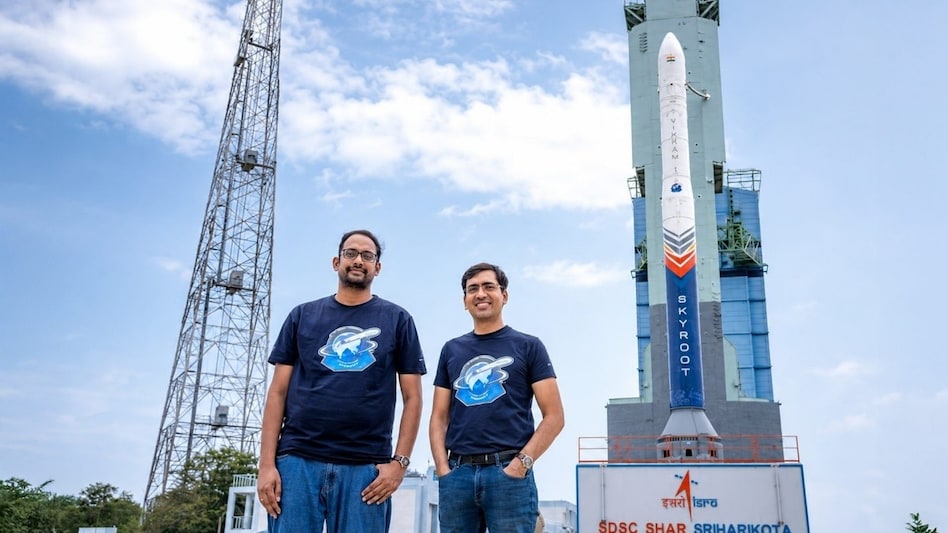
Every landmark technological breakthrough has a story behind it, and in Skyroot’s case, that story begins with two engineers who walked away from secure careers at ISRO to build something India had never seen before.
Skyroot Aerospace was founded in 2018 by former ISRO scientists Pawan Kumar Chandana and Naga Bharath Daka, both of whom had spent years working on India’s space programme before deciding that the future of space exploration would no longer belong solely to governments.
Inspired by the rapid rise of private space companies globally, they envisioned an Indian company capable of designing, building and launching rockets that could compete in the international commercial market.
The journey, however, was anything but straightforward. In 2020, Skyroot became the first Indian private company to successfully test a rocket engine. Two years later, it created history again with Vikram-S, India’s first privately built rocket to reach space. Those milestones helped attract investors and establish credibility, culminating in a funding round that valued the Hyderabad-based startup at around $1.1 billion, placing it among India’s growing list of unicorns.
Yet, Chandana and Daka have consistently maintained that building rockets is only part of their ambition. Their larger goal is to transform how satellites reach space.
Chandana has often described Skyroot’s long-term vision as creating a “cab service to space”—a future where satellite operators can book dedicated launches tailored to their schedules instead of waiting months, or even years, for space aboard shared missions. In an industry where timing can determine the commercial success of a satellite, that flexibility could become Skyroot’s biggest competitive advantage.
That vision reflects a broader shift taking place across the global space industry. Governments are increasingly relying on private companies to drive innovation, reduce costs and expand launch capacity. SpaceX transformed the economics of orbital launches in the United States, Rocket Lab carved out a niche in the small satellite market, and a new generation of commercial launch providers has emerged across Europe and Asia. Skyroot now hopes India can become part of that conversation – not merely as a supplier of engineering talent, but as a country exporting world-class launch services.
For Chandana and Daka, Vikram-1 is therefore more than a successful mission. It is proof that an idea conceived by two former government scientists can evolve into a company capable of reshaping India’s place in one of the world’s most competitive industries.
And while the company’s biggest commercial challenges still lie ahead, its historic first orbital success has already secured its place in India’s space story.
)
The One Detail That Even SpaceX Couldn’t Achieve
If Vikram-1’s successful launch was impressive, one detail makes the achievement even more remarkable – it reached orbit on its very first attempt.
In the world of rocketry, first-time success is the exception rather than the rule. Orbital launch vehicles are among the most complex machines ever built, where thousands of components must work in perfect synchronisation. A minor software glitch, a faulty valve, an engine shutdown lasting a fraction of a second too long, or a stage separation occurring milliseconds early can end a mission almost instantly. That is why even the world’s most successful space companies expect failures before they achieve orbit.
Perhaps the most famous example is Elon Musk’s SpaceX. Its Falcon 1 rocket failed on its first launch in 2006 after a fuel leak triggered a fire shortly after liftoff. A second attempt in 2007 also failed, followed by another setback in 2008 due to a stage separation problem. It was only on the fourth launch, later that same year, that Falcon 1 successfully reached orbit – an achievement that would eventually pave the way for SpaceX to become the world’s dominant commercial launch company.
SpaceX was hardly an exception. Rocket Lab, another leading private launch provider, also required more than one attempt before its Electron rocket successfully reached orbit. Across the industry, engineers often describe early launch failures as part of the learning process, with each unsuccessful mission generating invaluable flight data that improves future designs.
Against that backdrop, Skyroot’s first-attempt orbital success becomes even more significant. While the company will still spend months analysing engineering data before declaring Vikram-1 commercially operational, successfully completing its maiden orbital mission without suffering a launch failure places it in exceptionally rare company. It is a feat that many of the world’s best-known private space companies could not achieve during their own debut missions.
That does not necessarily mean Skyroot has surpassed SpaceX or other established launch providers, whose achievements today span hundreds of successful missions, reusable rockets and deep-space capabilities. But it does underline the quality of engineering behind Vikram-1 and demonstrates how rapidly India’s private space sector has matured. For a startup attempting its first orbital launch, there could hardly have been a stronger statement of intent.
The Next Frontier For Skyroot
While Mission Aagaman has secured Skyroot Aerospace a place in India’s space history, the company’s biggest challenge begins now. A successful demonstration flight is an important milestone, but turning that achievement into a sustainable commercial launch business will determine whether Skyroot can become a lasting player in the global space industry.
The immediate focus will be on analysing the enormous volume of flight data generated during Vikram-1’s maiden mission. Engineers will study everything from propulsion performance and structural loads to navigation accuracy, stage separation and payload deployment. The insights gathered will be used to validate the rocket’s design, fine-tune its systems and prepare Vikram-1 for routine commercial operations.
Once that process is complete, Skyroot plans to begin offering dedicated launch services to satellite operators across the world. The company is targeting one of the fastest-growing segments of the space economy 0 the small satellite market.
Governments, universities, research organisations and private companies are increasingly launching compact satellites for communications, Earth observation, climate monitoring, navigation, defence and scientific research. Rather than waiting for a slot on a larger rocket, many customers are willing to pay a premium for dedicated launches that place their satellites into the exact orbit they require.
That is where Vikram-1 could carve out its niche. With the ability to carry payloads of up to 350 kilograms into Low Earth Orbit, the rocket has been designed specifically for responsive, dedicated missions. Skyroot believes this approach can dramatically reduce waiting times for customers, reinforcing its vision of becoming a “cab service to space” for the rapidly expanding small satellite industry.
The timing may also work in the company’s favour. Analysts expect the global space economy to surpass a trillion dollars over the coming decades, driven by mega-constellations, commercial Earth observation, defence applications and growing demand for space-based connectivity. As more countries and private companies enter the market, reliable launch providers capable of offering flexible and cost-effective services are expected to remain in high demand.

India’s Space Boom Has One Major Problem
For all the excitement surrounding Vikram-1, India’s growing space ambitions face a challenge that cannot be solved by technology alone – there simply are not enough people to sustain the pace of growth.
Over the past decade, ISRO has taken on an increasingly ambitious workload. The agency has delivered landmark missions such as Chandrayaan-3, the Aditya-L1 solar observatory, and SpaDeX, while simultaneously preparing for the Gaganyaan human spaceflight programme, future lunar exploration, advanced Earth observation satellites and deeper planetary missions. Alongside these national priorities, ISRO is also expected to support a rapidly expanding private space ecosystem by sharing infrastructure, technical expertise and launch facilities.
Yet the organisation’s workforce has not kept pace with those expanding responsibilities. According to the available figures, ISRO is operating with thousands of vacant positions across its centres, raising concerns over whether India’s premier space agency has the manpower required to meet its long-term ambitions.
Scientists and engineers are expected to juggle an ever-growing portfolio of missions while also helping nurture more than 400 private space startups that have emerged since the sector was opened to private participation.
The challenge extends beyond recruitment. Developing experienced rocket scientists, propulsion engineers and mission specialists takes years of training and hands-on experience.
As India’s space industry expands, both ISRO and private companies such as Skyroot will increasingly compete for the same pool of highly skilled talent. Without a steady pipeline of engineers and researchers, sustaining the country’s momentum could become considerably more difficult.
Recognising this, the government has announced plans to strengthen recruitment and expand India’s space workforce, while encouraging greater collaboration between academia, industry and research institutions. Private companies are also expected to play a larger role by investing in indigenous research, developing specialised expertise and creating new career opportunities outside the traditional government ecosystem.
In many ways, Vikram-1 has illustrated both sides of India’s space story. On one hand, it proves that the country now possesses the entrepreneurial talent and technological capability to build world-class launch vehicles. On the other, it serves as a reminder that sustained success in space will depend not just on rockets, but on building the scientists, engineers and institutions capable of powering the next generation of missions.
The Last Bit, India’s Space Story Is No Longer Just ISRO’s
For decades, India’s achievements in space were synonymous with ISRO. From launching satellites on a shoestring budget to landing Chandrayaan-3 near the Moon’s south pole, the country’s space journey was driven almost entirely by one institution. Vikram-1 marks the beginning of a different era – one where private enterprise is no longer watching from the sidelines but helping shape India’s future beyond Earth.
Skyroot Aerospace’s maiden orbital success is more than a technological milestone. It is proof that the government’s decision to open the space sector to private participation is beginning to deliver tangible results.
In less than a decade, India has gone from having virtually no private space ecosystem to producing startups capable of designing, building and launching orbital-class rockets. That transformation has the potential to reshape not only the country’s space programme but also its position in the global commercial launch market.
The road ahead will not be without challenges. Skyroot must now demonstrate that Vikram-1 can evolve from a successful demonstration mission into a reliable commercial launch vehicle. India’s space sector will also need sustained investment, skilled talent, supportive policies and stronger collaboration between government agencies, private companies and research institutions if it hopes to compete with established global players.
Yet, Mission Aagaman has already achieved something that extends beyond placing payloads into orbit. It has shown that India’s space ambitions are no longer confined to government laboratories or state-funded programmes. A new generation of entrepreneurs, engineers and innovators is stepping forward, bringing fresh ideas, private capital and commercial ambition to an industry that is rapidly becoming one of the defining frontiers of the 21st century.
In many ways, Vikram-1 is not just the story of a rocket reaching space. It is the story of India’s space programme entering a new phase – one where ISRO remains the foundation, but private companies like Skyroot are helping carry the nation’s ambitions to even greater heights.