HRERA Order Jail For TDI Directors. How Builders, Bankers And Bureaucrats Stole The Middle-Class Dream Homes!
The Flat That Was Never Yours: India's Real Estate Betrayal and the Long Road to Justice...


Rajan Sharma saved for eleven years. He wasn’t a wealthy man; he was a mid-level government employee in Delhi, disciplined about money, the way only people who have none to spare ever are. Fixed deposits. Recurring deposits. A chit fund with his wife’s colleagues. Every surplus rupee went somewhere safe. And at the end of 11 years, he had enough for a down payment on a flat in a township near Sonipat. The builder had full-page ads in the newspaper. The model flat was gorgeous. The salesman said possession in 3 years. That was 2011.
Fast forward to Today. In 2026, Rajan still doesn’t have a flat. He does still have a home loan, though. The bank has made sure of that. His story isn’t unusual. It isn’t even especially remarkable by the standards of what has happened to homebuyers across North India over the last two decades. It is, in fact, embarrassingly common. Replace Sonipat with Noida. Replace 2011 with 2009, or 2013. Replace the fixed deposits with a provident fund payout. The story stays the same. The money goes in. The flat never comes out. And now, finally, the law is catching up.
The News That Made Thousands of Buyers Exhale
In May 2026, something happened in a hearing room at the Haryana Real Estate Regulatory Authority in Panchkula that made real estate lawyers sit up straight. HRERA Member Chander Shekhar ordered the civil imprisonment of five directors of TDI Infrastructure Limited — one of the most recognised builder names in Punjab, Haryana and the NCR. The directors facing this order include Kamal Taneja, Devki Nandan Taneja, Ravinder Kumar Taneja, Renu Taneja and Ved Prakash. Three months behind bars unless the company satisfies the outstanding court order.
Now civil imprisonment is different from the criminal variety. It’s a coercive measure under the Code of Civil Procedure, meant to force compliance with a legal obligation rather than punish a crime. But symbolically, strategically, in terms of what it communicates to an industry that has spent twenty years treating regulatory orders like spam email? It is enormous.
Because what triggered this wasn’t a new investigation. It wasn’t a dramatic raid or a whistleblower’s revelation. It was something far more mundane and far more infuriating. A homebuyer named Narender Kumar had filed a complaint against TDI back in 2019. HRERA had ruled in his favour. And TDI had simply, not complied. For years. While the court sent notices, the company sent its lawyers. While the order demanded payment, the directors sent assurances. While Narender Kumar waited, TDI waited him out.
HRERA, to its credit, eventually stopped accepting this. The authority noted that TDI appeared “financially capable of making payment” but was deliberately choosing non-compliance. It said that accepting endless verbal promises of settlement “would create an unfair advantage for errant entities.” It issued the warrants. The same case that started in 2019, six years of fighting for what a regulatory body had already said was his — is what brought five directors to the edge of a jail cell. Six years. Think about that the next time someone asks why homebuyers seem so angry.
But TDI’s Real Problem Is Much Bigger Than One HRERA Case
The HRERA order is the headline. The Enforcement Directorate’s investigation is the novel. TDI Infrastructure is at the centre of a money laundering case that the ED’s Gurugram Zonal Office has been building for years. And the figures that have emerged are not the kind you read quickly. They are the kind you put down, stare at the wall, and come back to.
Between 2005 and 2014, TDI launched 26 projects in Kundli, Sonipat and surrounding areas. In that time, the company collected ₹4,619.43 crore from 14,105 customers as advance booking amounts. Nearly five thousand crore rupees. From fourteen thousand families.
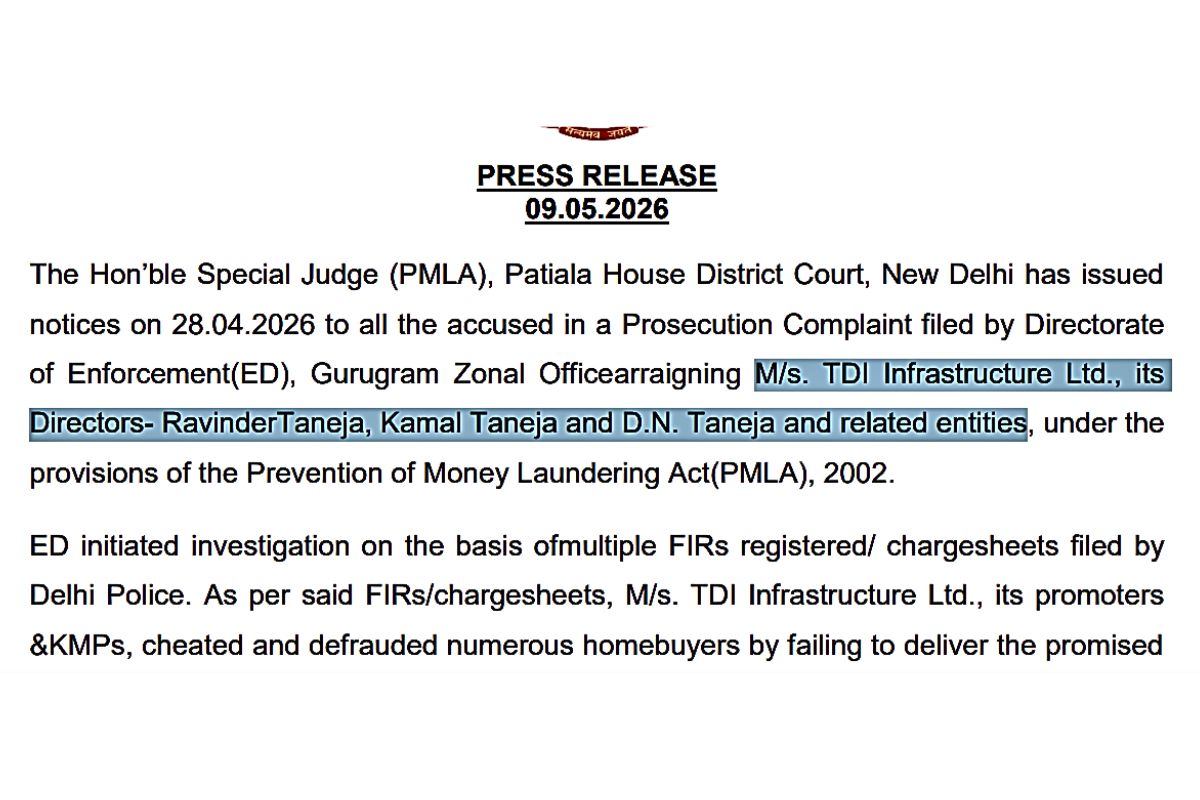
What happened to that money? The ED’s investigation has an answer, and it isn’t “they built flats.” According to the agency, the funds were diverted to subsidiaries and associated entities under the head of land purchases and “other purposes.” They were used to repay the company’s existing loans. They went into investments that had nothing to do with the buyers who had paid for homes. The result: occupation certificates for four projects are still pending. A project called “Park Street” remains unfinished. In some cases, buyers have been waiting 16 to 18 years for possession.
The ED has provisionally attached assets worth ₹349.55 crore across two rounds — ₹45.49 crore in 2024 and ₹304.06 crore in March 2026. A prosecution complaint has been filed before the Special PMLA Court at Patiala House in New Delhi. The court issued notices to TDI’s directors on April 28, 2026. The case is before the courts, and all accused are entitled to respond. But the story the numbers tell is already on the record.
The Subvention Scheme: The Smartest Scam That Wasn’t
To really understand how this happened, not just with TDI but with dozens of builders across India, you need to understand a financial product that was sold to buyers as a gift and functioned, in practice, as a trap. It was called the interest subvention scheme. And the pitch was irresistible.
Here’s how it worked. You, the buyer, take a home loan. The bank gives that loan — not to you — but directly to the builder. The builder, in exchange, promises to pay your EMIs until you get possession of the flat. So you’re getting a home, with a loan, without the immediate pain of monthly payments. What’s not to love? Everything, it turns out.
Banks were disbursing 60 to 70 per cent of the entire loan amount upfront, before verifying whether construction had actually reached the corresponding stage. The Reserve Bank of India had issued guidelines in 2013 saying disbursal must be linked to construction milestones. Those guidelines were being violated so routinely that the Supreme Court, reading through hundreds of petitions from defrauded buyers, eventually concluded that this wasn’t an industry-wide accident. It was an industry-wide arrangement.

Builders got enormous cash infusions. They used those infusions not just for construction but for buying new land, servicing old debts, funding other projects, or simply for things that had nothing to do with the flat you’d paid for. When the money ran out, so did the EMI payments they’d promised to make on your behalf. And then your bank, which had happily disbursed crores to the builder without asking too many questions, turned around and told you that you now owed them EMIs for a flat that didn’t exist.
You were holding the bag. The builder was somewhere else. The Supreme Court, presided over by Chief Justice Surya Kant, put it bluntly. It found “prima facie nexus between renowned banks and builders in Noida, Gurugram, Yamuna Expressway, Greater Noida, Mohali, Mumbai, Kolkata and Allahabad.” It called it an “unholy nexus.” The bench also noted the role of development authorities’ officials — the bureaucrats who gave approvals, cleared plans, and looked the other way. Builder. Banker. Bureaucrat. The unholy trinity of India’s real estate nightmare.
The CBI Wakes Up: Fifty Cases and Nine Chargesheets
The Supreme Court didn’t just describe the problem. It dispatched the CBI to dismantle it. In the scorching heat of 2026, CBI filed 9 chargesheets against builder-bank nexus! The investigation had broken its NCR boundaries and gone national.
As of May 2026, the CBI is investigating 50 cases, all registered under Supreme Court directions, against builders and financial institution officials across the country. Nine chargesheets have been filed:
Rudra Buildwell Constructions. Dream Procon. Jaypee Infratech. AVJ Developers — alongside officials of Bank of India, ICICI Bank and UCO Bank. CHD Developers. Shubhkamna Buildtech. Sequel Buildcon. Logix City Developers — alongside bank officials. And most recently, Manju J Homes India Limited — alongside officials of the State Bank of India.
Every single one of these chargesheets was filed for offences of criminal conspiracy, cheating, criminal breach of trust, forgery and use of forged documents under the IPC, and criminal misconduct under the Prevention of Corruption Act. Not minor violations. Not technical lapses. Criminal conspiracy. Alleged by a federal investigation agency, on the basis of what it describes as “substantial documentary and oral evidence.”
Most critically, notice who is being charged alongside the builders. Bank officials. Public servants. People who sat in offices, sanctioned loans, and approved transactions that the CBI says violated every norm that existed to protect homebuyers. The chargesheet against AVJ Developers names officials of three different banks. The Manju J Homes chargesheet names SBI officials. The Logix City chargesheet implicates ICICI and HDFC officials. This is not the story of rogue builders running wild. This is the story of a system that enabled them.
The Builder-Bank-Bureaucrat Nexus: How It Actually Worked
Let’s be concrete. How does a ₹5,000 crore fraud work in practice? How do you collect thousands of crores from ordinary people and walk away with it? You need the builder’s aggression, aka the willingness to launch projects you’re not sure you can complete, collect money you’re not sure you can account for, and run the whole thing like a financial circus where the balls in the air stay up only as long as new buyers keep signing agreements.
You need the bank official’s complicity — or at the very least, their spectacular indifference. Someone had to approve the disbursement of 70 per cent of a loan before the foundation was poured. Someone had to sign off on loans to proxy buyers — dummy purchasers recruited to generate cash flow for the builder without any actual housing transaction occurring. The CBI’s chargesheets suggest that “someone” often did this in exchange for something.
And you need the bureaucrat’s silence. Building plan approvals, environmental clearances, land acquisition permissions; these are the oxygen of any real estate project. In a market where large developers cultivated deep relationships with local authorities, getting approvals quickly was less about compliance and more about connection. The Supreme Court noted collusion of development authority officials specifically because its own amicus curiae had found evidence of it.

When all three work together, knowingly or through motivated carelessness, the buyer never stood a chance. RERA’s escrow mandate, which requires 70 per cent of buyer funds to stay in a ring-fenced account for that specific project, should have been the safeguard. But for the thousands of projects launched before 2016, RERA didn’t exist. And even where it did, TDI’s six-year compliance battle with a single buyer tells you exactly how seriously some developers took it.
What the Numbers Hide: Real People, Real Losses
Put down the crore figures for a moment. Think about what ₹30 lakh means to a family that earns ₹50,000 a month. It is five years of saving every rupee of income. It is the amount you tell your parents about when you’re finally an adult who has “made it.” It is the sum attached to a dream that your generation grew up believing was achievable — your own home, somewhere safe, somewhere permanent.
Now imagine handing that over. Watching your EMIs get debited every month. Calling the builder’s office. Getting told the project is “progressing.” Then getting told there are “minor delays.” Then getting told there’s a “regulatory issue.” Then getting nothing at all. Then getting a letter from your bank asking where this month’s EMI is — for a flat that has no roof, no walls, no possession date, and apparently no intention of ever existing.
That is not a hypothetical experience. That is the documented experience of over 14,000 buyers in TDI’s projects alone. Of hundreds in Rudra Buildwell’s Noida project, where the CBI found that the same flat had been sold to two different buyers, with the earlier sale hidden from the second buyer and from the bank. Of the investors in Dream Procon, Jaypee Infratech, AVJ Developers and dozens of other projects across the NCR that are now the subject of Supreme Court-directed investigations.
There are senior citizens in this story who put their retirement savings into plots that were never developed. NRIs who sent money from abroad to secure homes for parents who are still waiting. Young couples who deferred every major life decision — second child, car, holiday — because the EMI and the rent together were already too much.
RERA Helps, But It Has Limits
The Real Estate Regulation Act was a revolution when it came in 2016. For the first time, buyers had a dedicated forum, a mandatory escrow system, and the right to demand interest on delayed possession. State RERA authorities began processing complaints and passing orders. Slowly, the balance of power started shifting. But RERA was born with a critical limitation: it couldn’t travel backwards. Most of the projects now in CBI crosshairs were launched between 2005 and 2014 — before RERA existed. They exist in a regulatory grey zone where only criminal law, consumer courts or the ED’s money-laundering jurisdiction can reach.
And even for projects within RERA’s reach, enforcement is its Achilles’ heel. The TDI story makes this excruciatingly clear. A complaint filed in 2019 should not still be in execution proceedings in 2026. When a developer can simply refuse to comply with a RERA order for years, while its lawyers keep the case alive with adjournments and promises, the law has a credibility problem.
The HRERA civil imprisonment order matters precisely because it tries to solve this problem with blunt force — make non-compliance personally uncomfortable for the individuals who run the company, not just institutionally inconvenient for the company itself. It’s a crude solution. It shouldn’t need to exist. But in a country where some builders have treated RERA orders as optional suggestions, it may be exactly the right one.
What Changes Now — And What Must
The enforcement story of 2026 is, honestly, better than it was in 2020. The Supreme Court is personally monitoring 50 cases. The CBI has filed nine chargesheets in under a year. The ED has attached ₹349 crore. HRERA is sending directors to civil imprisonment. This is real. This is unprecedented in many ways. And none of it should be minimised.
But here’s what still needs to happen, urgently, if this reckoning is going to mean anything to the buyers who started waiting in 2008 or 2011 or 2013. The RBI must permanently, unambiguously close the subvention loophole. Not with a circular that gets ignored, but with a mandatory, escrow-backed, third-party-verified disbursement system. No construction milestone confirmation, no fund release. Full stop.
RERA needs legislative teeth to reach backwards. Parliament must amend the Act to cover pre-2016 projects still under construction — giving buyers in those projects the enforcement protection that RERA was supposed to provide. Fast-track housing fraud courts need real resources. Fifty CBI cases cannot be absorbed into an already-overburdened judicial system without specific provision. Dedicated benches, forensic accounting capacity, and hard timelines for trial completion are non-negotiable.
And PMLA confiscated assets must find their way to victims. The ED attaching ₹349 crore is meaningful only if a mechanism exists to distribute those funds to the 14,000 buyers who lost theirs. The law allows it. The process needs to be made faster, simpler and explicit.
The Bottom Line
India’s real estate sector built its reputation on a word: possession. That was always the promise. The flat will be yours. The keys will be yours. The EMIs will be for something real. For tens of thousands of buyers, that promise was broken — systematically, profitably, and for years without consequence. The consequence is arriving now. TDI directors facing civil imprisonment. Builder after builder named in CBI chargesheets. The Supreme Court of India refusing to look away. The ED following the money and attaching what it finds.

It’s later than it should be. It’s incomplete. The crores attached are a fraction of the crores stolen. The chargesheets are beginnings, not endings. But it is happening. And that, for Rajan Sharma and 14,000 people like him, is at least the beginning of an answer to the question they have been asking for years.
When will someone be held accountable?
Now. Finally. Now.