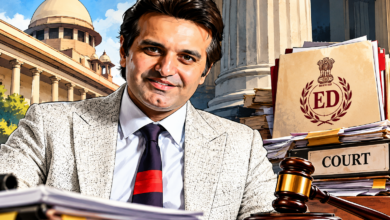
Satish Sanpal Is A Perfect Example Of How When You Have Money In Your Deep Pockets You Can Manage Everything In India


When Money Talks, Justice Walks: The Satish Sanpal Playbook and India’s Deep Systemic Crisis How a Jabalpur betting fugitive used ₹1,000 crore in alleged crime proceeds to buy silence, manufacture legitimacy, neutralise institutions, and rewrite his own story — and what it reveals about the price of everything in India’s system of power. — There is an old, bitter joke that circulates in the corridors of India’s lower courts, police stations, and newsrooms: “In this country, everything is available for a price. Justice just takes a little longer to deliver — and costs a little more.” It is not really a joke. It is a diagnosis. The case of Satish Sanpal — a 40-year-old man from Adarsh Nagar, Jabalpur, who allegedly ran one of central India’s largest illegal cricket betting and money laundering networks, moved over ₹1,003 crore through 13 shell companies, fled to Dubai, and has been listed as “Farar” (absconded) in Indian courts since June 2022 — is not merely a story about one man’s crimes. It is a masterclass in how deep pockets, in India, can systematically purchase what should never be for sale: the silence of the police, the inertia of investigative agencies, the cooperation of the media, the patience of the courts, and ultimately, the rewriting of reality itself. Sanpal’s story is the story of a system. And the system, as this investigation reveals, is working exactly as those with money have designed it to work.
Part One: The Crime That Built the War Chest
To understand how Satish Sanpal has allegedly bought his way out of accountability, one must first understand the scale of what he allegedly built. Starting from small-time street-level betting in Jabalpur in the early 2010s, Sanpal grew his operation into a 22-state digital betting empire by 2020, leveraging platforms like Open Web Exchange, Set Sports, Mumbai Exchange, and Set Casino to accept real-time wagers on cricket matches from users across the country. Daily collections at his Wright Town, Jabalpur office — housed at RK Tower, running from 5 PM to 11 PM every evening — ranged between ₹50 lakh and ₹2 crore during peak IPL match periods. The money, however, could not simply sit in a bank account. Illegal betting proceeds needed a path into the formal economy — what financial investigators call “layering.” Sanpal and his key associate Vivek Pandey allegedly constructed a sophisticated laundering architecture using 13 shell companies registered with the Ministry of Corporate Affairs, each one a paper entity with no office, no employees, no products, and no business — only bank accounts opened at Axis Bank, Yes Bank, ICICI Bank, HDFC Bank, Bank of India, and SBI. The accounts were registered in the names of people who had no idea they were company directors: a clothes presser who signed documents in exchange for a ₹30,000 wedding loan, an autorickshaw driver who surrendered his PAN card for a small advance, a domestic worker whose Aadhaar card was photocopied under false pretences. Through these accounts, transaction analysis confirmed, ₹1,003.24 crore flowed in and ₹1,001.12 crore flowed out — almost entirely within hours of each deposit, routed onward through hawala operators converting rupees to dirhams and landing, ultimately, in UAE-based accounts and assets. When Jabalpur police finally raided RK Tower on May 19, 2022, they found ₹21.55 lakh in cash — a single day’s collection — alongside 27 corporate seals, 34 cheque books, seven betting ledgers, and property documents hinting at collateral arrangements tied to Dubai holdings. Sanpal was not there. He had already left. He was in Dubai. And from Dubai, he had already begun spending his alleged crime proceeds on something more durable than luxury: the systematic purchase of impunity. The war chest was full. The campaign was about to begin.
Part Two: Buying Silence — The Police and Investigative Agency Problem
The first and most essential purchase any fugitive of means makes is time. Time during which evidence can be destroyed, witnesses can be intimidated, co-accused can be coached, and the investigation itself can be slowed to the point of irrelevance. In Sanpal’s case, the timeline is instructive. FIRs against him were lodged as far back as 2018 and 2019 — at Gorakhpur, Madan Mahal, and Omti police stations in Jabalpur — citing criminal intimidation, cheating, and violations of the Madhya Pradesh Gambling Act. For three to four years, through multiple registered complaints across multiple police stations, no decisive action was taken. The operation did not merely continue; it grew. It expanded from a city-level racket to a 22-state national network. Shell companies multiplied. Hawala volumes increased. And the man at the centre of it all continued to operate — first in Jabalpur, then increasingly from Dubai — with what can only be described as remarkable comfort. The question that investigators, lawyers, and journalists in Jabalpur ask — quietly, carefully — is not whether these years of inaction are explainable. They ask why, given multiple FIRs, growing evidence, and a network that was by all accounts brazenly visible at the local level, no senior officer made Satish Sanpal a priority. Why did the raids not happen in 2018 or 2019, when he was still in India and potentially stoppable? Why did it take until May 2022, by which point Sanpal and his key associates had already transited to Dubai? There are no confirmed answers. There are, however, patterns. Police sources in Jabalpur, speaking off the record, describe a culture in which well-connected operators — particularly those in the betting and gambling space, who by the nature of their business cultivate relationships across the criminal-political-police nexus — are able to operate with a kind of informal immunity. Their cash does not merely fund operations. It funds relationships. It funds the quiet understanding that certain names, certain offices, certain cases should not be pursued with excessive enthusiasm. This is not a new observation. It is a structural feature of how policing works in large parts of India. The problem is that when the accused is sufficiently wealthy, the informal immunity tends to be exceptionally durable. The Enforcement Directorate’s failure is perhaps even more glaring. The ED was formally informed of the ₹1,003 crore transaction trail in 2023. The documentation handed to them was comprehensive: bank statements, shell company registrations, hawala linkages, property records. The Prevention of Money Laundering Act gives the ED extraordinary powers — to attach assets, issue summons, conduct searches, and pursue proceeds of crime across international boundaries. As of the time of this investigation’s publication, no PMLA case has been formally initiated. No case. Against a man with ₹1,003 crore in documented suspicious transactions, nine criminal cases in Jabalpur courts, and an active Look Out Circular. No case. The reward offered for information leading to Sanpal’s arrest is ₹5,000. Five thousand rupees. Against a man who allegedly owns a residence in the Burj Khalifa and five Rolls-Royce cars. If the reward figure alone does not tell you something about the institutional seriousness with which this case is being pursued, nothing will.
Part Three: The Courtroom as a Tool — How Money Navigates the Judiciary
India’s judiciary is, in theory, independent. In practice, the theory encounters friction at every level — and nowhere more consistently than in the space where money, organised crime, and the law intersect. The judicial history of the Satish Sanpal case offers a textbook illustration of how the legal process itself can be weaponised by the wealthy accused to delay, frustrate, and ultimately neutralise prosecution. Consider the acquittals. Manoj Sanpal — Satish’s uncle, arrested on-site during the RK Tower raid — and Amit Sharma, the network’s document handler, were acquitted in January 2024 on grounds of “insufficient evidence.” Police are appealing. The acquittals were not, in the prosecution’s view, a reflection of actual innocence; they were, as prosecutors have argued in bail hearing after bail hearing, a reflection of evidentiary gaps — gaps created by witness reluctance, by document handling that made direct attribution difficult, and by the kind of careful operational separation that well-resourced criminal enterprises deliberately build into their structures. Evidentiary gaps, in other words, do not simply appear. They are engineered. And engineering them requires exactly the kind of legal expertise, document management sophistication, and witness management capability that money buys. Consider the bail applications. The filing of anticipatory bail applications by associates is a well-documented legal tactic in complex criminal cases — one that, when filed repeatedly and strategically, consumes prosecutorial resources, occupies court time, and signals to co-accused and witnesses alike that the network remains active and protective of its members. Vivek Pandey’s application was ultimately rejected on August 2, 2024 — a victory for the prosecution. But the fact that it was filed at all, by a man who had been absconding in Dubai, suggests a legal team confident enough in its resources to fight from abroad. And then there is the defamation weapon — perhaps the most chilling instrument in the arsenal of the wealthy accused. Independent journalists and media houses that have reported on Sanpal’s alleged crimes have faced legal pressure in the form of defamation suits and applications for interim injunctions. This is a pattern that has become disturbingly common across India: an economic offender, facing serious criminal charges, turns to the civil courts — and sometimes the criminal courts — to silence the journalists who are doing the work that the police and investigative agencies have failed to do. The mechanics are straightforward and devastating. A defamation suit is filed, often with an application for an interim injunction restraining publication or broadcast. Many courts, applying a superficially reasonable standard of “prima facie case” and “balance of convenience,” grant such interim relief quickly — sometimes within days, sometimes ex parte (without hearing the journalist or publication). The injunction may ultimately be vacated, but the damage is done: the story is suppressed, the journalist faces legal costs, the publication’s editorial appetite for similar investigations is chilled, and a public message is sent to every other newsroom in the country about the cost of holding this particular man accountable. This is not a malfunction of the legal system. It is a feature — one that expensive lawyers have learned to exploit with precision. When a man with deep pockets and sophisticated legal representation can obtain an interim injunction against a small independent news outlet within days of filing, while his own criminal cases languish for years without resolution, the message is unmistakable: the law moves at different speeds for different bank balances.
Part Four: Manufacturing the Billionaire — Crime Money and the PR Industrial Complex
Of all the ways that alleged crime proceeds are deployed to purchase impunity, perhaps the most sophisticated — and the least discussed — is the systematic use of money to manufacture a completely alternative public identity. Satish Sanpal, wanted fugitive, is also — in the parallel universe created by his PR and media operation — Satish Sanpal, visionary entrepreneur, hospitality innovator, self-made billionaire, and chairman of ANAX Holding, a Dubai-based conglomerate claiming a $3 billion real estate and hospitality portfolio. This alternative identity did not emerge organically. It was built, brick by brick, with money. The infrastructure of this image-making operation includes several distinct components, each targeting a different layer of the public information ecosystem. Sponsored Advertorials and Syndicated Content The foundation of the image rehabilitation campaign is a steady stream of sponsored content — articles that appear in legitimate-seeming publications but are, in reality, paid placements that present the subject’s preferred narrative as independent journalism. These pieces describe Sanpal in the language of entrepreneurship hagiography: “visionary,” “self-made,” “philanthropist,” “industry leader,” “inspirational journey.” They contain no reference to FIRs, no mention of absconding status, no acknowledgment of shell companies or Pramod Rajak’s stolen identity. Some of these articles are syndicated — republished across multiple platforms — creating a volume of positive search results that buries any negative coverage. For anyone conducting a quick online search on Satish Sanpal, the first page of results may well be dominated by this manufactured content, leaving the impression of a celebrated businessman rather than a court-designated absconder. Social Media and the Luxury Lifestyle Performance Parallel to the editorial campaign runs a social media operation centred on the performance of extreme wealth. Photographs from luxury Dubai venues, images of high-end automobiles, videos from exclusive events, posts tagged at the Burj Khalifa — this content serves multiple purposes simultaneously. It signals invincibility to those who might consider cooperating with investigators. It attracts legitimate business partners and investors who may be unaware of the Indian criminal proceedings. It creates a halo of social proof — the implicit argument that a man surrounded by such evident success could not possibly be the same person described in a Jabalpur court document. And it demoralises the investigators, prosecutors, and journalists pursuing the case, reinforcing the perception that no action is coming, that the system has been handled, that money has, once again, prevailed. The Republic World Problem: When Mainstream Media Becomes a Shield Perhaps the most damaging single piece of the image rehabilitation campaign was an article in Republic World — a major, nationally distributed Indian news outlet — that claimed, explicitly, that “no police report, court case, or legal document” connects Satish Sanpal to any wrongdoing. This statement is not a matter of interpretation or journalistic judgment. It is factually, demonstrably, verifiably false. The FIRs are public record. The eCourts portal lists Sanpal’s cases clearly. The Look Out Circular is documented. The raid records are available. Any journalist willing to spend thirty minutes on the eCourts portal could confirm, in minutes, that this claim is untrue. The Republic World article was not the product of poor journalism. Poor journalism produces inaccuracies through carelessness. This inaccuracy — this specific, targeted, perfectly shaped denial of publicly available court records — is the product of something else entirely. It is the product of money. The article functions as a shield. It is cited, forwarded, and deployed whenever Sanpal’s criminal history is raised. It provides a veneer of mainstream media legitimacy to the claim that the whole story is a fabrication. It makes it slightly harder for other journalists to pursue the story, slightly easier for potential business partners to dismiss the allegations, and slightly more comfortable for institutions that might otherwise act to continue their inaction. The price of that article is unknown. Its value to the man who commissioned it — or whose representatives commissioned it — is incalculable. The Defamation Weapon Against Independent Media If paid positive coverage is the carrot, defamation litigation is the stick — and it is wielded with particular brutality against independent media houses that lack the resources of large corporate publishers. When an independent journalist or small digital news outlet publishes an investigation into Sanpal’s criminal network, drawing on documented police records and court filings, the response is frequently not a factual rebuttal. It is a legal notice, followed by a defamation suit, followed — with troubling regularity — by an application for an interim injunction restraining further publication. The injunction strategy is particularly insidious. It does not require the plaintiff to prove that the published content is false. It requires only that a court find a “prima facie case” — a low threshold that a well-drafted application, prepared by senior counsel, can often meet. Once an injunction is in place, the publication is legally restrained from continuing its coverage. The journalist faces the choice of expensive litigation or silence. In most cases involving small independent outlets, the choice is not a difficult one: the costs of fighting a wealthy plaintiff through protracted civil proceedings are simply beyond reach. This is how money silences the press in India. Not through direct censorship. Not through government orders. Through the civil courts, through interim injunctions, through the sheer asymmetry of resources between a man with alleged ₹1,003 crore in laundered funds and an independent journalist working on a salary that, in all probability, does not exceed a few lakh rupees a year. The courts that grant these interim orders are not, in most cases, acting in bad faith. They are applying established legal standards. But the effect — the systematic suppression of accountability journalism through the machinery of civil litigation — is as corrosive to press freedom as any direct censorship would be. And it serves, with perfect precision, the interests of exactly those people most in need of press scrutiny.
Part Five: The Whitewash Architecture — How Criminal Money Becomes Entrepreneurial Capital
The transformation of Satish Sanpal from Jabalpur betting operator to Dubai billionaire chairman is not merely a PR success story. It is the end product of a carefully structured financial and narrative laundering operation that mirrors, at the level of reputation, the same principles as money laundering itself: placement, layering, and integration. In money laundering, “placement” introduces dirty cash into the financial system. “Layering” obscures its origins through complex transactions. “Integration” reintroduces it into the legitimate economy as apparently clean funds. In reputation laundering, the process is structurally identical. The dirty reputation — the FIRs, the absconding status, the shell company fraud — is the asset to be cleaned. “Placement” introduces the subject into legitimate social contexts: business events, hospitality industry gatherings, charity functions. “Layering” obscures the criminal history through volume — enough positive content, enough association with legitimate entities, enough social proof — that the original record becomes harder to find and easier to dismiss. “Integration” completes the transformation: the subject re-emerges as a recognised, celebrated, apparently legitimate figure whose criminal past has been so thoroughly buried under positive coverage that it requires active excavation to surface. ANAX Holding is the integration vehicle. A Dubai-based entity beyond the reach of Indian financial regulators — SEBI has taken no action, the RBI has issued no notices — it provides the institutional framework for Sanpal’s new identity. Its claimed $3 billion valuation is self-reported and unverified. Its properties, including VI Club Hotel, are real assets that create real social networks, real business relationships, and real legitimacy in a jurisdiction where his Indian criminal record carries no legal weight. The Burj Khalifa residence is not merely a luxury purchase. It is a branding statement. The five Rolls-Royces are not merely status symbols. They are props in a narrative performance. Every photograph from a Dubai gala, every press release about an ANAX development project, every sponsored profile in an Indian business magazine is a brick in the wall between the man Indian courts know as “Farar” and the man the world is being asked to see as a visionary entrepreneur. And it is working. That is the most uncomfortable truth of all. It is working.
Part Six: The Structural Enablers — Why the System Allows This
It would be comforting to believe that what has happened in the Satish Sanpal case is an aberration — the product of exceptional circumstances, extraordinary corruption, or unique institutional failure. It would be comforting, but it would be wrong. The Sanpal case is not exceptional. It is exemplary. It illustrates, with unusual clarity and documentary richness, the structural features of an Indian system that — across policing, investigation, prosecution, media, and courts — consistently advantages those with sufficient financial resources. The Police-Criminal-Political Nexus India’s police forces operate within a political and social ecosystem in which informal relationships between law enforcement, local power brokers, and organised crime operators are not the exception but, in many districts and states, the norm. Betting and gambling operators in particular occupy a unique position: their business requires regular, predictable contact with law enforcement, which creates ongoing opportunities for the payment of informal “protection” that the police call “hafta” and that everyone understands as the price of continued operation. When a betting operator of Sanpal’s scale is operating across 22 states, the informal protection payments are not sporadic or transactional. They are structural — a cost of doing business built into the operational budget, maintained through regular, reliable disbursement, and creating, over time, a web of obligation, complicity, and mutual dependency that makes decisive action against the operator extraordinarily difficult even when senior officers are willing. The Investigative Agency Paralysis The ED’s failure to initiate a PMLA case despite being presented with ₹1,003 crore in documented suspicious transactions in 2023 demands an explanation that has not been publicly offered. The PMLA is one of India’s most powerful financial crime statutes. Its provisions for asset attachment, account freezing, and international cooperation are specifically designed for exactly this kind of case. The failure to deploy them — two years after being formally informed of the evidence — is not explicable by resource constraints or procedural complexity alone. What it is explicable by, those familiar with the ED’s institutional culture suggest, is the same informal calculus that operates at the police level: cases involving well-resourced accused who have invested in relationships at the right levels of the right organisations move slowly. Very slowly. Sometimes they do not move at all. The Media Economy of Paid Coverage India’s media landscape has undergone a structural transformation over the past decade that has made it significantly more vulnerable to the kind of money-driven narrative manipulation that the Sanpal case exemplifies. Digital publishing economics, the collapse of traditional advertising revenues, and the proliferation of outlets competing for dwindling editorial budgets have created a media market in which the line between paid content and editorial content has, in many publications, effectively ceased to exist. Sponsored content, native advertising, and paid placement are not marginal practices in Indian digital media. They are, for a substantial number of outlets, the primary revenue model. In this environment, a wealthy subject with a narrative to promote and a budget to spend is not merely a PR client. He is an existential financial resource. And the publication that depends on such clients for its survival faces a structural conflict of interest that no editorial policy can fully resolve. The Republic World article about Sanpal — claiming no legal record connects him to wrongdoing — is an extreme example of what this structural conflict produces. But it is not an isolated one. It sits within an ecosystem in which “coverage” is routinely available for purchase, in which the distinction between journalism and advertising has been deliberately blurred, and in which the institutional credibility of major media brands is being rented out, piece by piece, to the highest bidder. The Interim Injunction Problem The readiness of Indian civil courts to grant interim injunctions restraining publication, on the basis of defamation claims filed by wealthy plaintiffs against independent media, represents one of the most serious and least discussed threats to press freedom in contemporary India. The legal standard for an interim injunction — prima facie case, balance of convenience, irreparable harm — is not an unreasonable one in the abstract. But in practice, when applied to defamation cases involving published reports based on documented public records, it produces outcomes that are deeply inimical to accountability journalism. A publication that draws on court records, police documents, and official filings to report on an accused person’s criminal history is not engaged in defamation. It is engaged in journalism. The fact that such publications can be, and are being, restrained by interim orders while the underlying criminal cases against the very person claiming defamation proceed at glacial pace is a structural inversion of priorities that serves, systematically, the interests of the powerful against the public interest. Independent media houses — particularly smaller digital outlets that have emerged as the primary practitioners of investigative journalism in India — face a calculated existential threat from this pattern. The message is not subtle: report on us, and we will tie you up in litigation until you cannot afford to continue. The chilling effect on investigative journalism is real, measurable, and precisely intended.
Part Seven: The Victims the System Has Forgotten
In the architecture of the Sanpal case — the shell companies, the hawala networks, the PR campaigns, the legal maneuvering — it is easy to lose sight of the human beings whose lives were dismantled to build it. Pramod Rajak, the clothes presser from Madanmahal, signed papers he did not understand in exchange for a ₹30,000 wedding loan. His identity was used to register a shell company. Through that company, ₹48 crore transacted without his knowledge. He now faces income tax scrutiny for financial turnover he never saw, in accounts he never controlled. His complaint — “he cheated me” — is three words that contain worlds of betrayal. He is not alone. Across the 13 shell companies documented in this case, there are at least a dozen similar stories: people in financial distress who were approached with small kindnesses — loans, advances, promises of help — and in their moment of vulnerability, stripped of their identities for use as laundering instruments. They did not know they were company directors. They did not know their PAN numbers were processing crores. They knew only that someone had helped them when they needed it, and that the papers they signed were nothing to worry about. Beyond the direct victims of the shell company scheme, there are the communities of bettors — working-class men, primarily, drawn into Sanpal’s platforms by the promise of easy money on cricket matches they already loved. Police records and community accounts from Jabalpur describe the social devastation: high-interest loans taken to cover betting losses, asset forfeitures, family breakdowns, and — in the most tragic cases — suicides that go unreported and uncounted in any official tally of the network’s human cost. These people — the Rajaks and the bettors and the families — are not parties to the defamation suits. They do not appear in the sponsored advertorials. They do not feature in the ANAX Holding press releases. They are the invisible cost of the Sanpal empire, as invisible in death as they were in life: the human substrate on which a claimed billionaire’s fortune was built.
Part Eight: What Justice Would Actually Require
The Satish Sanpal case is not unsolvable. It is not, in strictly legal terms, even particularly complex. The documentation is extensive. The transaction trail is documented. The shell companies are registered. The witnesses exist. The law is clear. What is required is not new law. What is required is the will to apply the law that exists, to the person it describes, regardless of his resources, his location, or his capacity to purchase the patience of institutions. Concretely, this means: Immediate formal initiation of a PMLA case by the Enforcement Directorate, with application for attachment of ANAX Holding’s identified assets and coordination with UAE financial intelligence authorities through established mutual legal assistance channels. Accelerated extradition proceedings under the India-UAE bilateral treaty framework, with the Sanpal file treated as a priority matter rather than a routine administrative correspondence. Police appeals against the acquittals of Manoj Sanpal and Amit Sharma pursued vigorously in higher courts, with fresh forensic evidence from seized digital devices and bank records presented to address the evidentiary gaps that allowed the original acquittals. Mandatory regulatory reform in corporate registration — physical verification of registered offices for all new companies, enhanced KYC for current account openings at banks, real-time transaction flagging for high-volume accounts linked to recently incorporated entities. Protection and rehabilitation support for individuals like Pramod Rajak who were unwittingly incorporated as shell company directors and now face tax and regulatory consequences for transactions they never authorised. Press freedom protections that raise the threshold for interim injunctions in defamation cases involving journalism based on documented public records — recognising that the current standard is being systematically abused to silence accountability reporting. None of these steps is technically difficult. All of them require the same thing: institutions willing to perform their mandated functions without reference to the financial resources of the person those functions are directed against. That is, of course, the hardest thing to achieve. Because the entire architecture of the Sanpal case — from the years of police inaction, to the ED’s unexplained delay, to the sponsored media coverage, to the defamation suits against independent journalists — has been constructed precisely to make those institutions unwilling to act. To make the cost of action seem higher than the cost of inaction. To make the path of least resistance lead away from accountability. Money talks. In India, it talks very loudly. And what it says, in the Satish Sanpal case, is: not yet. Not this man. Not while the accounts are full.
Conclusion: The Mirror This Case Holds Up
Satish Sanpal did not invent the system he is exploiting. He did not create the police culture in which betting operators buy years of informal immunity. He did not design the media economy in which coverage is available for purchase. He did not write the civil procedure that allows interim injunctions to be used as press-suppression tools. He did not build the institutional culture in which the ED can sit on a ₹1,003 crore transaction trail for two years without acting. He found these systems as they were. And he used them. With skill, with resources, and with the cold efficiency of someone who understands, from long experience, that in India, sufficiently deep pockets are not merely an advantage. They are, for those willing to spend them correctly, a near-complete substitute for innocence. That is the mirror this case holds up. Not to Satish Sanpal alone, but to every institution that had the mandate to act and did not. To every publication that accepted the cheque and ran the advertorial. To every court that granted the interim injunction without asking why a man with nine criminal cases and an absconding designation was in a position to file it. To every senior officer who received the file, read the numbers, and found a reason to wait. The ₹21.55 lakh found in that Jabalpur almirah in May 2022 — a single day’s collection — has grown, through years of alleged laundering and image rehabilitation, into a claimed $3 billion empire. The clothes presser whose identity funded a portion of that journey still faces income tax notices for money he never saw. Sanpal still posts from the Burj Khalifa. The courts still say “next hearing.” Money talks. Until the institutions of a democracy decide, collectively, that it does not — that the rule of law applies uniformly regardless of the size of the war chest arrayed against it — cases like this one will continue to end the same way. Not with justice. With the next hearing date. — This article is based on documented court records from the eCourts portal (Jabalpur), official police FIRs and charge sheets, Income Tax Department transaction analyses, bank account records presented in judicial proceedings, statements by affected individuals, investigative reporting by journalist Unmesh Gujarathi (Sprouts News), and publicly available corporate filings. All factual claims regarding criminal proceedings are sourced from official public records. ANAX Holding’s claimed $3 billion valuation is self-reported and has not been independently verified by any Indian financial regulator. This publication stands by every word of this investigation and will vigorously contest any attempt to suppress it through legal proceedings.