The Adanification Of India? How One Conglomerate Is Expanding Across Ports, Airports, Defence, Power, Cement, Media And Infrastructure? Why Critics Fear Corporate Concentration And The Nation Is Not Happy With This Centralisation Of Industrial Opportunity?

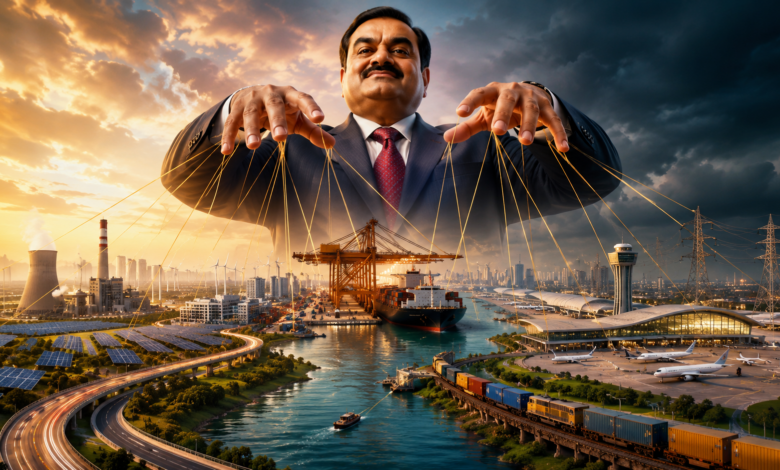
Yesterday it was ports. Then airports. Then power. Then transmission. Then cement. Then media. Then data centres. Now, with the July 5, 2026 ground-breaking of a ₹2,500-crore missile manufacturing ecosystem in Shivpuri, Madhya Pradesh, described by Adani Defence & Aerospace as South Asia’s largest private-sector missile facility, it is missiles. At what point, would it be wrong if we say, “corporate diversification is becoming concentration?”
Is Our Nation Moving Towards Adanification Of India?
This is not a rhetorical trap. Every large economy has conglomerates that span multiple sectors; so that alone proves nothing. But when a single business group’s footprint touches the loading of nearly a third of the nation’s seaborne cargo, the runways a quarter of its air travellers land on, a meaningful share of the electricity running through its grid, the cement in its buildings, the newsroom Indians increasingly get their television news from, and now the missiles its armed forces will fire; it becomes reasonable to ask a narrower, more answerable question: is India’s economy safely diversified across its “national champions,” or is it becoming structurally dependent on the fortunes, and the risk appetite, of one group?
We do not claim that “India is under the Adani empire,” nor that “the nation is unhappy”. What follows instead is a sector-by-sector accounting of the last decade, built on disclosed market-share figures, acquisition values, regulatory findings, and documented public criticism, with the allegations that remain allegations clearly marked as such, and the conclusion left open for the reader to draw.
Mapping the Adani Expansion (2015–2026)
Ports: the gateway business
Adani Ports and Special Economic Zone (APSEZ) is unambiguously India’s largest port operator. As of the 2025-26 financial year, the company’s domestic ports capacity stood at 653 million metric tonnes (MMT), and its all-India cargo market share had risen to 27.1 percent, up from roughly 26 percent just two years earlier.
The company handled 500.8 MMT of cargo in FY26 alone, becoming the first Indian integrated transport operator to cross the 500-MMT mark in a single year, and it represents roughly 44 percent of India’s containerised seaborne cargo specifically. APSEZ now operates 15 domestic ports across nearly every coastal state, plus four international terminals in Israel, Tanzania, Sri Lanka, and Australia, and has set a public target of handling 1 billion tonnes of cargo annually by 2030.
Ports matter strategically because they are chokepoints for trade: nearly all of India’s import and export volume, energy supplies, and raw materials pass through a small number of them. A quarter to a third of that national flow running through terminals controlled by one company is not inherently alarming — but it is a level of concentration worth tracking, especially given the company’s own ambition to nearly double that share by decade’s end.
Airports: from zero to national gatekeeper in six years
Adani had no presence in Indian aviation infrastructure before 2019. Today, Adani Airport Holdings Limited (AAHL) operates eight airports, Mumbai, Ahmedabad, Lucknow, Jaipur, Guwahati, Mangaluru, Thiruvananthapuram, and the newly operational Navi Mumbai, making it, by the company’s own account, India’s largest airport infrastructure operator, accounting for roughly 25 percent of the country’s passenger footfalls and about a third of its air cargo traffic.
This dominance traces back to a single bidding round. In the 2018-19 privatisation exercise, Adani Enterprises, then a company with no prior experience operating a commercial airport, won all six airports on offer: Ahmedabad, Jaipur, Thiruvananthapuram, Lucknow, Mangaluru, and Guwahati, in some cases outbidding rivals by a wide margin. A subsequent Rajya Sabha admission by the Civil Aviation Ministry acknowledged that mandatory public consultation and state-government consultation procedures for that round were not followed. It is worth noting plainly: this describes a documented procedural lapse acknowledged by the government, not proof of any illegal favouritism, and no court has held the award itself unlawful. However, the fumes of favouritism could be traced back in this pre-Covid event.
Adani then added Mumbai’s Chhatrapati Shivaji Maharaj International Airport in 2021, acquiring it from the debt-strapped GVK Group, and commissioned the greenfield Navi Mumbai International Airport in December 2025, a facility the company says still has substantial runway capacity left to develop. This has not gone entirely unchallenged: rival operator GMR Airports Infrastructure, which still runs Delhi and Hyderabad airports and secured roughly ₹6,300 crore in funding from the Abu Dhabi Investment Authority in 2024, remains the one large competitor keeping India’s airport sector from being a single-company market.
But GMR operates two major airports against Adani’s eight, and Adani has publicly stated its intention to bid for all 11 airports in the next NMP privatisation round — a stance that has visibly concerned policymakers enough to consider capping any single bidder’s winnings for the first time.
The pattern of a single bidder sweeping an entire privatisation round has visibly shaped current policy. As India prepares to privatise 11 more airports under the National Monetisation Pipeline (NMP), officials are reportedly considering a rule capping any single bidder at two airport “bundles” (roughly four airports), which is a safeguard explicitly designed, according to reporting, to prevent a repeat of 2018’s clean sweep, at a time when Adani has again signalled it will “very aggressively” bid for all 11. How much aviation infrastructure should one corporate group operate? It is a question India’s own aviation ministry now appears to be asking itself.
Defence: from rifles to a missile ecosystem
Adani’s defence footprint has grown from small arms to, now, integrated missile manufacturing. Since 2020, the group has run a small-arms facility in Gwalior, Madhya Pradesh, producing pistols, carbines, assault rifles, and light machine guns for the Indian armed forces, reportedly delivering 2,000 light machine guns 11 months ahead of schedule. The July 2026 Shivpuri project extends this into missile system assembly, composite propellant production, and TNT manufacturing at a single integrated site — a capability the company describes as India’s first backward-integrated private-sector missile ecosystem, expected to create roughly 5,000 direct and indirect jobs and draw in more than 50 MSMEs.
Defence manufacturing differs from the other sectors on this list in one crucial respect: it is explicitly classified as a national-security domain, and concentration there raises a distinct set of questions; not primarily about consumer pricing, but about how many companies a nation wants its military supply chain to depend on, and how that dependency is governed.
Power: generation, coal, and transmission
Adani Power is India’s largest private thermal power producer, with an installed capacity of roughly 17,550-18,000 MW, accounting for about 7.3 percent of India’s total domestic coal-based power generation capacity. The company has announced plans to nearly double that to 30,000 MW by 2031, backed by a roughly $13 billion capital programme that credit-rating agencies have flagged as aggressive, given a planned 70 percent increase in debt to fund it.
On the renewable side, Adani Green Energy has been adding gigawatt-scale wind and solar capacity annually — 5.1 GW of renewables commissioned in FY26 alone — while Adani Energy Solutions operates one of India’s largest private electricity transmission networks. Taken together, the group now sits across generation (both coal and renewable), transmission, and distribution (through Adani Electricity in Mumbai) — a degree of vertical integration across the energy value chain that few single groups in any country achieve.
Cement: instant market leadership through acquisition
In May 2022, Adani announced the acquisition of Swiss firm Holcim’s entire stake in Ambuja Cements and ACC for approximately $10.5 billion; at the time, the largest acquisition in Adani’s history and India’s largest-ever M&A transaction in the infrastructure and materials space. The deal instantly made Adani India’s second-largest cement manufacturer, with combined capacity of 67.5 million tonnes per annum (MTPA) at closing.
Since then, Ambuja has gone on to acquire Sanghi Industries (2023), Penna Cement (2024), and Orient Cement (2024), and by mid-2025 group cement capacity had grown to roughly 105 MTPA, en route to a stated target of 118 MTPA. In December 2025, Adani announced a merger folding ACC and Orient into Ambuja to create what it called a “pan-India cement powerhouse,” with combined market share of around 16.6 percent — still behind market leader UltraTech Cement’s 28 percent, but a dramatic rise for a company with zero cement capacity before 2022.
Media: the NDTV takeover
In August 2022, Adani’s AMG Media Networks acquired a 29.18 percent stake in NDTV, one of India’s most prominent and historically independent television news networks, by buying out a company that held a decade-old loan-conversion right, a move NDTV’s founders publicly said was carried out without their “discussion, consent or notice.” An open offer followed, and by December 2022 Adani held a 64.71 percent controlling stake. In the weeks around the takeover, several of NDTV’s most senior journalists, including Ravish Kumar, Sreenivasan Jain, and anchor Nidhi Razdan, resigned.

International press-freedom organisations, including Reporters Without Borders (RSF) and the International Federation of Journalists, publicly raised concerns about editorial independence, given Adani’s proximity to the ruling Bharatiya Janata Party government; RSF’s Asia-Pacific director said the acquisition raised “serious questions about respect for NDTV editorial independence.” Adani himself has repeatedly stated that a firewall, he called it a “lakshman rekha”, exists between management and editorial decisions, and has said NDTV would remain “a credible independent global network.”
This is a genuinely contested question rather than a settled one: independent media-monitoring analyses note that NDTV has continued to produce credible journalism since the takeover, even as its coverage patterns have visibly shifted away from the adversarial government scrutiny that defined its earlier identity, and several of its defining editorial voices have departed. Separately, in March 2023, AMG Media Networks acquired a 49 percent stake in Quintillion Business Media, the holding company of digital outlet The Quint — another outlet previously known for critical government coverage. India currently has no cross-media-ownership regulations restricting how much of the news landscape a single conglomerate, in any sector, can own.
Logistics and Data Centres: the newer frontiers
Beyond its ports, Adani has built out an integrated logistics arm spanning rail freight, warehousing, and trucking — its logistics segment revenue grew 55 percent year-on-year in FY26 to ₹4,478 crore. The group has also moved into digital infrastructure, announcing a strategic alliance with Jabil to build AI data-centre infrastructure in India, positioning itself for the anticipated boom in cloud and AI compute demand. Neither logistics nor data centres are yet dominated by Adani the way ports or airports are, but both represent the group extending its “one roof” model — owning the physical infrastructure underlying an increasing share of how goods, information, and now digital compute move through the Indian economy.
Is India Moving Towards a Duopoly?
Corporate concentration is not unique to Adani, and economists have tools to measure it more rigorously than descriptive market-share figures alone.
The Herfindahl–Hirschman Index (HHI), calculated by summing the squares of each firm’s market share in a sector, is the standard regulatory yardstick; competition authorities in the US and EU generally treat markets with an HHI above 2,500 as “highly concentrated.” India’s telecom sector, for instance, has effectively consolidated into a three-player market (Reliance Jio, Bharti Airtel, and a much-weakened Vodafone Idea) following the collapse of half a dozen smaller operators in the mid-2010s, which is a textbook case of a market drifting from fragmented competition toward oligopoly, driven by capital intensity and price wars rather than any single acquisition.
Cement, as shown above, currently sits at a more moderate concentration level — UltraTech’s 28 percent and Adani’s 16.6 percent leave meaningful room for other players like Shree Cement and Dalmia Bharat, and a back-of-envelope HHI using just the top four players (UltraTech, Adani, Shree, and Dalmia) would likely land in the “moderately concentrated” band rather than the “highly concentrated” one, since no single player controls close to half the market.
Ports and airports, by contrast, sit closer to the highly concentrated end: with Adani alone holding 27 percent of port cargo and roughly a quarter of airport passenger traffic, and the next-largest single competitor in each sector, whether a state port trust or GMR in aviation, controlling a noticeably smaller share, a properly computed HHI for either sector would likely register well above the conventional 2,500 threshold once Adani’s share is squared and added to the rest.
Renewables and large-scale infrastructure concessions, similarly, tend to concentrate among a handful of capital-rich groups — Adani, Tata, Reliance, and a few others — simply because the capital and execution requirements price out smaller entrants. India’s telecom sector offers perhaps the starkest illustration of how concentration can emerge organically rather than through any single acquisition: a market that had a dozen or more operators a decade ago has consolidated to effectively three — Reliance Jio, Bharti Airtel, and a heavily indebted Vodafone Idea — after a brutal, multi-year price war eliminated the rest.
An HHI calculation using just Jio’s and Airtel’s combined subscriber shares, which together exceed 70 percent of the market, would place Indian telecom unambiguously in “highly concentrated” territory by any conventional antitrust standard, even though no formal monopoly finding has been made against either company.
None of this, on its own, proves an unlawful monopoly in the legal sense. The Competition Commission of India (CCI) has specific statutory threshold tests for “dominant position” and “abuse of dominance” under Sections 3 and 4 of the Competition Act, and — as discussed below — it has, in at least one recent instance, specifically examined and rejected a complaint alleging anti-competitive conduct against Adani. But HHI-style concentration and legal “monopoly” are different standards, and a sector can be uncomfortably concentrated in an economic sense well before it crosses into the second.
A separate, harder question is whether the CCI’s existing statutory toolkit, built primarily to assess dominance and mergers within a single relevant market, is even designed to evaluate the kind of cross-sector concentration this write-up documents, where no single sector shows an outright legal monopoly, but one group’s cumulative footprint across ports, airports, power, cement, and now defence is nonetheless unusually broad. India currently has no regulatory mechanism analogous to, say, a “systemically important conglomerate” designation that would treat this cross-sector breadth as a distinct category of scrutiny in its own right.
Government Policies That Enabled Rapid Expansion
None of Adani’s expansion happened outside a legal framework, it happened through the exact policy tools available, at least in principle, to every large Indian conglomerate. The relevant policies include:
- Asset monetisation and the National Monetisation Pipeline (NMP), launched in August 2021, which identified public assets — including 25 AAI-operated airports — for private-sector concession over four years, explicitly to raise capital without an outright sale of the underlying asset.
- Privatisation and long-term PPP concessions, the model under which both the 2003-06 wave (Delhi, Mumbai, Bengaluru, Hyderabad airports) and the 2018-19 wave (Adani’s six airports) were structured, typically granting 30-to-60-year operating rights in exchange for revenue-sharing with the state.
- Strategic disinvestment, the broader push to reduce government ownership across sectors, which has opened space in cement, power, and other capital-intensive industries previously dominated by public-sector units.
- Defence Acquisition Procedure (DAP) 2026, which raised indigenous-content requirements to 60 percent and streamlined procurement categories, explicitly to draw private capital and system-integration capability into a sector historically reserved for DRDO, HAL, and the Ordnance Factory Board.
- Production-linked incentive (PLI) schemes, which offer manufacturing subsidies across electronics, solar cells, and other sectors Adani has entered.
These policies are, in principle, sector-neutral and open to any qualified bidder. The pattern worth examining is not that such policies exist, but why a specific group has proven unusually successful at winning them — a mix of factors that likely includes access to cheap and abundant capital, an aggressive risk appetite that outbids more conservative rivals (as in the 2018 airport round), fast execution once assets are won, and, critics argue, political proximity that eases regulatory friction — a claim the Adani Group has consistently and strongly denied, attributing its wins to superior bids and execution capability alone.
The Strategic Sectors Now Linked to One Conglomerate
Should any single group hold a meaningful share across this many categories of critical national infrastructure at once? That is the real question this table is meant to provoke; not because holding shares in multiple sectors is inherently wrong, but because the combination, spanning the movement of goods, people, energy, information, and now weapons, is a different order of systemic reach than dominance in any one of them alone.
Public Criticism Over the Last Decade
A decade of expansion has not gone uncontested. Some of the most significant public flashpoints, documented rather than asserted:
Airport privatisation and consultation lapses. As noted above, the government itself acknowledged in Parliament that mandatory consultation procedures were skipped in the 2018-19 round that Adani swept entirely.
Environmental and land-rights protests. Communities have protested specific Adani projects on environmental and consent grounds, including opposition in 2025 to a proposed Adani thermal power project in Kokrajhar, Assam, where residents said forested land recognised under the Forest Rights Act had been allotted without consultation, and longstanding international criticism of the Adani-operated Carmichael coal mine in Australia over its impact on indigenous land rights and the Great Barrier Reef’s catchment area.
Media plurality concerns following the NDTV takeover, detailed above, including formal statements of concern from Reporters Without Borders and the International Federation of Journalists.
The 2023 Hindenburg Research report. On January 24, 2023, US short-seller Hindenburg Research published a report alleging that Adani Group had engaged in “brazen” stock manipulation and accounting fraud over decades, including allegations about the use of offshore shell entities to route funds and inflate share prices. The Adani Group called the report “baseless” and “a calculated attack on India,” and published a 413-page rebuttal. In the following weeks, Adani Group companies lost roughly $150 billion in combined market value at the low point, Gautam Adani briefly fell from the world’s third-richest to around 30th-richest person, and the group cancelled a fully-subscribed ₹20,000 crore follow-on public offering.
The Supreme Court of India ordered the Securities and Exchange Board of India (SEBI) to investigate. A court-appointed six-member expert panel reported in May 2023 that it found no “evident pattern of manipulation.”
SEBI’s investigations continued for over two years; in September 2025, SEBI issued final orders concluding that the specific related-party-transaction allegations examined were “not established” and that no violation had occurred, closing that chapter of the probe — though this covered specific allegations rather than every claim in Hindenburg’s original report, and separate matters have surfaced since, including a 2024 Hindenburg report alleging (and later denied by all parties) that the then-SEBI chairperson had a personal financial stake in offshore entities connected to the case. Hindenburg Research itself announced it was shutting down in January 2025.
The 2024 US indictment and its 2026 dismissal. In November 2024, US federal prosecutors in Brooklyn indicted Gautam Adani, his nephew Sagar Adani, and others, alleging a roughly $265 million bribery scheme to secure Indian solar energy contracts and alleging that the scheme’s existence was concealed from US investors. The Adani Group denied all wrongdoing.
In May 2026, the US Department of Justice moved to drop the case; the Securities and Exchange Commission separately settled its related civil case, with Gautam Adani agreeing to pay $6 million and Sagar Adani $12 million without admitting or denying the allegations. The dismissal came shortly after reports that Adani’s legal team had offered a $10 billion US investment pledge contingent on the case being dropped — a proposal two US senators publicly called “an egregious quid pro quo offer.”
As of early July 2026, a federal judge overseeing the case has demanded a fuller justification for the dismissal from prosecutors, and the matter remains unresolved in court. It should be stated clearly: this sequence of events — an indictment, a dismissal, a settlement, and a judge’s ongoing scrutiny of the dismissal itself — does not establish guilt; nor does it constitute exoneration. It is an active, unresolved legal matter, and readers should treat any firm conclusion about it, in either direction, with caution.
Debt-fuelled expansion concerns. In 2022, credit research firm CreditSights published a report describing the Adani Group as “deeply overleveraged,” warning of a potential “debt trap” scenario in a worst case; after engagement with Adani, the firm softened its language but maintained its core concern. As of FY26, the group reports portfolio-level net-debt-to-EBITDA of roughly 2.6-3.3x — which the company describes as conservative relative to global infrastructure peers — alongside record capital expenditure of ₹1.5 lakh crore in FY26 alone, nearly doubling the prior year’s pace.
Does Corporate Concentration Affect Competition?
Economic theory offers a reasonably settled account of why concentration, even when lawfully achieved, carries risk. Fewer independent bidders in infrastructure auctions tend to produce less competitive pricing over time, since incumbents with existing scale, cheaper capital, and relationships with regulators can outbid new entrants almost by default — visible in the 2018 airport round, where Adani, a first-time bidder, still won all six contests.
Concentrated ownership of “essential facility” infrastructure (ports, airports, transmission grids) can create pricing power over downstream users — shippers, airlines, industrial electricity consumers — who often have no practical alternative supplier in their region. High capital and regulatory barriers to entry, already steep in these sectors, become steeper still once one player has both scale economies and privileged access to concessions.
And perhaps most consequentially for a national economy, concentration creates systemic financial risk: if a conglomerate spanning ports, power, and cement faces genuine financial distress, the shock does not stay contained to one sector — it can ripple through banking-sector exposure, infrastructure continuity, and investor confidence simultaneously, a risk global antitrust literature (from the “too big to fail” debates following the 2008 financial crisis to more recent EU merger-control theory) treats as a distinct category of harm separate from ordinary price-competition concerns.

International Comparisons
India’s pattern is not without global precedent, and the comparisons illuminate both risks and possible upsides.
South Korea’s chaebols — Samsung, Hyundai, LG, SK, grew explosively from the 1960s onward with heavy state support, turning South Korea into an industrial power within a generation. But their concentrated family control has also been repeatedly linked to governance scandals (including a presidential impeachment in 2017 tied to Samsung), and South Korea has since introduced specific chaebol-focused regulation, including cross-shareholding restrictions, precisely because unregulated conglomerate concentration had begun to crowd out smaller firms and distort capital allocation.
Japan’s keiretsu system, interlocking business groups built around a core bank, such as Mitsubishi or Mitsui, drove Japan’s post-war industrial rise but has also been blamed by some economists for contributing to the corporate rigidity and reduced entrepreneurial dynamism that characterised Japan’s subsequent “lost decades.”
US Big Tech — Google, Amazon, Meta, Apple — represents a different flavour of concentration: not conglomerate diversification across unrelated sectors, but dominance within adjacent digital markets, which has drawn sustained antitrust action, including the Department of Justice’s ongoing cases against Google.
China’s state-supported national champions — in telecoms, energy, and infrastructure — show that concentrated, state-aligned capital can execute infrastructure at extraordinary speed, but at the cost of minimal competitive discipline and, per most independent assessments, reduced transparency in capital allocation.
The common thread: every one of these economies eventually built specific regulatory guardrails — cross-shareholding limits, antitrust enforcement, mandatory disclosure — once concentration reached a point where ordinary market competition stopped functioning as a check. India’s equivalent institutions (the CCI, SEBI, sector regulators like TRAI and the Directorate General of Civil Aviation) exist, but critics argue they have not yet been tested, or empowered, to address conglomerate-wide concentration spanning unrelated sectors, as opposed to concentration within a single market.
Counterargument: The Case for Scale
A fair accounting of this debate has to take seriously the argument in Adani’s, and the government’s favour, because it is not a frivolous one.
India needs infrastructure built at a pace and scale that its historically underfunded public sector has struggled to match — the country has a well-documented, decades-long infrastructure deficit in ports, airports, and power capacity relative to the size of its economy and population. Building a modern deep-water port, an international airport terminal, or an integrated missile-manufacturing ecosystem requires access to tens of thousands of crores in capital, sophisticated project-execution capability, and a tolerance for multi-year payback periods that few Indian firms other than the largest conglomerates can sustain.
Proponents argue that India, like South Korea and Japan before it, needs a small number of globally competitive “national champions” capable of executing at this scale — and that artificially fragmenting these sectors among many smaller, undercapitalised players could simply mean the infrastructure doesn’t get built at all, or gets built more slowly and expensively.
There is also a genuine employment and export case specific to defence: the Shivpuri missile project alone is projected to generate roughly 5,000 direct and indirect jobs and integrate more than 50 MSMEs into a specialised supply chain, and it sits within a broader private-sector defence push that has helped drive India’s defence exports to a record ₹38,424 crore in FY26 — a figure private firms contributed nearly half of.
Supporters argue that only a company with Adani’s balance sheet and execution track record could credibly commit ₹2,500 crore to a facility of this technical complexity, and that gatekeeping defence manufacturing to smaller, more fragmented players would slow exactly the import-substitution and export growth India’s strategic planners are trying to accelerate.
Finally, it’s worth noting that some of Adani’s most consequential legal and regulatory battles have resolved in the company’s favour on the merits presented — SEBI’s 2025 finding that the specific related-party allegations were “not established,” and the Competition Commission of India’s own 2026 dismissal of a complaint alleging anti-competitive conduct in the SECI solar contracts, on the grounds that the complainant failed to establish either anti-competitive conduct or a dominant market position in the relevant market. These are real regulatory findings, not merely company denials, and they complicate any narrative that treats every controversy attached to Adani as proven wrongdoing.
Conclusion
Every major economy produces large conglomerates — the United States has its Big Tech giants, South Korea its chaebols, Japan its keiretsu, China its state-backed champions. The existence of a dominant business group is not, by itself, evidence of a broken system. The real question is not whether India should have national champions capable of building world-class infrastructure at scale. It is whether India currently has enough competitive bidding, regulatory transparency, and institutional oversight to ensure that its national champions do not become indispensable gatekeepers across too many strategic sectors simultaneously — trade, transport, energy, cement, information, and now national defence.
On the evidence assembled here, the picture is neither the alarmist “Adani owns everything” narrative nor an untroubled story of healthy industrial growth. It is something more specific and more useful: a documented, decade-long pattern of one group winning an unusually large share of the exact sectors India has chosen to open to private capital — sometimes through processes later acknowledged to have skipped required steps, sometimes through aggressive but lawful bidding, and against a backdrop of serious fraud and bribery allegations that have been variously denied, partially investigated and cleared, and, in the US case, dropped in circumstances a federal judge is still actively questioning as this article is published.
The Shivpuri missile groundbreaking is, on its own, a defence-manufacturing milestone genuinely worth celebrating as a step toward Indian self-reliance. But it is also, inescapably, the latest data point in a decade-long trend — and it is fair, not unfair, to keep asking the question this article opened with: at what point does diversification become concentration? India’s competition regulators, its Parliament, and its citizens are the ones who will ultimately have to answer it.