Air India’s Anniversary Test: When Silence Speaks Louder Than Statements
One year after AI-171, the question is no longer what caused the crash; it is whether institutions remember the human cost with the dignity it deserves!

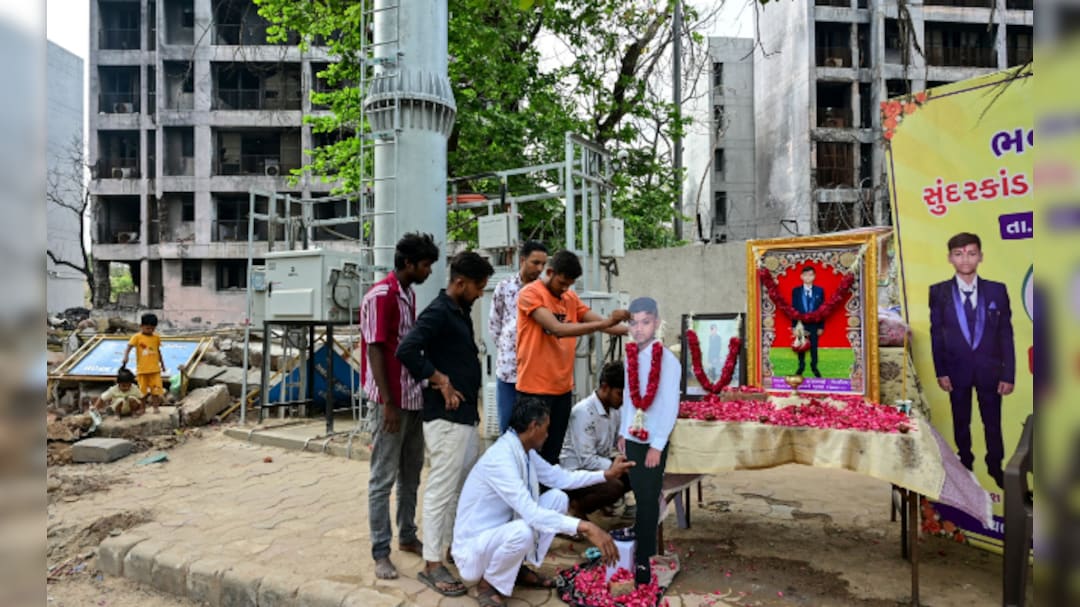
On the morning of June 12, 2026, Sita Ben Patni stood at the crash site in Ahmedabad’s Meghaninagar neighbourhood and mourned her son Akash. Around her, the ruins of the B.J. Medical College hostel, partially rebuilt now, but still bearing the unmistakable geometry of catastrophe, offered a grim frame for her grief. Other families gathered too, quietly, some with garlands, some with photographs. Artists from Gurukul School of Art had brought paintings to honour the dead. British High Commissioner Lindy Cameron flew in from Delhi, laid floral wreaths, and posted on social media: “I will never forget arriving in Ahmedabad and visiting the site on that day. I am back with some of them in Ahmedabad today.”
Somewhere across the city, Air India’s staff observed a two-minute silence at their workstations. Somewhere in the background of every news report about the anniversary, there was a notable absence: no senior Tata Group or Air India leadership was reported to have been physically present at the Meghaninagar site on the day the nation paused to remember 260 lives.
The first anniversary of AI-171 was observed. It was not inhabited, at least not at the level of visible, senior, institutional presence that the scale of the tragedy might have warranted. That distinction is worth examining carefully, not to assign blame, but to ask a harder question: when a company inherits a national institution, does it also inherit a moral responsibility to grieve visibly?
Thirty-Two Seconds…Just!
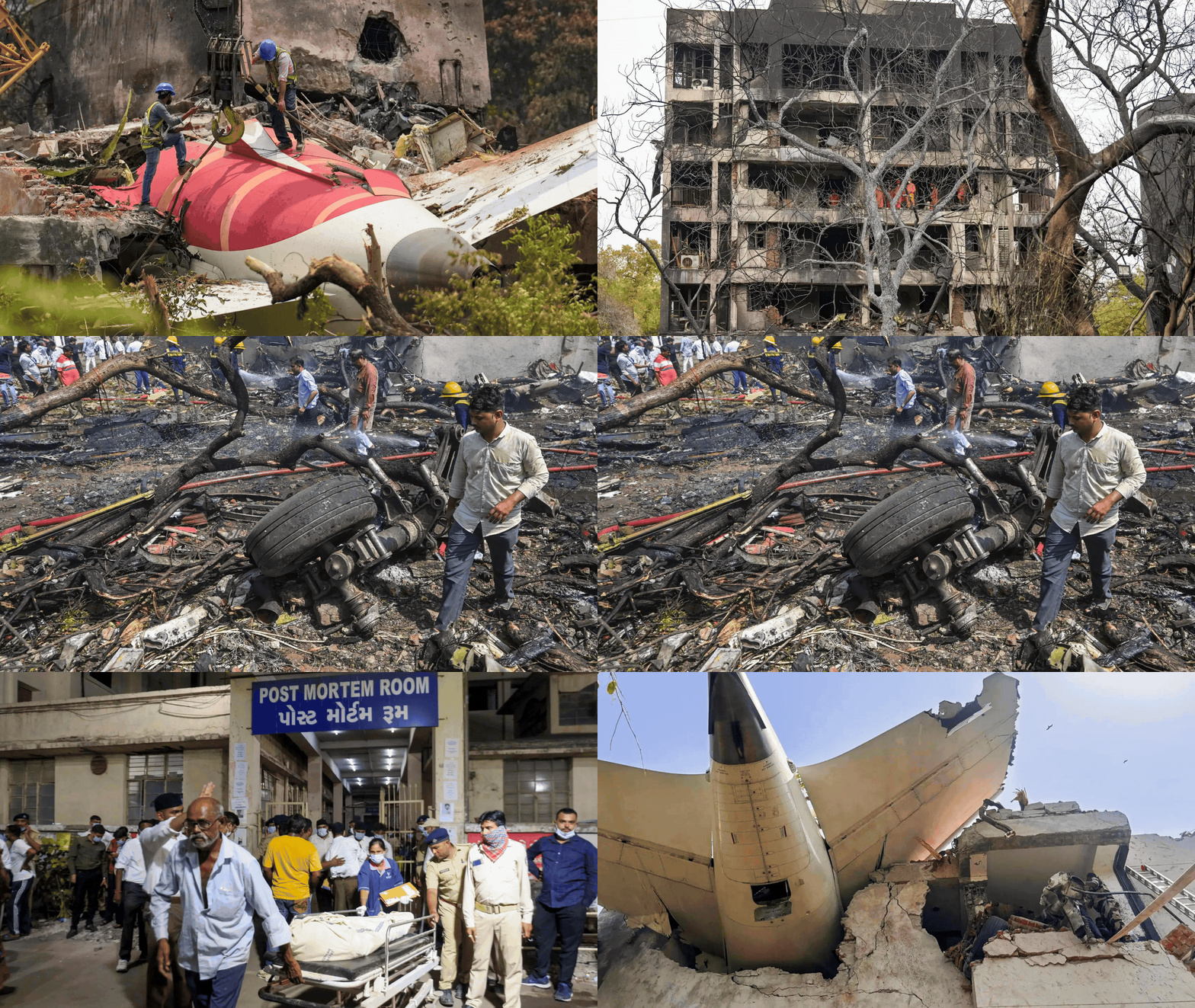
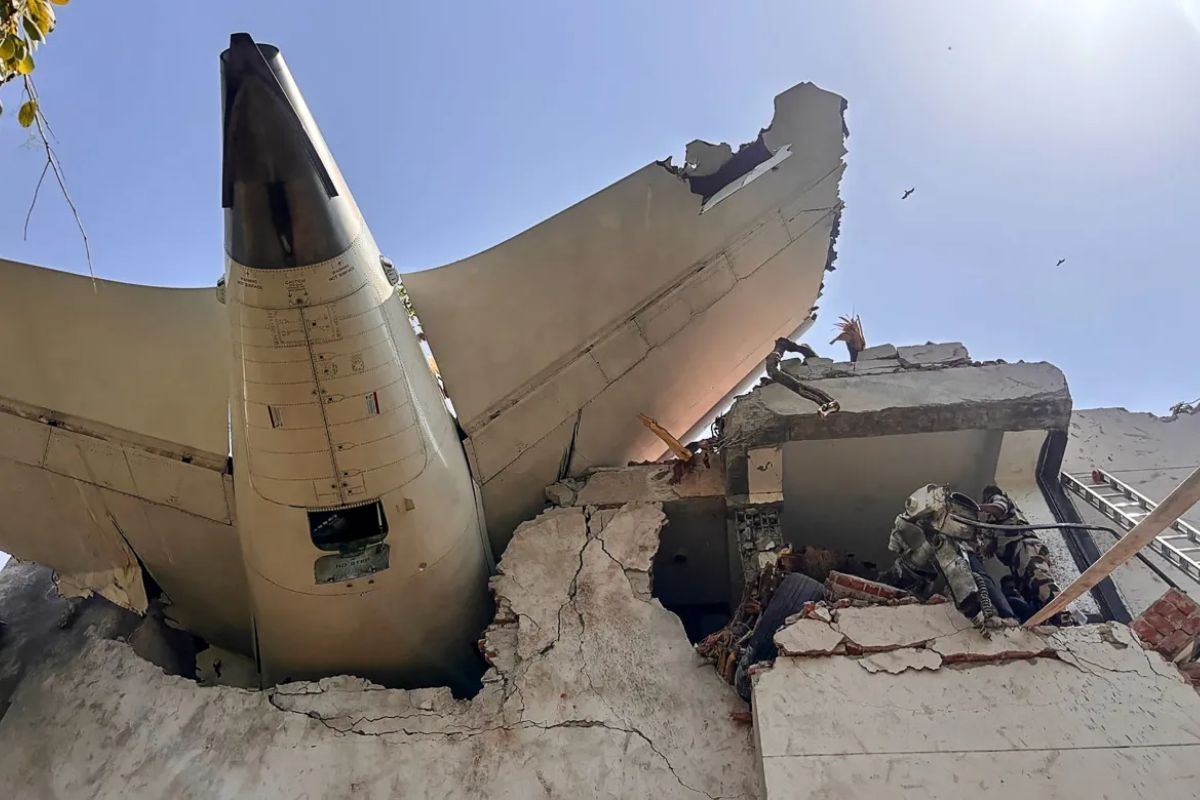
The facts of June 12, 2025 are now familiar, but they bear brief repetition because they remain extraordinary in their horror. Air India Flight 171, a Boeing 787-8 Dreamliner, departed Sardar Vallabhbhai Patel International Airport at 1:39 pm IST, bound for London Gatwick. Thirty-two seconds into its flight — before most passengers would have finished adjusting their seatbelts — the aircraft went down. It crashed into the student hostels of B.J. Medical College, approximately 1.7 kilometres from the runway. A Mayday call was placed. Contact with Air Traffic Control was lost almost immediately after.
Of the 242 people on board, 230 passengers and 12 crew, only one survived: a British national of Indian origin, pulled from the wreckage and hospitalised. On the ground, 19 more people lost their lives when the aircraft impacted the hostel complex, and 67 others suffered serious injuries. The death toll reached 260. Among the dead were 169 Indian nationals, 53 British nationals, seven Portuguese nationals, one Canadian national, and among them, former Gujarat Chief Minister Vijay Rupani.
India’s worst aviation disaster in recent memory had claimed its place in history with brutal efficiency. In thirty-two seconds, it changed 260 families permanently. Tata Group Chairman N. Chandrasekaran, in the immediate aftermath, called it “one of the darkest days” in the company’s history. “What occurred yesterday was inexplicable, and we are in shock and mourning,” he said. “To lose a single person we know is a tragedy, but for so many deaths to occur at once is incomprehensible.” The words were genuine and appropriate to the moment. The question the anniversary raised was a different one: what did those words require of the institution in the months and year that followed?
The Report That Did Not Arrive
On the first anniversary, the Aircraft Accident Investigation Bureau offered an interim update. It confirmed what aviation analysts had long suspected: that the full investigation would take considerably longer. The preliminary findings had already narrowed the focus of the inquiry to the engine fuel control switches — the suspected mechanism through which both engines may have been cut off moments after takeoff — but the definitive conclusions, encompassing the full analysis of crew action, technical failure, systemic oversight, or some combination of factors, remained months away at minimum.
This delay is not unusual. Major aviation investigations routinely take two to three years. The AAIB’s caution is procedurally sound and professionally appropriate. But the families gathered in Ahmedabad were not waiting for a final report. They were waiting for something else: a sign that the institution which operated the flight that killed their loved ones remembered them not merely as case numbers in a compensation file, but as people whose absence continued to matter.
The distinction between investigative accountability and commemorative accountability is important, and it tends to get collapsed in public discourse about aviation disasters. Companies rightly argue that they cannot comment on live investigations, cannot assign responsibility before findings are established, cannot do anything that might prejudice legal proceedings. All of this is true. None of it explains the absence of a senior leader at a memorial ceremony that asked nothing of the investigation at all.
The Weight of the Tata Name
To understand why the anniversary response generated unease in certain quarters, one must understand what the Tata name means in the Indian public imagination — and what expectations that name carries into a crisis.
The Tata Group is not a typical conglomerate. Over more than a century, it has cultivated an identity built consciously on what might be called ethical capitalism — the idea that business can and should be conducted in ways that serve national interests, treat workers with dignity, and demonstrate that profit and public good are not incompatible. JRD Tata’s Air India was the manifestation of this philosophy applied to civil aviation: an airline that was not merely a carrier of passengers but a statement about what India could aspire to be in the world.
When the Tata Group reacquired Air India from the government in 2022, the homecoming was treated as more than a corporate transaction. It was framed by the company, by commentators, by government, as a restoration of purpose. Air India would return to the values of its founder, would become once again something Indians could be proud of.
That framing created an expectation that cuts both ways. A Tata-run Air India is held to a higher standard than most carriers precisely because it chose to position itself as the custodian of a national institution rather than merely the operator of a commercial airline. When tragedy struck, the standards of ordinary crisis management were not sufficient. The public expected something commensurate with the identity the company had claimed.
What Corporate Remembrance Looks Like
There is an established global vocabulary for how institutions respond to major tragedies in the years after they occur. It is worth examining because it provides a standard against which any anniversary response can be assessed fairly.
After the 1988 Lockerbie bombing, Pan Am’s institutional response, or rather, the perceived inadequacy of it, became part of the legacy of the disaster itself. The families of victims felt that the airline treated them as a legal liability rather than as grieving human beings. Pan Am’s collapse two years later meant that the institutional memory was carried forward imperfectly and incompletely, leaving a wound in the affected communities that took decades to partially close.
By contrast, the response of some institutions to other disasters offers a different template. Memorial foundations created in victims’ names. Annual ceremonies where senior leadership is visibly and personally present, not as a legal obligation but as a human one. Transparent, regular communication with families that does not wait for legal proceedings to conclude before offering emotional acknowledgment. These gestures do not resolve grief. Nothing resolves grief. But they signal that the institution regards its moral obligations as extending beyond the settlement of financial claims.
On these measures, the AI-171 anniversary presents a mixed picture. Air India’s institutional response has included real substance: a ₹500 crore AI-171 Memorial and Welfare Trust was established, with Tata Sons and Tata Trusts each contributing ₹250 crore. Ex-gratia payments of ₹1 crore were disbursed to 91% of the families of the deceased. Interim compensation of ₹25 lakh had reached 96% of families. Over 22,000 personal belongings were catalogued and returned to families. CEOs of Tata companies reportedly met 152 of the 165 affected families in India and the UK to offer condolences directly.
These are not nothing. They are, in fact, significant. The Tata Group’s financial commitment went beyond legal requirements, and the scale of the support infrastructure — 500 volunteers, dedicated caregivers for each family, a single-window helpdesk maintained for over two months — reflected genuine organisational effort. And yet. On the anniversary itself, the figure who made headlines by showing up physically at Meghaninagar was the British High Commissioner. The most prominent acts of visible public remembrance came from a diplomat whose 52 nationals were among the dead, not from the airline’s leadership. Air India’s staff observed two minutes of silence at their desks.
The silence was not total. But it was partial in ways that became visible precisely because others filled the space more completely.
What Families Hear in Institutional Silence
It is important to be careful here. Families’ grief is not a rhetorical device, and this article does not intend to instrumentalise it. But it would be dishonest to discuss the anniversary without acknowledging what absence communicates to people who are watching for signals of institutional memory. For families who have lost someone in a corporate tragedy, the years after the event become a long exercise in reading institutional behaviour for signs of continued regard. Is our person still remembered? Are we still people to this organisation, or have we become files? Does the passage of time mean we have been forgotten, or merely that the immediate crisis has been managed?
These questions are not irrational. They are the natural consequence of loss in a context where an institution holds power that the family does not. The compensation, however substantial, can feel clinical. What families often want alongside it, what cannot be purchased or processed in a trust deed, is the sense that the people responsible for the institution that caused their loss still carry that loss with them.
Physical presence at a memorial communicates this in ways that press releases do not. A senior leader standing at the site of a crash, in the presence of families, with no cameras required and no legal obligation driving the attendance, sends a signal that transcends the formal accountability structures. It says: I remember. We remember. This is not behind us.
Fair Questions, Honest Answers
There are legitimate reasons why senior corporate leaders do not always attend public anniversary events at crash sites. Active investigations create genuine legal sensitivities. Public appearances by company leadership can be misinterpreted, can be used in litigation, can create impressions of liability that lawyers rightly counsel against. Companies sometimes choose private outreach over public ceremony specifically because they believe it is more respectful to engage families directly rather than theatrically. These are real considerations. They deserve to be taken seriously.
But they also need to be weighed against the specific context of AI-171. The question is not whether Tata or Air India grieved privately. There is no reason to doubt that they did, and considerable evidence, the trust, the caregiver programmes, the family meetings that institutional concern was genuine and sustained. The question is narrower: did the anniversary create an opportunity for visible, senior-level public remembrance, and was that opportunity taken in a way commensurate with the scale of the loss and the identity of the institution?
The British High Commissioner’s presence in Ahmedabad, returning a year later to stand with families at the site, represents a standard of personal institutional commitment. It is worth asking whether Air India’s leadership, which had claimed the airline as a national institution restored to its proper custodians, met a comparable standard on the day the nation paused to remember.
Reputation Is Built in the Long Aftermath
For Air India, which is simultaneously managing a transformation agenda, a leadership transition following CEO Campbell Wilson’s departure, and the weight of an incomplete investigation, the anniversary was also a reputational moment. Crises in the airline industry do not end when the immediate media cycle concludes. They continue to shape institutional reputation for years, sometimes decades, through the way the company behaves in the long aftermath. Families talk to journalists. Anniversaries generate coverage. Every subsequent incident, however minor, is interpreted through the lens of how the company handled its most defining moment.
Tata’s moral capital, the genuine, historically grounded public trust that differentiates it from ordinary conglomerates is a strategic asset for Air India in a way that it is not for most carriers. An airline that people trust emotionally, not just operationally, commands loyalty that no frequent-flyer programme can fully replicate. That emotional trust is built slowly, through consistent demonstrations of ethical seriousness, and it can be eroded, not through dramatic failures, but through perceived indifference in moments when human expectation was clear. The anniversary of AI-171 was one of those moments.
Memory as Accountability
In aviation, investigations establish technical causes. They determine whether a crew acted within parameters, whether a component failed within tolerances, whether a system responded as designed, whether a regulatory oversight was adequate. They answer the question of what happened and, where possible, who bears responsibility in the formal sense.
But anniversaries test something else entirely. They test whether institutions remember the human cost with the dignity it deserves. They test whether the people running the organisation on the day of remembrance feel the weight of what occurred under their institutional watch, regardless of where formal responsibility eventually settles. They test whether commercial transformation, the refurbished cabins, the new routes, the turnaround narrative has proceeded without erasing institutional compassion.
Air India is not merely an airline. Even under private ownership, even in the midst of a modernisation programme, it carries the accumulated meaning of seven decades of Indian civil aviation history. Families who lost loved ones on AI-171 did not only lose them as passengers on a Tata-operated flight. They lost them on a flight that carried the name of an institution that generations of Indians had regarded as their own.
That inheritance of name, of identity, of public trust is not only a commercial opportunity. It is a moral obligation that does not pause during investigations, does not conclude with compensation payments, and does not end when the headlines move on. The families at Meghaninagar knew this. The British High Commissioner knew this. The question the first anniversary posed — and left, to some degree, unanswered — is whether the institution that now stewards Air India’s name understands it with the same depth.
One year on, that question remains the most important one the investigation cannot resolve.