Bournvita, Patanjali, MDH, Everest: How FSSAI Is Becoming A Toothless Tiger, Who Just Issues Notices, And Does Nothing!
India's Food Safety Paradox: World-Class Rules, Third-World Enforcement

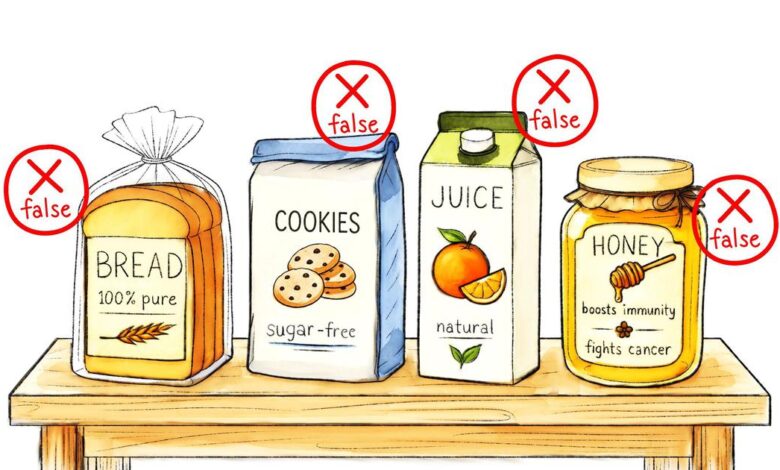
In the normal functioning of a food safety regulator, a flag is a prelude to action. A product is found to make a misleading health claim. The regulator flags it, investigates, and within a defined timeframe, the claim is removed, corrected, or the product faces market consequences. That is the theory.
In India’s version of this story, we found something that should have generated significantly more alarm than it did: India’s food regulator had flagged over 160 misleading claims. Years later, 120 were still around. The claims had been filed, deliberated upon, and, in most cases, neither resolved, prosecuted, nor corrected. The products continued to sit on shelves. The health claims continued to reach consumers. The companies continued to profit.
This is not an isolated failure. It is the operating mode of the Food Safety and Standards Authority of India, the FSSAI, the agency created in 2006 under the Food Safety and Standards Act to be the apex guardian of food quality and consumer protection in one of the world’s largest and most complex food economies.
Two decades in, the evidence suggests FSSAI has become something distinct from what it was designed to be- not a regulator that creates market fear and enforces standards with consequence, but an institution that has perfected the art of the advisory, the surveillance announcement, and the strategically worded press release, while the underlying problems it was created to solve quietly worsen.
Let’s Start With The Architecture of Inaction: What FSSAI Is, and What It Actually Does
FSSAI was born out of a genuine legislative impulse. Before 2006, food safety in India was fragmented across at least eight different central and state laws, enforced by overlapping agencies, producing inconsistent standards and near-zero accountability. The FSS Act consolidated this into a single regulatory architecture, with FSSAI at the apex — responsible for setting science-based food standards, licensing food businesses, overseeing testing, coordinating inspections, and prosecuting violations.
On paper, the penalties are not trivial. Under the FSS Act, adulteration injurious to health can attract a minimum imprisonment of six months, extendable to three years, and fines up to ₹10 lakh. The Bharatiya Nyaya Sanhita, 2023, also contains specific provisions dealing with food adulteration, including Section 274, which provides for imprisonment of up to six months and fines of up to ₹5,000 for adulterating food intended for sale. FSSAI has even proposed life imprisonment as a penalty for extreme adulteration cases. The statutory teeth exist. The question is whether they are ever used.
The ground-level reality is documented in FSSAI’s own data. The number of food samples analysed increased from 1.07 lakh in 2020-21 to 1.77 lakh in 2022-23. Non-conforming samples peaked at 44,626 in 2022-23 before declining to 33,808 in 2023-24. Civil cases rose sharply from 24,195 in 2020-21 to 38,053 in 2022-23. Criminal cases remained relatively stable, around 4,700 to 4,900.
Civil cases rising sharply is not necessarily reassuring, in FSSAI’s legal framework, civil cases are primarily financial penalties, while criminal prosecution represents the deterrent force. A criminal case figure of roughly 4,700 annually, against a backdrop of over 44,000 non-conforming samples in a single year, means that fewer than one in nine non-conforming sample results led to a criminal action. That ratio alone is a story.
Then consider the complaint pipeline. More than 7,700 complaints related to food adulteration and safety were received in 2024-25, out of which nearly 6,000 have been resolved. In 2022-23, 4,330 complaints were received, of which 4,074 were resolved. In 2023-24, the number rose to 4,735.
The government presents resolution rates as a success story. But “resolved” is a definition that demands scrutiny. Does resolved mean a fine was imposed? A product recalled? A license cancelled? A prosecution filed? Or does it mean a file was closed, a notice was acknowledged, a clarification was accepted? FSSAI’s own minister provided the answer in Parliament, almost as an aside: “Regulatory action on such complaints is taken by the respective state food safety departments in accordance with the provisions of the Food Safety and Standards Act, 2006.”
The regulator set up to be the apex authority routinely deflects enforcement responsibility to state governments — a structural arrangement that produces exactly the kind of inconsistent, jurisdiction-dependent, resource-constrained enforcement that the FSS Act was designed to overcome.
The Notice Raj — A Catalogue of Flags Without Consequence
The Bournvita Episode
In April 2023, food activist and social media influencer Revant Himatsingka, known as FoodPharmer, posted a video questioning Bournvita’s sugar content and its positioning as a children’s “health drink.” The National Commission for the Protection of Child Rights subsequently asked Mondelez India to withdraw all “misleading” advertisements, packaging and labels. The NCPCR also urged FSSAI to take action against companies that falsely market these products as health drinks.
According to market experts, food advertising has been a “fairly violative sector” with terms such as Natural, Fresh, Pure, Original, Nutritional, and Organic being used often in misleading ads. FSSAI’s response to the Bournvita episode was characteristically procedural. FSSAI said it continues to act against food business operators reported to be involved in making false or misleading claims to protect consumer interests. The regulator in a statement said it “has taken note of various media reports.” Taking note. The regulatory equivalent of a read receipt.
The Patanjali Pattern: Defiance in Plain Sight
If the Bournvita case illustrates regulatory hesitancy, the Patanjali saga illustrates something more troubling: the complete absence of deterrence. The saga commenced in August 2022, when the Indian Medical Association brought a petition before the Supreme Court, accusing Patanjali of disseminating false and disparaging claims against allopathic medicine. Despite a categorical warning from the Court in November 2023 to cease misleading advertising, Patanjali allegedly continued its deceptive marketing tactics. The sustained defiance provoked a strong response from the judiciary in February 2024, resulting in a temporary ban on Patanjali’s advertisements and the initiation of contempt proceedings.
ASCI found that 25 out of 33 Patanjali advertisements examined violated its code, spanning exaggerated health claims and comparative claims that disparaged competitors. Even after the Supreme Court expressed displeasure and issued warnings in late 2023, the brand ran fresh advertisements making similar claims in December 2023 and January 2024. The court called Patanjali’s subsequent apology “lip service.” It took the Supreme Court of India, not the food regulator to impose meaningful consequences on a company that had been making false health claims for years. FSSAI watched. The Supreme Court acted.
The Dabur and Patanjali Files That Got “Closed”
Among the major companies whose products appear in the documents is Dabur. FSSAI officials flagged different products from Dabur’s Real range of juices twice over seven months — first in November 2023, and then again in the March 2024 meeting. In November 2023, the regulator noted that the company’s statements about the composition of its mixed fruit juice seemed to be “ambiguous”, and that its claims about “health and sehat” were “misleading” and violative of regulations. It directed officials to “close the matter.”
Directed to close. The violation was found, the file was flagged, and then the file was closed. Not because the violation was resolved — but because the system has a mechanism for making violations administratively disappear.
Among the flagged cases was Patanjali’s honey, about which the regulator received a complaint from the Central Consumer Protection Authority. The claims committee discussed the matter in December 2023. As of March 2024, the matter remained unresolved. At the time of publishing, on its own website and e-commerce websites, the company continued to make the claims that had been flagged by the authority, two-and-a-half years after the FSSAI committee first probed the claims. Two and a half years. From flag to publication, the claims were still live.
In May 2024, a food activist had filed an RTI request, asking FSSAI to share details of companies whose licenses had been revoked for violating food advertisement regulations. The regulator responded that “no such information is available.” No license had been revoked. At least none that the regulator could locate in its own records.
The Penalty Problem
The financial architecture of FSSAI’s enforcement regime is itself a structural disincentive to compliance. The current monetary penalty of ₹3 lakh for misbranded food is too low to cause any strong deterrence when compared to the USA, where fines can go up to $250,000 and imprisonment.
A company generating hundreds of crores annually from a falsely marketed “health drink” faces a maximum financial penalty of ₹3 lakh, approximately $3,600, for misbranding. This is not a deterrent. It is a business cost so trivial it can be treated as a rounding error in marketing budgets. In 2015, authorities sued Nestle for $100 million over “unfair trade practices”, causing damage to consumers through misleading advertisements related to its Maggi noodles.
The Global Shame — When the World Rejects Indian Food
The most powerful and commercially devastating argument against FSSAI’s regulatory adequacy is not found in consumer complaints or internal committee documents. It is found in the rejection statistics of foreign food safety authorities.
527 Products. One Carcinogen. No Recall.
The European Union flagged cancer-causing chemicals in 527 Indian food products, ethylene oxide, a substance that the EU banned at the food level due to its toxicity and carcinogenic potential. This is not a narrow category. Five hundred and twenty-seven Indian products, many of them market leaders, bore contamination that European authorities considered a public health risk serious enough to flag across their rapid-alert systems.
The European Union member states rejected 365 Indian food products between May 2024 and May 2026 due to excessive pesticide residues and heavy metal contamination. More than 450 Indian products faced regulatory action during the same period. Around 50 products were flagged for microbiological hazards, including Salmonella, aflatoxin B1, and ochratoxin A. Chlorpyrifos, a pesticide banned in many countries, was found in approximately 135 products. Ethylene oxide was detected in around 40 products. Tricyclazole, a fungicide associated with rice cultivation, was present in 53 consignments.
These are not random bad actors. The Wire reported that over 400 export-quality products from India were flagged by the European Union between 2019 and 2024 for containing contaminants. Fourteen of these products had lead. Other metals like mercury and cadmium were also discovered in fish, among other products.
European authorities have frequently raised concerns over pesticide residues, aflatoxins, microbiological contamination, and weak traceability systems. One of the biggest crises emerged in 2020 when ethylene oxide contamination in Indian sesame seeds triggered large-scale recalls across Europe. Despite subsequent corrective measures, many of the same concerns continue to resurface. The same concerns. Resurfacing. Because the systemic source of the contamination, inadequate pre-export testing, insufficient regulatory pressure on producers, lax enforcement, was never meaningfully addressed.
The MDH and Everest Crisis — Household Names, Global Bans
In April 2024, the crisis became impossible for India’s regulatory apparatus to ignore or quietly file away. In April 2024, Singapore and Hong Kong halted sales of some spices produced by Indian companies MDH and Everest over suspected elevated levels of ethylene oxide, a carcinogenic pesticide. The Maldives subsequently became the third country to ban their products. The US Food and Drug Administration was also investigating.
MDH and Everest are not fringe producers. They are among the most recognised spice brands in India and across the Indian diaspora globally. Their products sit on kitchen shelves in millions of homes. The contamination flagged was not a trace-level technical exceedance — it was ethylene oxide, a known carcinogen that the EU has banned from food use entirely. The $4-billion Indian spice export industry faced intense international scrutiny. The US, Bangladesh, Australian, New Zealand, and Indian food regulators all announced investigations. Both Everest and MDH denied any wrongdoing.
In the most stringent crackdown impacting all Indian spices, Britain’s food watchdog applied extra control measures on all spice imports from India — not just the products of the two flagged brands, but all Indian spices. The UK’s Food Standards Agency stated: “The use of ethylene oxide is not allowed here and maximum residue levels are in place for herbs and spices.”
A single contamination episode with two brands resulted in the UK applying heightened scrutiny to the entire Indian spice sector. This is what regulatory failure at the domestic level costs: not just the reputational damage to MDH and Everest, but a blanket increase in inspection overhead for every Indian spice exporter — a cost borne by thousands of legitimate businesses because the regulator failed to enforce pre-export standards with sufficient rigour to prevent the crisis.
FSSAI’s response was to direct state regulators to collect samples of MDH and Everest products for testing, and to plan a nationwide surveillance exercise for 2024-25 covering fruit and vegetables, salmonella in fish products, spice and culinary herbs, fortified rice, and milk. Surveillance. Announced after the international crisis. Not before it. Not proactively. Reactively, weeks after Singapore and Hong Kong had already acted.
The MRL Scandal Within the Scandal
Days before the EU report, news emerged that FSSAI had allowed a 10-times increase in the quantity of pesticides, known as the maximum residue limit, compared to what was allowed earlier. At a moment when India was facing international scrutiny for pesticide contamination, the domestic regulator was reported to have raised the permissible level of those same pesticides in domestic food products. The optics were extraordinary. The policy logic, if any existed, was never satisfactorily explained publicly.
The Global Comparison — What a Real Food Regulator Looks Like
The US FDA: Enforcement as the Default Response
The US Food and Drug Administration does not operate on the notice-first, enforcement-later model that characterises FSSAI. Its enforcement framework creates a credible threat of market consequences at every level of violation. When the FDA issues a warning letter, it is the beginning of a process that can rapidly escalate to mandatory recalls, import alerts, injunctions, consent decrees requiring third-party audits, and criminal prosecution. The FDA’s warning letters are published in full on its public website, searchable by company, date, and violation type — creating both public accountability and reputational pressure that operates independently of the fine or penalty.
On the financial side, US fines for food safety violations can reach $250,000 — compared to FSSAI’s maximum of ₹3 lakh (approximately $3,600) for misbranded food. For criminal adulteration with health consequences, the US can pursue multi-million dollar settlements and corporate debarment.
The European RASFF System: Real-Time Cross-Border Enforcement
The European Union’s Rapid Alert System for Food and Feed (RASFF) is one of the most sophisticated food safety enforcement mechanisms in the world. When a food safety hazard is detected in one EU member state, the RASFF system notifies all 27 member states and associated countries within hours, enabling simultaneous market withdrawal across the entire bloc.
European authorities have maintained extensive food-monitoring infrastructure, and the alerts generated by EU member states have covered hundreds of analytical results and millions of samples across coordinated surveillance programmes. The system’s power lies not just in its technology but in its legal architecture: member states are legally required to act on RASFF notifications within defined timeframes, and the Commission can ask product withdrawals if member states fail to act.
India has no equivalent. There is no mandatory, time-bound, cross-state notification system when a food safety hazard is detected. A contaminated product found in Maharashtra may not trigger any automatic notification to food authorities in Tamil Nadu, Uttar Pradesh, or Karnataka. In a country where food supply chains cross dozens of state borders, this is a structural vulnerability that no amount of surveillance announcements can substitute for.

Singapore’s Benchmark Response
Singapore’s Food Safety Authority exemplifies what pre-emptive, data-driven food regulation looks like. While both MDH and Everest were flagged for ethylene oxide contamination in Hong Kong, Singapore’s SFA issued an official recall specifically for the Everest Fish Curry Masala. The MDH products were banned and recalled in Hong Kong, but not initially recalled in Singapore. The response time from hazard identification to market action was measured in days, not months. This decisiveness is not Singapore’s unique regulatory personality. It reflects a regulatory system where enforcement action is the expected response to a detected hazard, not an escalation from the expected response of issuing a notice.
The Regulatory Paradox — Strong Laws, Weak Will
India’s food safety legal framework, taken as a written document, is not obviously weaker than comparable frameworks in developed economies. The FSS Act provides for significant penalties, including life imprisonment for severe adulteration. The regulatory mandate is comprehensive. The institutional structure, with FSSAI at the apex and state authorities as implementing arms, has clear lines of authority. The problem is the gap between statutory text and institutional behaviour.
FSSAI serves as India’s primary food regulator, licensing food businesses, establishing food standards, monitoring compliance, conducting inspections, and coordinating food testing. In theory, it functions as the guardian of food safety. In practice, however, serious concerns remain regarding its effectiveness. Food safety enforcement depends upon reliable scientific testing, accreditation, skilled personnel, and advanced testing capabilities. Without scientifically robust laboratories, enforcement actions become vulnerable to challenge. India’s food market is one of the largest in the world. Yet food safety departments frequently operate with limited personnel. Several institutional factors explain the gap.
The state-centre split. FSSAI sets standards, but enforcement is primarily a state responsibility. This creates a system where the standard-setter cannot directly enforce its own standards, and the enforcers (state food safety officers) operate within highly variable resource and political environments. A state government that is politically close to a major food industry player has significant practical discretion in how energetically it pursues violations. FSSAI has no direct mechanism to override this discretion.
Laboratory infrastructure. Enforcement actions are only as strong as the testing infrastructure that supports them. A food business operator challenging a non-conforming sample result can significantly delay enforcement through contested testing procedures. When testing laboratories are overloaded, under-equipped, or geographically inaccessible to field officers, the practical ability to build enforceable cases against violators is constrained regardless of what the statute says.
The penalty-to-revenue ratio. When the maximum penalty for misbranding is ₹3 lakh and the revenue from the misbranded product is measured in hundreds of crores, the rational corporate calculus is simple: comply if convenient, and absorb the penalty if it is cheaper to do so. This is not corporate malice — it is elementary incentive economics. A regulator that cannot impose costs that exceed the benefits of non-compliance has no credible deterrent regardless of how many notices it issues.
The revolving door and political exposure. In India’s regulatory environment, large food companies are also large political and economic actors — employers, tax payers, and in some cases, donors. The institutional culture that makes aggressive enforcement difficult is not unique to FSSAI; it characterises most Indian regulatory bodies that deal with powerful industry interests.
The Broader Pattern — India’s Regulatory Deficit
FSSAI does not sit alone in this critique. It represents a pattern that recurs across India’s regulatory architecture. India’s pollution control boards have long been flagged for issuing notices to industries exceeding emission standards — and then accepting compliance timelines that stretch for years. The pharmaceutical drug regulator CDSCO — the Central Drugs Standard Control Organisation — has faced persistent criticism for its inspection rates, its approval processes, and the speed of its responses to adverse event reports. Building regulators in urban bodies issue occupancy certificates to structures that visibly violate approved plans.
The pattern across all of these institutions is remarkably consistent: legislation that establishes strong-looking standards, regulatory bodies that process paperwork against those standards, enforcement that is slow, inconsistent, politically influenced, and ultimately inadequate to create genuine market compliance.
India should require every packaged food product to contain a government-verifiable QR code linked to an FSSAI database. This is one of the technology-enabled reform proposals that has been floated for years. It has not been implemented. The proposal itself is less significant than the fact that it exists in the discussion while nothing prevents its implementation except institutional inertia and insufficient political priority.
What This Costs India — Trade, Trust, and Global Ambition
India aspires to become a global food processing and export hub. The government has identified food processing as a priority manufacturing sector, and agricultural exports are a significant component of India’s trade policy ambitions. Spice exports alone constitute a $4-billion industry. Rice, tea, fresh produce, processed foods — the aggregate is enormous, and growing global middle-class demand for Indian cuisine creates genuine commercial opportunity. Every international food rejection is a tax on that ambition.
Brands like Everest and MDH experienced significant financial setbacks due to reduced market access in countries like Singapore, Hong Kong, and Saudi Arabia. The bans have driven the Indian spice industry to improve quality control measures, but the reputational damage has required sustained effort to repair. Indian exporters must avoid dangerous and banned chemicals like ethylene oxide, tricyclazole, and carbendazim, which are commonly found in Indian exports such as rice, spices, and tea. These chemicals are banned under EU regulations because they pose serious health risks to consumers and the environment.
The compliance cost imposed on Indian exporters by inadequate domestic regulatory enforcement is not abstract. It includes additional testing at export stage (since foreign markets don’t trust Indian pre-export certification at face value), higher insurance premiums for export consignments, expedited compliance upgrades when international alerts force a crisis response, and the permanent loss of shelf space in international markets that once stocked Indian products.
Many of the same concerns about pesticide residues and microbiological contamination continue to resurface despite corrective measures announced after previous crises. This sentence, from an analysis of India’s EU export rejection pattern, is the most damning characterisation of FSSAI’s fundamental regulatory failure. The concerns resurface because the corrective measures were announcements rather than enforcement. Surveillance is announced. Testing is announced. Crackdowns are announced. And the same contaminants appear in the next shipment.
Conclusion: The Regulator India Deserves, Versus the One It Has
FSSAI was created with a mandate that India genuinely needed: a single, powerful, science-based regulatory authority capable of ensuring that the food eaten by 1.4 billion people meets consistent safety standards. The institutional architecture was sound. The statutory powers were meaningful. The stated intent was public health protection.
What India got, in practice, is an institution that has become extraordinarily proficient at the procedural dimensions of regulation — licensing, surveillance announcements, inter-committee deliberations, advisory issuances — while remaining inadequate at the one dimension that determines whether any of this activity actually changes market behaviour: enforcement with consequence.
The current monetary penalty of ₹3 lakh for misbranded food is too low to cause any strong deterrence. This assessment, from a food policy expert, is not a criticism of individual FSSAI officers or the competence of its scientific panels. It is a structural critique. The system is not designed to create fear. It is designed to create process. And process, without consequence, is theatre.
The global data makes the domestic failure concrete. 365 Indian food products were rejected by EU member states between May 2024 and May 2026 for excessive pesticide residues and heavy metal contamination. More than 450 Indian products faced regulatory action in the same period. 527 Indian food products were flagged by the EU for ethylene oxide, a cancer-causing chemical. The UK applied heightened scrutiny to every Indian spice import following a contamination crisis involving two brands.
This is the reputational infrastructure on which India’s food export ambitions are being built: a foundation of inconsistently enforced domestic standards, a regulator known primarily for issuing notices, and a global impression that Indian food safety certification is not a reliable proxy for safety.
A country whose food regulator cannot reliably remove a carcinogen from its most famous exported spice brands is not a country that global food supply chains will trust with premium market access. A regulator that flags 160 misleading health claims and resolves fewer than 40 of them is not a regulator that food companies fear. And a regulator that cannot tell an RTI applicant which licenses it has revoked for advertising violations — because it has revoked none that it can find records of — is not a regulator that is doing the job it was created to do.
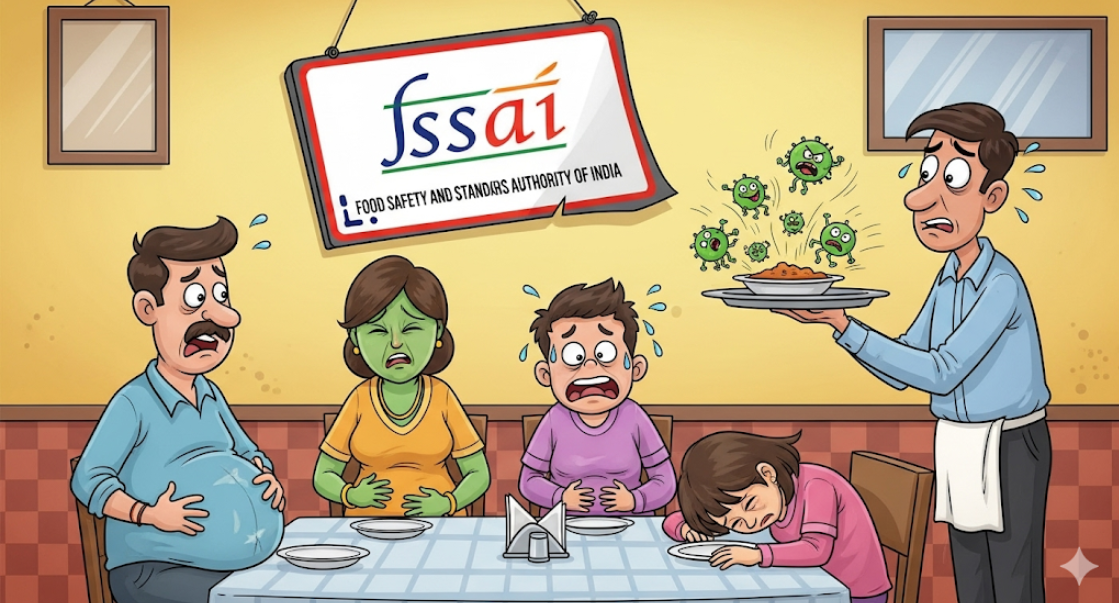
The real question for India’s policymakers is not whether FSSAI needs to improve. The answer to that question is visible in every rejected EU shipment, every unresolved Patanjali file, every ₹3 lakh penalty absorbed by a company that charged crores for a falsely labelled health drink. The question is whether the political will exists to transform FSSAI from a body that processes violations into a body that penalises them — with the speed, severity, and public transparency that the scale of India’s food safety challenge genuinely demands. The world is watching. And increasingly, the world is rejecting.