
CRED’s Billion-Dollar Bet: Inside the Financial Journey That Led to Kunal Shah’s WhatsApp Moment
For years, CRED occupied a curious place in India’s startup conversation. It was the app with the unmistakably premium aesthetic, the one that rewarded affluent credit card holders for simply paying their bills on time, and the one that burned through investor capital at a pace that made even seasoned venture capitalists raise an eyebrow. Founded in 2018 by serial entrepreneur Kunal Shah, fresh off his earlier exit from FreeCharge, CRED built its identity around exclusivity, design, and trust, targeting India’s top-tier credit card users with a members-only app that blended bill payments, rewards, lending, and eventually a sprawling fintech ecosystem.
That story took an unexpected turn this week. Shah announced he is stepping back from CRED’s day-to-day operations to join Meta as the global head of WhatsApp, with longtime CRED executive Miten Sampat stepping in as interim CEO. The announcement arrived alongside news that Meta is investing roughly $900 million into CRED, reportedly valuing the company at around $4.5 billion and giving Meta a minority stake near 20 percent. Shah, in his own telling, also said CRED had recently posted its first profitable quarter and scaled annualized revenue to roughly $325 million.
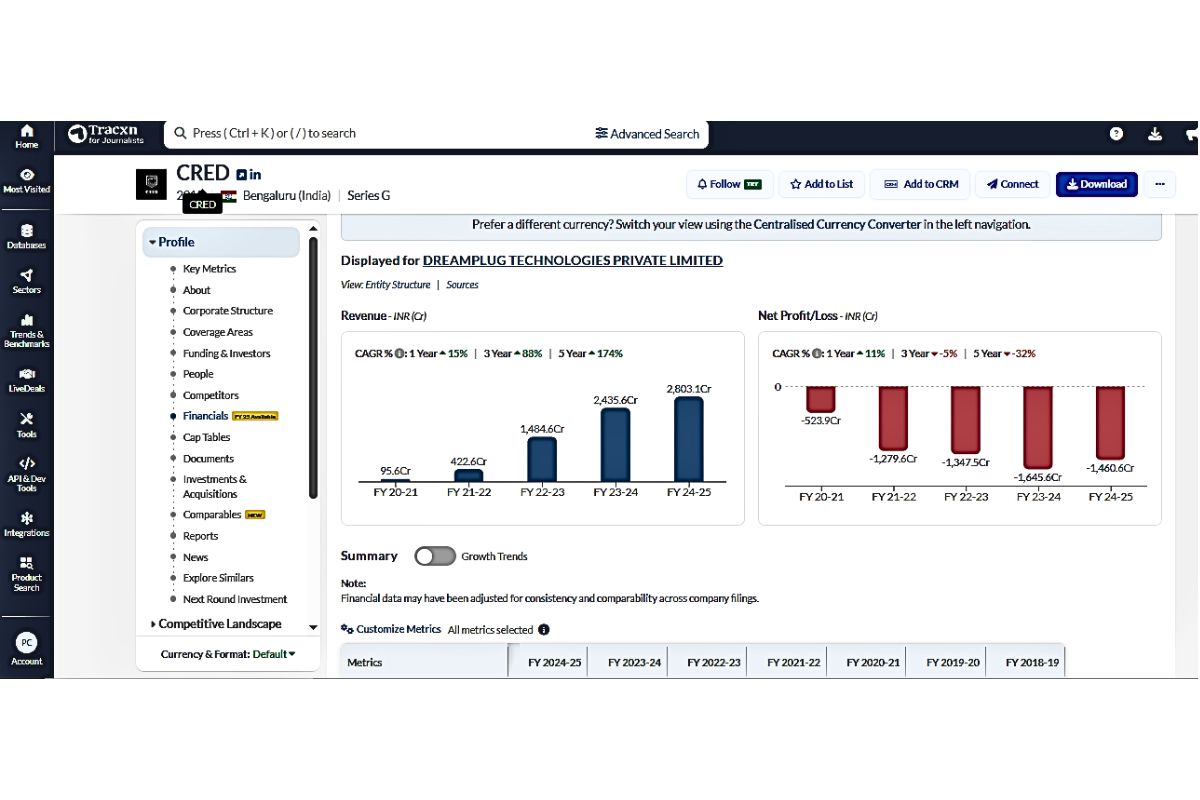
It is a dramatic moment for a company whose audited financials — the ones that matter for understanding its real trajectory rather than its headlines — tell a more complicated story. According to data compiled by Tracxn from DreamPlug Technologies Private Limited’s regulatory filings, CRED’s revenue climbed from ₹95.6 crore in FY2020-21 to ₹2,803.1 crore in FY2024-25, even as net losses swelled from ₹523.9 crore to a peak of ₹1,645.6 crore in FY2023-24, before easing slightly to ₹1,460.6 crore in FY2024-25.
Revenue Growth Analysis: From Niche App to Multi-Thousand-Crore Business
The headline number in CRED’s financials is unambiguous: revenue has grown nearly 30-fold in five years, from ₹95.6 crore in FY2020-21 to ₹2,803.1 crore in FY2024-25. Few companies in any sector manage growth at this scale and pace, and it places CRED firmly in the category of businesses that found genuine product-market fit rather than ones merely buying growth through discounting.
But the shape of that growth curve matters as much as its scale. Revenue roughly quadrupled from FY20-21 to FY21-22 (₹95.6 crore to ₹422.6 crore), more than tripled the following year to ₹1,484.6 crore, then grew 64 percent to ₹2,435.6 crore in FY23-24, before slowing sharply to just 15 percent growth in FY24-25, reaching ₹2,803.1 crore. Expressed as compounding rates, the five-year CAGR stands at an extraordinary 174 percent, the three-year CAGR moderates to 88 percent, and the most recent one-year CAGR falls to 15 percent.
This deceleration is not necessarily a red flag, it is, in fact, closer to what economists would call a natural maturation curve. Early-stage startups routinely post triple-digit growth rates off small bases; doubling revenue from ₹100 crore to ₹200 crore is mathematically and operationally easier than doubling it from ₹2,000 crore to ₹4,000 crore. As the base grows, the law of large numbers begins to assert itself, and growth rates compress even when the absolute rupee growth remains substantial. CRED added roughly ₹368 crore in absolute revenue between FY23-24 and FY24-25, which is a meaningful sum, even if the percentage growth looks modest next to earlier years.
That said, a slowdown this pronounced, from 64 percent year-on-year growth to 15 percent, also invites scrutiny of underlying drivers. Possible explanations include, increased competitive intensity in India’s credit-and-rewards fintech space, saturation within CRED’s core addressable market of premium credit card holders (a deliberately narrow segment by design), a strategic pivot toward profitability that involved pulling back on growth-at-any-cost initiatives, or simply the natural cooling that follows a multi-year hyper-growth phase. Each of these is plausible; the filed numbers do not, by themselves, tell us which dominates.
Loss Trajectory and Burn Rate: The Other Side of the Ledger
If revenue tells a story of scale, losses tell a story of cost. CRED’s net loss expanded from ₹523.9 crore in FY20-21 to ₹1,279.6 crore in FY21-22, more than doubling, then crept up further to ₹1,347.5 crore in FY22-23 and ₹1,645.6 crore in FY23-24, before narrowing to ₹1,460.6 crore in FY24-25. Expressed as a one-year CAGR, that represents an 11 percent reduction in losses for the most recent year, even as the three-year and five-year metrics (-5 percent and -32 percent respectively) reflect the earlier years of loss expansion baked into longer time windows.
The FY24-25 improvement, losses shrinking by roughly ₹185 crore even as revenue grew by ₹368 crore is the single most encouraging data point in this entire financial picture. When a company’s losses fall while its revenue rises, it typically points to one of three dynamics, often in combination: genuine operating leverage, where fixed costs are spread across a larger revenue base and each incremental rupee of revenue costs less to generate; improved monetization, where the company is extracting more value per user or transaction without proportionally higher spend; or cost discipline, where management has deliberately throttled discretionary spending — most commonly marketing, brand spend, and employee stock compensation — to manage the bottom line ahead of a fundraise or strategic event.
It would be premature to declare CRED has achieved durable operating leverage based on a single year of improvement. Loss reduction in any one fiscal year can also reflect one-off effects: a reduction in non-cash ESOP charges, a deferred or rescheduled marketing campaign, a change in accounting treatment for credit losses in its lending book, or cost reclassification between fiscal years. Without a line-by-line breakdown of CRED’s profit-and-loss statement — separating employee costs, marketing and customer acquisition spend, technology infrastructure, and credit/lending provisions — it is not possible to determine definitively whether FY24-25’s improvement reflects structural progress or a temporary pullback timed around the company’s broader strategic positioning, including the Meta transaction that followed shortly after.
What can be said with confidence is that the direction of travel — narrowing losses alongside continued (if slower) revenue growth — is the pattern investors and analysts generally want to see in a maturing growth-stage company. The next one to two fiscal years will determine whether FY24-25 was an inflection point or an aberration.
Unit Economics and the Path to Profitability
Examining the ratio of losses to revenue across the five years gives a clearer sense of CRED’s trajectory toward sustainability. In FY20-21, the company’s loss of ₹523.9 crore actually exceeded its revenue of ₹95.6 crore — meaning CRED was losing more than five rupees for every rupee of revenue it generated, a burn profile typical of an early-stage company still investing heavily to acquire its first wave of premium users. By FY21-22, that ratio had improved meaningfully, with losses of ₹1,279.6 crore against revenue of ₹422.6 crore — roughly three rupees lost per rupee earned.
A simplified illustrative ratio derived from Tracxn portal analyses the loss-to-revenue ratio across these years, offering a clearer picture of CRED’s trajectory toward sustainability. In FY2022-23, the company posted a net loss of ₹1,347.5 crore against revenue of ₹1,484.6 crore, meaning it lost roughly 91 paise for every rupee of revenue earned.
That ratio improved further in FY2023-24, with a loss of ₹1,645.6 crore against revenue of ₹2,435.6 crore, narrowing the figure to approximately 0.68, or 68 paise lost per rupee earned. The trend continued into FY2024-25, with losses of ₹1,460.6 crore against revenue of ₹2,803.1 crore, bringing the ratio down to roughly 0.52 — meaning CRED now loses about 52 paise for every rupee it brings in, compared with losses exceeding revenue just a few years earlier.
This steadily improving ratio, from losses exceeding revenue to losses representing roughly half of revenue, is arguably the most important long-term signal in the dataset, more telling than any single year’s absolute loss figure. It suggests that even as CRED has continued to invest heavily (likely in customer acquisition, lending capital, rewards subsidies, and technology), each rupee of investment has produced more revenue over time.
Extrapolating from filed data alone, reaching breakeven would require either revenue to continue growing while costs grow more slowly, or for the rate of loss reduction (the 11 percent annual improvement seen in FY24-25) to continue and accelerate for several more years. If CRED could sustain a similar pace of loss reduction, combined with stronger revenue growth than the most recent 15 percent, a path to breakeven within two to four years becomes mathematically plausible, though this should be read as illustrative arithmetic rather than a forecast, since it assumes consistent conditions that real businesses rarely maintain.
Notably, this is also roughly where Shah’s own public comments intersect with the filed numbers: his statement that CRED recorded its “first profitable quarter” in 2026 would represent exactly the kind of inflection the loss-to-revenue trend in the audited data had been pointing toward. If accurate and sustained, it would mark the transition from a structurally loss-making business to one approaching operating breakeven — though a single profitable quarter, even if true, is not equivalent to full-year profitability, and the claim has not yet been verified through audited annual filings.
/entrackr/media/media_files/2025/09/15/kunal-shah-credit-card-2025-09-15-15-52-08.png)
Industry Context: CRED’s Burn Profile Against Its Fintech Peers
CRED’s growth-first, profitability-later trajectory is far from unique in Indian fintech. The broader pattern, illustrative rather than a precise comparison, since each company’s business model, disclosure standards, and accounting periods differ, has played out repeatedly among India’s venture-backed digital finance companies.
Paytm, India’s most prominent listed fintech, spent the better part of a decade posting substantial losses while scaling its payments and financial services footprint, only achieving its first operating profit at a EBITDA level several years after its 2021 public listing — a journey that took considerably longer, and involved far greater absolute losses, than CRED’s current trajectory.
PhonePe, the UPI-led payments giant backed by Walmart, similarly operated at a loss for years while it built scale in payments before management began emphasizing a path toward profitability through diversification into insurance, lending, and wealth products — a playbook CRED appears to be following in miniature. Razorpay, the payments infrastructure company, took a comparatively more disciplined approach to burn relative to its revenue base, though it too prioritized market share and product breadth in its earlier years before profitability became a central narrative.
Set against this backdrop, CRED’s five-year journey, from a loss-to-revenue ratio above 5x to one around 0.5x, looks like a reasonably efficient version of the standard Indian fintech growth playbook, albeit one that took place over a comparatively compressed timeframe relative to some peers. This is, again, an illustrative comparison rather than a rigorous benchmarking exercise; precise like-for-like comparison would require normalizing each company’s financials for differences in business mix, accounting treatment of lending losses, and the maturity of each company’s monetization strategy.
The broader playbook these companies share is one familiar to anyone who has followed venture-backed technology businesses globally: raise capital at a high valuation premised on a large addressable market, subsidize early growth heavily to establish habit and scale, accept years of losses as the cost of building defensible market position, and only pivot toward profitability once the user base and product suite are mature enough to support healthier unit economics. CRED’s recent loss reduction, paired with reported profitability claims around the Meta transaction, would place it at a similar maturation point to where Paytm and PhonePe arrived after their own multi-year journeys — albeit, if Shah’s figures hold up, on a faster timeline.
Business Model Diversification: Beyond Bill Payments
CRED’s original product was narrow by design — a members-only app that rewarded users for paying credit card bills on time, monetizing through a mix of rewards-driven engagement and an emerging advertising and brand-partnership ecosystem. Over the years, the company has expanded well beyond that initial wedge.
CRED Cash, the company’s personal lending product, allows members to access short-term credit lines, and lending typically carries materially higher revenue intensity per user than a pure rewards-and-payments product, since interest and fee income flow directly to the platform (or its lending partners, depending on the underlying NBFC structure). The company has also built out UPI-based payments, stockbroking and wealth management features, merchant-facing commerce tools that let CRED members discover and transact with partner brands, and — per Shah’s own description at the time of the Meta announcement — insurance and a fuller suite of credit card-linked services.
/entrackr/media/post_attachments/wp-content/uploads/2024/07/Kunal-Shah-Cred.jpg)
This diversification likely explains a meaningful share of the revenue acceleration visible in the FY21-22 through FY23-24 period, when revenue grew most aggressively in absolute terms. Lending products, in particular, tend to scale revenue quickly once a lending book reaches sufficient size, because interest income compounds with the loan book itself — though this same dynamic also introduces credit risk that does not show up clearly in top-line revenue figures and could be a contributing factor to losses in any given year if default rates rise.
It is reasonable to infer, though again, the filed financial data does not break out segment-level revenue — that CRED’s transformation from a single-product rewards app into a multi-product financial services platform is the primary structural force behind both its revenue growth and its gradually improving loss ratio, since a more diversified revenue base reduces the company’s historical reliance on subsidized engagement and rewards spending alone.
Risks and Challenges Ahead
Despite the encouraging trendlines, CRED’s business model carries risks that any reading of its financials should account for. Foremost among these is regulatory exposure: India’s central bank, the Reserve Bank of India, has tightened oversight of digital lending and fintech-NBFC partnerships in recent years, including rules around first-loss default guarantees, co-lending structures, and disclosure requirements. Any company with a meaningful lending business, as CRED now has through CRED Cash, operates with a degree of regulatory risk that can affect both revenue growth and credit costs depending on how rules evolve.
A second risk is the sustainability of customer acquisition costs in a model built around an explicitly premium, narrow user base. CRED has differentiated itself by targeting high-credit-score, high-income credit card holders rather than the mass market that competitors like Paytm and PhonePe pursue. This positioning supports higher revenue per user but also caps the total addressable market, meaning continued growth increasingly depends on deepening monetization of existing members (through lending, commerce, and new product cross-sell) rather than simply adding new ones — a transition that is generally harder to execute and slower to show results.
Competitive pressure is a third consideration. India’s fintech landscape includes well-capitalized, mass-scale players in payments and lending, alongside traditional banks that have improved their own digital credit card and rewards experiences. CRED’s premium positioning has provided some insulation, but it does not eliminate competitive intensity, particularly as banks and larger platforms invest in their own loyalty and rewards ecosystems.
Finally, leadership transition itself is a risk worth naming plainly. Kunal Shah was not merely CRED‘s founder but its primary public face and product visionary for nearly eight years. His move to lead WhatsApp globally — even with continued involvement as a shareholder — represents a meaningful change in the company’s leadership structure. Miten Sampat, stepping in as interim CEO, has reportedly been close to Shah and involved in CRED’s strategy and finance functions since 2020, which may provide continuity, but any leadership transition introduces execution risk, particularly at a moment when the company appears to be approaching a profitability inflection point that will require sustained discipline to consolidate.
What FY24-25 — and the Meta Deal — Signal for Investors
Taken together, CRED’s audited financial trajectory and the events surrounding Shah’s departure tell a layered story. The filed numbers through FY24-25 show a company whose losses, while still substantial in absolute terms, have been narrowing relative to a fast-growing revenue base — precisely the kind of trend that precedes a credible profitability narrative. The Meta investment, reportedly valuing CRED at around $4.5 billion with Meta taking a roughly 20 percent minority stake, suggests that sophisticated investors share at least some confidence in that trajectory, since major strategic investors do not typically commit capital of this scale without underwriting a path to sustainable returns.
Shah’s own disclosure, that CRED recorded its first profitable quarter in 2026, alongside a fifth employee stock ownership buyback and an annualized revenue figure in the $325 million range, would, if confirmed in audited filings, represent the culmination of the improving trend visible in the FY20-21 through FY24-25 data.
For CRED’s next steps — including any future funding rounds or a longer-term path toward a public listing — the practical implication is that the company now has a credible, data-backed profitability narrative to build on, something many of its Indian fintech peers took considerably longer to establish. An IPO is not imminent based on anything in the public record, and the company would typically need to demonstrate sustained, full-year profitability — not a single profitable quarter — before public markets would price it on profitability metrics rather than growth and valuation comparables alone. The Meta transaction, and the leadership transition that accompanies it, effectively buys CRED time and capital to consolidate that narrative under new operational leadership.
Conclusion: Maturing Business or Growth-Stage Burn, Still?
CRED’s five-year financial history, as captured in its filed results, does not offer a simple verdict. It is neither a runaway profitability success story nor a cautionary tale of unchecked burn. It is, more accurately, the record of a company that spent its first several years subsidizing growth heavily — as nearly every venture-backed Indian fintech has — before beginning to show, in its most recent reported year, the kind of operating improvement that suggests a more disciplined, more diversified business taking shape underneath the losses.
The 15 percent revenue growth and 11 percent loss reduction recorded in FY24-25 are modest compared to CRED’s own explosive early years, but they may matter more, because they represent the first clear evidence that growth and improving economics can coexist within this business — rather than growth coming, as it so often did in CRED’s earlier years, at an escalating cost.
Whether that pattern holds, accelerates, or reverses will depend on factors the public filings alone cannot answer: how CRED’s lending book performs through changing credit cycles, how successfully Miten Sampat’s interim leadership sustains strategic continuity without Shah’s day-to-day involvement, and whether the profitability Shah has publicly claimed for 2026 shows up, durably, in the company’s next set of audited results.

What is clear is that CRED enters this leadership transition from a stronger financial position than at almost any point in its history — a meaningfully larger revenue base, a narrowing loss trajectory, and now, a deep-pocketed strategic backer in Meta. The coming one to two fiscal years, rather than the Meta announcement itself, will be the real test of whether CRED has built a sustainable fintech franchise or simply found a well-timed moment to tell a profitability story before the next chapter of growth-stage investment begins again.