India’s Quick Commerce Boom: The Tale Of Convenience, Capital And The Coming Crunch
When The VC Cheques Stop Coming, Will You Still Get Your Onions In 10 Minutes?

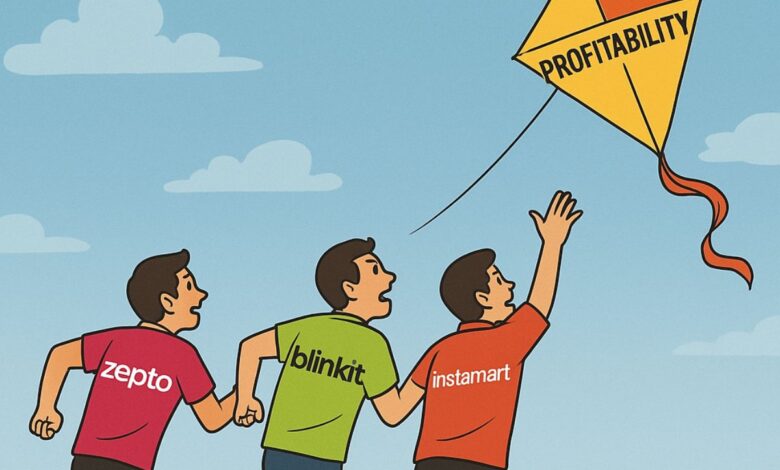
In December 2025, Quick Commerce Sector’s Market Leader, Mr. Albinder Dhindsa, the chief executive of Blinkit, India’s single largest quick-commerce platform, sat down for an interview and said something that executives at high-growth startups almost never say. He warned that India’s quick-commerce sector was hurtling toward a shakeout. He said the model that had relied on relentless fundraising was nearing its limits. He told Bloomberg News that companies would soon have to decide how long they could keep absorbing steep losses. And then he added: “Usually when this kind of imbalance exists, the correction is very swift. It often catches people by surprise.”
This was not a disgruntled investor. This was not a short-seller. This was not a legacy retailer watching digital upstarts eat its lunch. This was the CEO of the market leader, the man who stands to gain the most from the sector’s continued momentum, issuing a warning so clear it should have sent tremors through boardrooms from Mumbai to Bengaluru.
That is the story worth telling. Not simply the story of one company or one founder, but the broader and more urgent question of whether India’s quick-commerce boom, one of the most closely watched startup experiments in the world, is repeating the precise mistakes that destroyed earlier “growth-at-any-cost” businesses across the globe. The evidence, when examined honestly, is deeply uncomfortable.
The Warning From Blinkit’s CEO, When Insiders Start Sounding the Alarm
The significance of Dhindsa’s warning lies not in the words themselves but in the mouth from which they came. Throughout the history of venture-capital-fuelled bubbles, the most revealing signal is rarely the first analyst who raises concerns or the first journalist who asks hard questions. Those warnings are easy to dismiss as envy, ignorance, or short-termism. The genuinely alarming signal arrives when industry insiders, the very people who understand the business from the inside, who have skin in the game, who are supposed to be optimists by professional obligation, begin speaking the language of structural doubt.
We have seen this pattern before. Before the food-delivery consolidation wave that swept through Europe and the United States, there were CEOs who warned quietly about irrational pricing. Before the Chinese bike-sharing collapse of 2018, which turned city streets into graveyards of abandoned coloured bicycles, there were insiders who cautioned about the unsustainability of zero-cost rides funded entirely by venture capital. Before the dot-com crash of 2001, a handful of company founders had begun, in private conversations and occasional public remarks, to question whether “eyeballs” and “page views” could really substitute for revenue indefinitely.
In each case, the warnings came. In each case, the market largely ignored them. In each case, the correction arrived anyway. Dhindsa is now occupying that uneasy position in India’s quick-commerce story. He is the insider saying the uncomfortable thing. He is watching competitors burn cash on discounts and dark-store expansion at a pace that cannot be sustained. He is, to his credit, saying so publicly rather than waiting for the shakeout to begin before pretending he always knew it was coming.
The broader context amplifies his concern. Swiggy, Blinkit’s smaller rival was, at the time of his warning, preparing a $1.1 billion share sale barely a year after its $1.3 billion market debut, with its stock trading near its IPO price. This is not the behaviour of a company confidently reinvesting from operating cash flows. It is the behaviour of a company that needs external capital to survive. Zepto, the third major player, had simultaneously raised $450 million ahead of its own planned IPO.
The amount of money circling this sector is staggering. The confidence with which it is being deployed is either visionary or reckless, and the difference between those two descriptions will only become clear in hindsight.
The Fundamental Question — Does Quick Commerce Actually Make Money?
Set aside for a moment the language of “disruption” and “ecosystem” and “first-mover advantage.” Strip away the funding announcements, the valuation headlines, the breathless coverage of order-volume milestones. Ask the simplest possible question about any business:
When a customer places an order, does the company make money?
For quick commerce, the honest answer is: not yet, and possibly not for a very long time.
Consider the economics of a typical transaction. A customer in Bengaluru opens an app, orders ₹250 worth of groceries, perhaps some milk, bread, onions, and a packet of biscuits, and expects delivery in ten minutes. Free delivery, naturally. Perhaps with a discount code applied at checkout.
Let us trace where the money goes.
First, there is the dark store. Quick-commerce companies do not use traditional warehouses or retail outlets. They operate hyperlocal “dark stores”, small fulfilment centres positioned within a few kilometres of their customer base, stocked with fast-moving items. These dark stores must be leased in urban locations where real estate is expensive. Zepto’s own IPO filings reveal that lease rentals for its existing dark stores cost ₹1,734.9 crore in a single financial year. Its investment in new dark stores added another ₹1,629 crore.
Second, there is inventory. Goods must be purchased, transported to dark stores, stored, and managed. Procurement of goods remained Zepto’s biggest expense, accounting for roughly 63% of its total costs.
Third, there is the delivery rider. Every order requires a human being on a two-wheeler who must pick, pack, and transport the order within the promised window. Delivery and handling expenses surged over 90% year-on-year in Zepto’s FY26 filings, reflecting the operational intensity of ensuring rapid fulfilment timelines.
Fourth, there is technology. Apps, logistics algorithms, inventory management systems, cloud infrastructure. Zepto spent ₹1,324.8 crore on technology and cloud infrastructure alone.
Fifth, there is customer acquisition. Advertising, promotional discounts, first-order offers. Zepto’s advertising and promotional spend reached ₹1,389 crore.
Now add back: the ₹250 the customer paid. Even at the most optimistic assumptions about margins on those groceries, and even ignoring the free-delivery economics, the numbers do not work for a single transaction at this scale of overhead.
This is not a secret. Industry participants know it. Investors know it. The companies themselves disclose it in their filings. The argument, and it is a reasonable argument in its proper context is that these are early-stage losses being incurred to build scale, and that scale will eventually produce profitability through better order density, improved logistics efficiency, and higher average order values.
That is the thesis. It is not proven. And the time horizon over which it must be proven is growing shorter as investor patience grows thinner. The critical distinction that often gets lost in the growth narrative is this: Gross Merchandise Value is not profit. Order growth is not profit. Market share is not profit. Revenue growth can be purchased with investor money. Profitability cannot.
The Great VC Subsidy — Customers Are Not Paying the Real Price
Here is a thought experiment worth sitting with.
Every time an Indian consumer orders ₹300 worth of groceries on a quick-commerce app with free delivery and a ₹50 discount, part of that transaction is being paid for by a venture capital firm. Not the grocery cost, because that is covered by the order value. But the delivery cost, the overhead cost, the portion of the dark-store lease attributable to that order, the slice of the marketing budget that convinced the customer to open the app; every meaningful portion of these are funded by investor capital deployed in the expectation of future profits.
This is not inherently wrong. It is standard practice in early-stage consumer technology businesses. Uber did the same thing. Airbnb did the same thing. Amazon ran losses for years in pursuit of scale. The model has precedent and the precedent includes some of the most valuable companies in history. But the precedent also includes failures. Many of them.
Uber’s early years were sustained by billions of dollars in venture capital that subsidized artificially cheap rides for consumers. When the company eventually moved toward profitability, prices rose, driver incentives were reduced, and the “magical” experience of a $4 ride became a somewhat less magical $18 ride. Consumer behaviour adjusted. Some customers left. The business survived, but the golden age of VC-subsidized rides ended.
Food delivery followed the same arc. During the wars between Swiggy and Zomato in India, and between DoorDash and Uber Eats in the United States, consumers enjoyed extraordinary discounts funded by investor capital. As consolidation occurred and funding discipline was enforced, discounts shrank, delivery fees appeared, and the casual user who ordered food three times a week on a whim became the considered user who ordered once a week only when the discount made sense.
The question for quick commerce is whether the consumer behaviour being cultivated right now, with the expectation of free 10-minute delivery on any order of any size, is real demand or subsidized demand. Because those are two very different things, and only one of them survives when the VC cheques stop arriving.
The real customer in the current quick-commerce model is often not the shopper browsing for groceries. The real customer is the institutional investor willing to fund losses in the expectation of future dominance. When that customer becomes unavailable or demanding of returns, the business model faces its true test for the first time.
Zepto — The Poster Child of Growth Without Profit
If you want to understand the economics of India’s quick-commerce sector, look at Zepto’s numbers. Not the top-line numbers that make headlines. All of them, together.
Zepto was founded in July 2021 by Aadit Palicha and Kaivalya Vohra, two Stanford dropouts who identified an opportunity in ultra-fast grocery delivery. Their story is genuinely compelling: young, brilliant, fast-moving founders who built a significant business from scratch in a matter of years.
The numbers they have produced are equally genuine. Revenue from operations more than doubled in FY26, reaching ₹22,623.58 crore, up from ₹11,109.94 crore in FY25 and just ₹4,454 crore in FY24. The growth trajectory is extraordinary by any standard. At 23.3 lakh orders per day in Q4 FY26, Zepto is processing transactions at a scale that would have been unimaginable for an Indian grocery startup even five years ago.
But the losses have grown too. Net loss increased 26% year-on-year to reach ₹5,905.19 crore in FY26, widening from ₹4,699.71 crore in FY25 and ₹1,214.8 crore in FY24. Zepto has not reported a profit in any financial year since its founding. Total annual expenses ballooned to ₹29,026.70 crore in FY26.
There are glimmers of improvement in unit economics, per-order cost losses have reduced from ₹136.15 in FY25 to ₹78.75 in FY26, which is genuine progress. Advertising revenue has grown remarkably, reaching ₹1,636 crore in FY26 from just ₹49 crore two years earlier, representing an increasingly important and higher-margin revenue stream. But the company’s own IPO filings state plainly that it has incurred losses in every fiscal year since inception and warns that it may continue to face negative cash flows as it expands.
There is a question worth asking about any high-growth, high-loss business that applies here with particular force: Growth answers the question “Can customers be acquired?” Profitability answers the question “Should they be acquired?” The first question has been answered emphatically in Zepto’s case. The second question remains open.
The IPO is approaching, the company plans to raise ₹8,010 crore through a fresh issue of equity shares, targeting a listing by mid-2026. The timing is worth noting. IPOs in high-growth, loss-making businesses often arrive when private funding becomes more difficult or expensive to access. The public markets are being asked to fund the next chapter of expansion that private investors may be less eager to back.
The Cash Burn Machine — Why Growth Can Hide Structural Weaknesses
Modern startup accounting has developed a sophisticated vocabulary for discussing financial performance without discussing profit. EBITDA. Adjusted EBITDA. Contribution margin. GMV. Order frequency. Annual transacting users.
These metrics are not meaningless. They capture real aspects of business performance. But they can also be deployed strategically to direct attention toward the numbers that look good and away from the number that ultimately matters: cash generation.
Cash burn is the rate at which a company consumes its available capital. Runway is the amount of time remaining before that capital runs out. Funding rounds are the mechanism by which companies extend their runway. Valuation is the price attached to future hopes. The cycle works beautifully as long as investors remain willing to participate. New money arrives, extends the runway, allows growth to continue, creates better metrics that justify the next round at a higher valuation. The business looks, by most measures, increasingly impressive.
What breaks the cycle is not failure. What breaks it is hesitation.
When capital markets become uncertain — when interest rates rise, when public markets turn risk-averse, when a sector experiences visible stumbles elsewhere in the world — the willingness to fund another round at the same or higher valuation falters. Growth rates that once seemed to justify any loss start to look insufficient. Profitability timelines that seemed comfortably distant start to feel urgently near.
Zepto’s own cash consumption trajectory illustrates this concern. Adjusted EBITDA loss rose by 11.5% to ₹5,041.5 crore in FY26, even as per-order losses improved. The company is spending more in absolute terms even as it becomes more efficient per order, because it is also expanding its dark-store network, now comprising 1,139 locations across 66 cities.
This is the fundamental tension of the current moment: the business is improving its efficiency while simultaneously increasing its absolute losses through expansion. Both things are true simultaneously. Which one matters more depends entirely on whether expansion eventually produces the density and order volume needed for profitability — and on whether investor patience lasts long enough to find out.
The ED Shadow — Regulatory Risks Nobody Talks About
India’s quick-commerce sector faces not only economic risks but regulatory ones, and these tend to receive less analytical attention than they deserve.
Zepto’s updated Draft Red Herring Prospectus, filed with SEBI ahead of its proposed IPO, disclosed that the Enforcement Directorate summoned founders Aadit Palicha and Kaivalya Vohra in April 2026 in connection with matters related to the Foreign Exchange Management Act. The company has stated compliance with applicable laws and no wrongdoing has been established. The investigation remains ongoing.
The importance of this disclosure lies not in any presumption of guilt, none is warranted or intended here, but in what regulatory scrutiny does to investor confidence, particularly at the moment of a public listing. IPO-bound companies operate under a microscope. Every material risk must be disclosed. Every pending investigation, however preliminary, becomes a line item in a prospectus that institutional investors scrutinise carefully. Even if ultimately resolved without adverse findings, an unresolved investigation creates uncertainty. Uncertainty increases the cost of capital. A higher cost of capital makes the already difficult task of achieving profitability even harder.
There are also broader regulatory concerns around quick commerce that extend beyond any single company. Complaints have been raised regarding “dark patterns” in consumer interfaces — user experience designs that make it harder to cancel orders, apply refunds, or understand true pricing. Labour regulators have examined conditions for delivery riders, particularly the pressure created by guaranteed 10-minute delivery promises. Consumer protection bodies have raised questions about pricing practices and product authenticity.

None of these risks individually threatens the sector’s existence. Collectively, they represent a regulatory environment that is still forming around a business model that evolved faster than the rule-making apparatus could follow. As that apparatus catches up, compliance costs will rise and some current practices will require adjustment.
For a sector already under pressure on unit economics, every additional cost is material.
Global Graveyard of Quick-Commerce Dreams — The Getir Story
In 2021, Getir was one of the most exciting companies in the world.
The Turkish startup had pioneered the concept of truly rapid grocery delivery, not in 30 to 45 minutes like the earlier generation of services, but in 10 minutes, using a network of dark stores positioned strategically in dense urban neighbourhoods. The model worked in Istanbul. Then it worked in London. Then Amsterdam, Berlin, Paris, New York.
Investors poured in. Getir raised over $1 billion in less than six months in 2021, growing its valuation to $7.5 billion. It acquired rivals — including Berlin’s Gorillas in a deal valued at approximately £1 billion — to consolidate market position. At its peak, Getir was valued close to $12 billion and operated in nine countries across Europe and North America.
Then the pandemic subsided. Consumers returned to supermarkets. Interest rates rose. Venture capital grew cautious. And the unit economics that had been masked by explosive growth became visible.
In June 2023, Getir filed for bankruptcy in France, leaving approximately 1,800 employees uncertain about their futures. It exited Spain the following week, leaving thousands more without jobs. Italy and Portugal followed. By March 2023, the company had already begun mass layoffs in the UK, with workers describing what one called a “redundancy massacre.” By April 2024, Getir announced it was pulling out of the US, UK, and all of Europe to refocus entirely on its home market of Turkey — a retreat that affected more than 6,000 jobs across the closing markets.
From $12 billion to a single-country operator in approximately three years. The autopsy is instructive. Consumer demand for quick delivery existed and was real. Investor enthusiasm was genuine and well-funded. The technology worked. The dark-store model was operationally viable. What did not exist was a path to profitable unit economics at the scale and in the markets where the company was expanding.
Getir’s collapse did not happen because people stopped wanting groceries quickly. It happened because delivering groceries quickly, at the prices consumers had come to expect, in markets where labour and real estate were expensive, could not be done profitably. The business was structurally dependent on continued capital infusion, and when that infusion stopped, the business could not sustain itself.
The question for India is not whether this story is familiar; it is, but whether the Indian context is sufficiently different to produce a different ending. Proponents argue that India’s lower labour costs, denser cities, and enormous middle-class population create a fundamentally more favourable economics. Sceptics note that India also has lower average order values, which compress margins, and that the rapid expansion into Tier 2 cities is replicating the same mistake Getir made when it expanded into markets where order density was insufficient to make dark stores economically viable.
Before Getir There Was Webvan — The Original Warning Nobody Learned From
In 1996, a man named Louis Borders — co-founder of the Borders bookstore chain — had an idea that seemed, in the context of the dot-com moment, entirely plausible. He would revolutionise grocery retail by delivering to customers’ homes within a 30-minute window of their choosing, ordered entirely online.
The company was called Webvan. It raised approximately $800 million from investors including Goldman Sachs, SoftBank, and Sequoia Capital. It went public in 1999 in one of the largest IPOs in history. It built state-of-the-art automated warehouses costing $35 million each. It expanded from San Francisco to Sacramento, San Diego, Los Angeles, Chicago, Seattle, and beyond. It placed a $1 billion order with the construction firm Bechtel to build facilities across 26 American cities within 24 months.
On July 9, 2001, Webvan filed for Chapter 11 bankruptcy. It had burned through more than $1.2 billion. Two thousand employees lost their jobs. The company had lost $830 million since inception without coming close to profitability.
The cause of death was economic, not technological. The service worked. Customers liked it. The problem was that after accounting for the cost of goods, delivery, and overhead, Webvan lost money on every single order. Its average order size was approximately $80, and after all costs, the company lost roughly $20 on each one. To achieve profitability, the company would have needed to either double its average order value or halve its delivery costs — neither of which was achievable without fundamentally restructuring the model.
The parallel to modern quick commerce is uncomfortably precise. Change “automated warehouse” to “dark store.” Change “30-minute window” to “10-minute guarantee.” Change “dot-com venture capital” to “SoftBank and Middle Eastern sovereign funds.” Change “26 American cities” to “66 Indian cities.” The sentence structure is essentially identical.
The technology has changed enormously in the intervening quarter century. Mobile payments, real-time logistics algorithms, GPS tracking, app-based ordering — all of this makes the modern version operationally superior to Webvan in every measurable way. But the fundamental economic challenge — delivering physical goods quickly in urban environments at prices consumers will pay, while covering all associated costs and generating a profit — has not changed.
Webvan failed because it expanded before it had proven the economics in a single market. Many investors in India’s current quick-commerce boom were not yet in venture capital when Webvan collapsed. Some were in primary school. The lesson has not been universally absorbed.
The Hidden Victims — Gig Workers and Discount-Addicted Consumers
Every 10-minute delivery that arrives at someone’s door involves a human being who rode a two-wheeler through traffic, found parking, climbed stairs, and handed over a bag of groceries within a window that does not allow for error. The economics of that human being’s employment deserve more scrutiny than they typically receive.
Delivery riders in India’s quick-commerce sector work under incentive structures tied to delivery speed and order completion rates. The promise of 10-minute delivery is not an aspiration — it is an operational target that feeds directly into rider performance metrics. When targets are missed, compensation can be affected. When demand surges, riders are expected to maintain the same speed regardless of traffic conditions or weather.
There have been regulatory concerns raised specifically about 10-minute delivery marketing and its potential impact on worker safety. Riding faster, taking more risks, cutting through gaps in traffic: these are the rational responses of a worker whose income depends on hitting time targets that leave almost no margin. The social cost of this model is diffuse, distributed across thousands of individual incidents rather than concentrated in a single visible event, which makes it easier to overlook in aggregate analyses of sector performance.
Then there is the consumer side of the equation. A generation of urban Indian consumers, particularly the 25-to-40 demographic that constitutes the core quick-commerce customer, has been trained, through months and years of subsidized convenience, to expect free 10-minute delivery as the normal standard for grocery fulfilment. The friction of going to a physical store, or even waiting 30 minutes for delivery, has been conditioned away.
This conditioning is valuable to the platforms as long as the subsidy continues. It becomes a liability if the subsidy is withdrawn. The genuinely unknown variable is what percentage of current heavy users would maintain their order frequency if delivery fees doubled to ₹50 or ₹80 per order, and discounts disappeared entirely. Industry analysts who have modelled this scenario suggest that a meaningful portion of current orders — particularly the small, impulsive orders that make up a significant share of transaction volume — would not survive a return to economically rational pricing.
If that modelling is correct, then the “demand” being cultivated right now is partly real and partly artificial. The real portion will persist through a pricing correction. The artificial portion will evaporate. And the business models have been built on the assumption that total current demand reflects sustainable future demand.
The Endgame — What Happens When Venture Capital Stops Writing Cheques?
We have arrived at the question that every analysis of this sector must eventually address: What happens next?
There are three plausible scenarios, and they are not mutually exclusive.
Scenario One: Consolidation
This is the most historically precedented outcome for over-funded, competitive consumer-technology sectors. In Indian food delivery, Swiggy and Zomato survived; dozens of regional players did not. In global ride-hailing, Uber and Lyft absorbed or outlasted competitors across multiple markets. The pattern is consistent: during the expansion phase, capital funds multiple competitors simultaneously; during the correction phase, two or three well-capitalised players survive by acquiring or simply outlasting the rest.
In quick commerce, Blinkit (backed by Zomato’s balance sheet), Swiggy Instamart, and Zepto are the current major players. A correction scenario likely sees one of them — probably the weakest in terms of funding runway — exit the market or accept an acquisition at a dramatically reduced valuation. The survivors gain market share, improve order density in their remaining dark stores, and slowly move toward profitability with fewer competitors sharing the customer pool.
This scenario is painful but orderly. It is probably the outcome most investors are quietly hoping for.
Scenario Two: Price Correction
In this scenario, the major players survive but the consumer experience changes fundamentally. Delivery fees rise — from zero to ₹30 to ₹50 to eventually ₹80 or more on smaller orders. Discounts disappear or become targeted only at high-value customers. Minimum order values are enforced more strictly. The casual, small-basket quick-commerce order — ₹150 for some bread and milk — becomes economically irrational for both customer and platform.
This scenario produces a smaller, more profitable sector serving a narrower customer base. Heavy users — families ordering ₹800 or more at a time, customers valuing premium convenience over cost — remain. Casual users migrate back to traditional retail or wait for scheduled delivery. The market shrinks in order volume but improves in economics.
This scenario is probably necessary for long-term sector survival, but it requires platforms to act simultaneously to avoid being penalised individually. In a three-player market where Blinkit raises delivery fees and Zepto does not, Blinkit loses customers. The game theory of pricing corrections in competitive markets is difficult, which is why they typically follow consolidation rather than preceding it.
Scenario Three: The Bubble Bursts
In this scenario, funding dries up before unit economics improve sufficiently. One or more major players runs out of runway. Expansion halts. Layoffs begin. Valuations collapse. The IPO market turns hostile. The sector experiences a sudden, visible failure that reshapes investor sentiment globally.
This scenario is not the most likely outcome, but it is not implausible. It is precisely the scenario that the Blinkit CEO warned about — swift and surprising. It is the Getir scenario, adapted for India. It is, in miniature, the Webvan scenario: a business that was genuinely useful and genuinely loved by its customers, brought down not by lack of demand but by the inability to serve that demand at a price that covers costs.
The Single Unresolved Question
Quick commerce in India has successfully proven one thing beyond reasonable doubt: people love receiving groceries in ten minutes. The demand is real. The convenience is genuinely valuable. The technology works. The logistics, while difficult, are manageable at the operational level.
What India’s quick commerce sector has not yet proven is whether delivering groceries in ten minutes can be a sustainably profitable business at the scale, pricing, and service levels that current customers expect.
That is the only question that matters. Every funding round, every dark-store opening, every order-volume milestone, every revenue headline — all of it is prologue to the answer to that single question.
Zepto has lost over ₹11,000 crore in the last two financial years combined while revenue doubled. Blinkit’s own CEO is warning of a sector-wide reckoning. Getir, which once seemed to prove the model worked, is now operating only in Turkey after retreating from every market it had expanded into. Webvan, which faced the same fundamental question in 1999 with better technology than any grocer before it, burned through $1.2 billion and filed for bankruptcy eighteen months after its IPO.
History does not repeat, but it rhymes with uncomfortable frequency.
India’s quick-commerce sector may yet prove that the rhyme scheme is different this time. Perhaps the density of Indian cities, the cost structure of Indian labour, and the scale of the Indian middle class create a genuinely new context in which the economics work. Perhaps the improvements in unit economics — Zepto’s per-order losses halved in a single year — represent the beginning of a trajectory toward genuine profitability. Perhaps the consolidation that is already beginning will produce a sustainable two-player market with rational pricing.
These are real possibilities, and the investors and founders backing them are not fools.
But the investors and founders who backed Webvan were not fools either. Neither were those who backed Getir. The history of venture-capital-funded convenience businesses is littered with genuinely smart people who believed that this time was different, that the fundamentals had changed, that the lesson from the last failure did not apply because the context was new.
Sometimes they were right. More often, they were early — which, in a cash-dependent startup, is functionally the same as being wrong.
The correction, when it comes, will catch people by surprise. The Blinkit CEO said so himself.