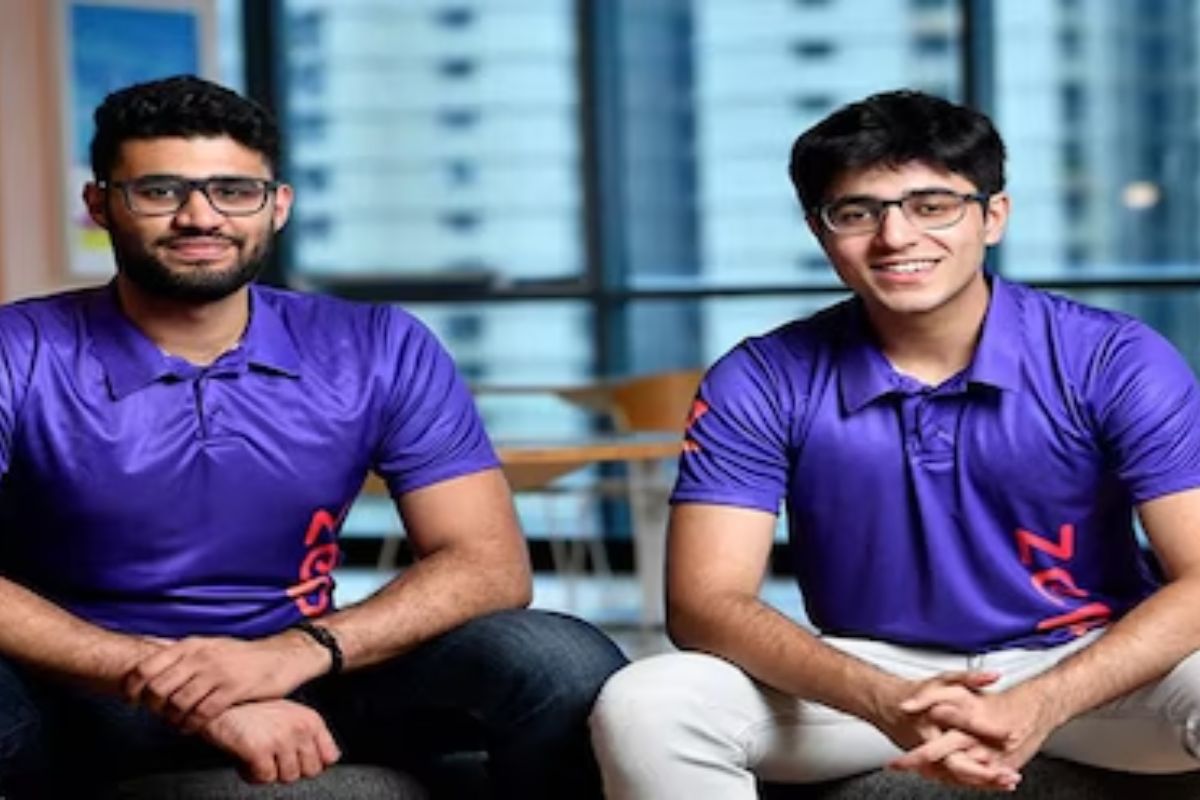
There is a particular kind of hubris that infects fast-growing startups. It sounds like this- “We are building something the world has never seen. The losses are temporary. The market is everything.” Zepto, the Bengaluru-based quick-commerce firm founded by two Stanford dropouts in 2021, has delivered that pitch with remarkable consistency, to venture capitalists, to regulators, to the public, and now, as it prepares for a public listing, to the stock markets.
The story, on the surface, is genuinely impressive. From zero to ₹22,623 crore in revenue in 5 fiscal years. Over 1,139 dark stores spread across India’s cities. A valuation that touched $7 billion before being quietly walked back by 15–20% to around $5.6–5.95 billion ahead of its IPO. Founders celebrated on magazine covers, in TED-style keynote addresses, in LinkedIn posts that their communications teams clearly agonise over.
But documents tell a different story. Zepto’s own updated Draft Red Herring Prospectus, filed with SEBI on June 9, 2026, does something unusual for a company going public on a wave of optimism: it openly acknowledges, in the dry language that regulators require, that it has incurred losses in every fiscal year since its inception in July 2021, and that it may continue to face negative cash flows. Behind this admission is a constellation of structural vulnerabilities that deserve more scrutiny than they have received. This article attempts to provide some.
Let us begin with the number that matters most and gets glossed over fastest: Zepto has never made a profit. Not once. Not even for a quarter.
The financial trajectory is worth tracing carefully. In FY23, Zepto posted losses of ₹1,272.4 crore on revenue of ₹2,025 crore. In FY24, revenue more than doubled to ₹4,454 crore, but losses barely moved — down marginally to ₹1,248.6 crore. Co-founder Aadit Palicha celebrated this on LinkedIn as proof that “PAT as a percentage of revenue improved significantly from -63% in FY23 to -28% in FY24.” He wasn’t wrong. But a 28% loss ratio is still a 28% loss ratio on a rapidly growing base.
Then came FY25 and FY26, and the absolute losses exploded. Net losses widened to ₹4,699.71 crore in FY25, and then widened further to ₹5,905.19 crore in FY26. Revenue doubled too, from ₹11,109.94 crore to ₹22,623.58 crore, but the company’s accumulated losses as of March 2024 already stood at ₹29,128 million, and this was before two of its worst years for absolute losses. Total expenses in FY26 hit ₹29,026.70 crore, with the purchase of traded goods alone consuming ₹18,199 crore.
The question the DRHP itself asks, and does not answer satisfactorily, is when and whether, this changes. Zepto has been burning ₹250–660 crore per month at its peak. Industry insiders pointed out that for the first time in four years, Zepto missed its own revenue targets in Q4 FY25, even after aggressively spending nearly half of its $1.3 billion fundraise from 2024. For a company asking the public to buy its shares, this is not a minor footnote. It is the central question.
Acquiring Customers Is Easy. Keeping Them Is Not.
Zepto’s marketing machine is impressive. Sensor Tower data from 2025 showed it generating over 250,000 daily downloads at its peak in January, a number fuelled by aggressive paid advertising, discount offers, and the viral energy of a product that genuinely is convenient.
The customer retention problem in quick commerce is structural, not a Zepto-specific failure. Internal industry data from Q1 2024 showed a monthly churn rate of 47.35% for the sector, meaning nearly half of customers who use a quick-commerce platform in a given month do not return the following month. The customer acquisition cost stands at approximately ₹1,240, while the customer lifetime value has hovered around ₹890. This means the average newly acquired customer costs more to win than they generate in value. That is not a business model. That is a subsidy programme.
The competitive dynamics compound this. Blinkit, backed by Zomato’s deep balance sheet, now commands roughly 46% of India’s quick-commerce market. Swiggy’s Instamart and BigBasket’s BBNow are in close pursuit. When three well-funded competitors are all running discount wars simultaneously, consumer loyalty is driven by price and promotional offers, not brand affinity. The moment a competitor offers a deeper discount, the customer switches, as a 2024 LocalCircles poll that showed 62% of churned Blinkit customers switching to Zepto illustrates. The same dynamic cuts in both directions.
Blinkit now enjoys a weekly active user lead over Zepto of approximately 8.2 million users, up from fewer than one million just eight months ago. It seems like Zepto’s paid-ad-driven customer acquisition engine has been essentially turned off. How the company rebuilds and sustains its user base without the marketing spend that created it in the first place is a question the DRHP does not convincingly answer.
The Delivery Partner Time Bomb
If the customer side of Zepto’s equation is fragile, the labour side may be more so. Quick commerce’s founding promise, delivery in 10 minutes, has always depended on delivery partners who ride fast, accept low per-order pay, and bear their own operating costs including fuel and mobile data. The model was financially viable for companies while it was morally invisible. In 2025 and 2026, it became politically and operationally impossible to ignore.
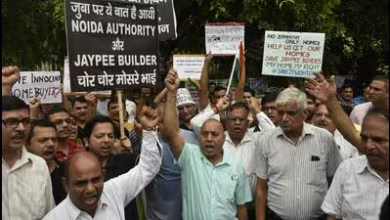
In May 2025, the Telangana Gig and Platform Workers’ Union (TGPWU) filed a formal complaint with the state’s Department of Labour, accusing Zepto of paying delivery workers as little as ₹10–₹15 per order, imposing 10–15 minute delivery deadlines that force unsafe speeds, providing no restrooms or clean drinking water at dark stores, and offering no ESI, PF, health insurance, or accident coverage. Workers staged a four-day strike in Hyderabad at multiple store locations; Zepto management declined to engage.
Around the same period, a Delhi-based workers’ union filed a separate complaint. MediaNama reported that Zepto’s “Rural Migration Program” had been recruiting workers from Tier 2 and Tier 3 cities with allegedly misleading salary claims, only for the workers to find conditions at dark stores far below what was advertised. A Reddit group focused on Zepto complaints crossed 5,000 members in 20 days in May 2025, with complaints spanning overcharging, poor customer support, and a description of “toxic work culture.”
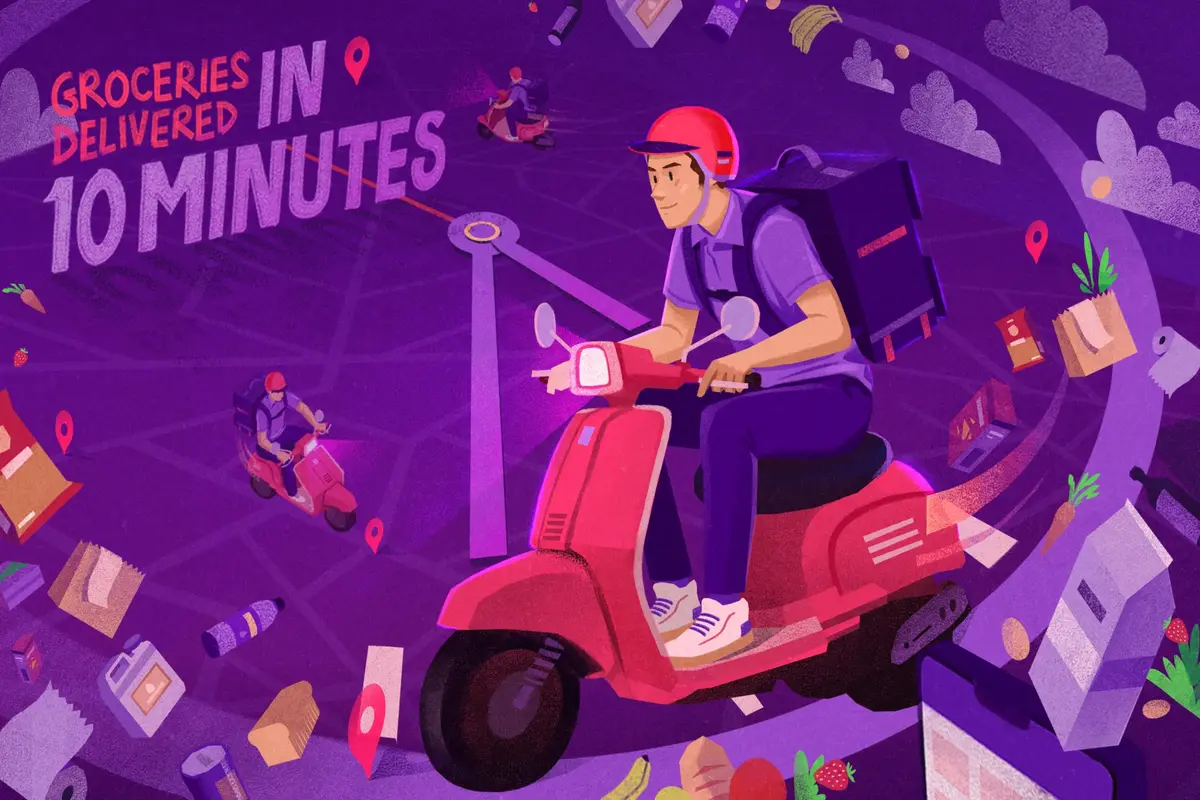
The situation escalated to Parliament. AAP Rajya Sabha MP Raghav Chadha repeatedly raised gig worker conditions on the floor of the House. In January 2026, after meetings between the Labour Ministry and major platforms, Blinkit and Zepto agreed to pause their “10-minute delivery” branding — a concession that, while framed as voluntary, was effectively government-mandated. Delivery workers had staged strikes on New Year’s Eve 2024, and the federation of app-based workers alleged that companies responded to the Christmas Day strike with threats to deactivate workers’ accounts — a power dynamic that, if sustained, is both ethically untenable and regulatorily unsustainable.
The operating implication is direct: if workers organise effectively, win minimum wage protections or employee status reclassifications, and secure social security contributions, Zepto’s per-delivery economics, which is already marginal would become deeply loss-making at the unit level. The model, as currently constructed, prices in worker precarity. Any correction to that precarity reprices the entire business.
Dark Stores Are Bright in Theory, Complicated in Practice
The dark store is to quick commerce what the branch was to banking, which means they are the irreducible physical infrastructure without which the promise cannot be kept. Zepto has 1,139 of them as of March 2026, up from 337 in FY24. This rapid expansion is both the company’s greatest operational achievement and one of its most significant ongoing risks.
A dark store requires approximately ₹50 lakh in gross merchandise value (GMV) per month with 800–1,000 SKUs just to break even at the store level. In high-density metro areas with reliable demand, the best-performing stores generate EBITDA margins of 4–6%. But 90% of dark stores are concentrated in 10–12 metro and Tier-1 cities. The economics of the model depend on a very specific geography: high apartment density, disposable income, digital payment penetration, and cultural willingness to pay for convenience.
The evidence of the structural limits of this model in smaller cities arrived in vivid form in May 2025. Zepto suspended operations at 44 of its cafes across five Tier-2 cities like Amritsar, Chandigarh, Meerut, Mohali, and Agra citing supply chain issues. Smaller cities can offer lower rents and reduced competition, but they also generate smaller average orders, higher operational costs per delivery (because delivery distances are longer), and demand patterns that are fundamentally different from the dense urban core that quick commerce is designed for.
A Bernstein report from April 2026 was characteristically blunt: “Tier-1 to Tier-3 potential is still unproven.” While smaller cities offer headroom, the report noted “structural challenges including lower population density, awareness, and spending power.” As of the same period, Blinkit served 172 cities and Instamart operated in over 100. Zepto was present in approximately 73, a notably more conservative geographic footprint, reflecting the gap between ambitious expansion announcements and the operational reality of making dark stores work outside megacities.
The reality of getting a dark store location approved, fitted, stocked, staffed, and optimised is also operationally expensive and time-consuming. Real estate negotiations in Indian cities are complicated, particularly for units that require specific cold storage infrastructure, loading docks, and proximity to dense residential zones. CEO Aadit Palicha has acknowledged that Zepto analyses “dozens of factors like road patterns, traffic density, geographic centricity, weather patterns, real estate prices, and size and proximity of residential societies” before each store launch. That is not a fast process. It is not a cheap one either.
What Happens When the Cold Chain Breaks?
Speed is Zepto’s brand. But speed, applied to perishable products, is only valuable if what arrives at the customer’s door is fresh, safe, and correctly stored. The events of 2025 raised serious questions about whether Zepto’s operational tempo was creating conditions incompatible with food safety.
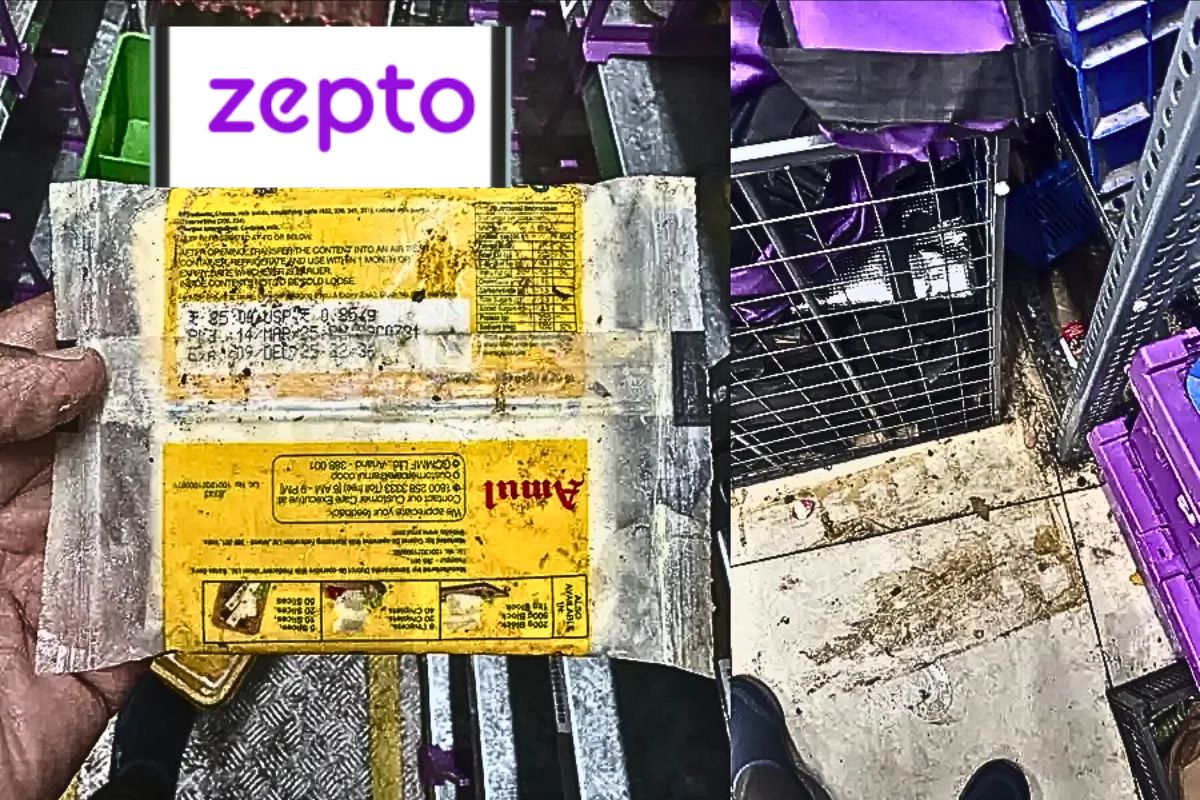
In late May 2025, Maharashtra’s Food and Drug Administration conducted a surprise inspection of Zepto’s Mumbai dark store in Dharavi, and found what official reports described as “fungal growth on food items, expired products, and unhygienic storage conditions.” The FDA suspended Zepto’s food business license. Inspectors found food crates placed next to stagnant sewage and standing water, with perishables lying on wet, dirty floors, and fresh groceries mixed with spoiled stock including expired eggs, dairy, and vegetables. One FDA assistant commissioner warned the facility would remain sealed until Zepto cleared all violations.
Zepto appealed, submitted a compliance report and photographic evidence of corrective action, and had the suspension revoked in June 2025, a relatively rapid resolution. But the episode was not isolated.
A former Zepto employee’s post on Reddit went viral in the same period, alleging: “I worked at Zepto for three years, and I can’t stay silent anymore.” The post described monsoon flooding at a Pune facility, with workers packing groceries while ankle-deep in gutter water, without shoes, for 9-hour shifts. “Fruits came in damaged. Vegetables were rotting. Products well past their expiry dates were allegedly packed and sent out, business as usual.” In one instance, the worker alleged a customer ordered Greek yoghurt, three expired units remained in stock, and the store in-charge instructed staff to dispatch them regardless.
The industry context matters here. In mid-2024, a Blinkit warehouse in Telangana was found storing expired and suspected-infested food, with authorities flagging the absence of trained food safety staff and poor handling practices. These are not freak incidents at outlier operators. They are recurring warnings about what happens when the logic of speed — pack it fast, dispatch it now — overrides the logic of food safety. At Zepto’s scale, with 1,139 stores managed by thousands of store-level personnel under pressure to meet delivery time targets, the systemic risk is significant.
The Subsidiaries Are Bleeding Too
One financial dimension of Zepto’s risk profile that receives less scrutiny than it deserves is the condition of its corporate structure. Zepto is not a single entity. It operates through a web of subsidiaries, and those subsidiaries are loss-making alongside the parent.
The DRHP confirms that Zepto’s subsidiary, Zepto Marketplace Private Limited, is being earmarked for investment specifically for marketing and business promotion expenses, meaning capital raised in the IPO will be directed not toward achieving profitability of the main entity, but toward funding further promotional spending across subsidiary operations. This is the financial architecture of a company that is not yet managing existing entities to profitability, but expanding the surface area of its spending.
The accumulated losses across the group, ₹29,128 million as of March 2024, before the FY25 and FY26 loss expansions reflect a company that has never generated enough cash from operations to fund itself. Every rupee of dark store construction, every rupee of technology investment, every rupee of marketing spend has been funded by external capital. The business is, in the most precise technical sense, entirely dependent on the continuation of investor confidence.
The Funding Flywheel — and What Happens When It Stops
Since its founding in 2021, Zepto has raised approximately $1.8 billion from investors including SoftBank, Google, Bain Capital, Lightspeed, General Catalyst, and most recently CalPERS — the California Public Employees’ Retirement System, which led a $450 million Series H round in October 2025 at a $7 billion valuation. The company has treated fundraising not as a necessity of last resort but as a strategic engine, raising in three separate rounds in 2024 alone and watching its valuation triple from $1.4 billion to $5 billion in a single year.
The IPO, if it succeeds, would raise approximately ₹10,000 crore (around $1.2 billion) from the public market, with ₹8,010 crore as a fresh issue. The stated use of proceeds includes investment in dark store infrastructure, technology, acquisitions, and funding the operations of subsidiaries. Notice the word “acquisitions.” Zepto has explicitly signalled inorganic growth as part of its strategy. The company intends to pursue acquisitions for which it will need further capital, meaning the IPO is not the end of the funding story but one chapter in a sequence that has no internally-funded conclusion on the visible horizon.
This is the fundamental question that any serious investor must ask: at what point does Zepto’s growth become self-sustaining? The company’s revenues are growing rapidly, 103% in FY26 alone. But costs are growing faster. Total expenses rose from ₹1,62,410.69 million in FY25 to ₹2,90,267.46 million in FY26. Every revenue milestone generates a new expense requirement. The company has cut its cash burn by approximately 75% from peak levels, which is genuine operational progress. But the path from “burning less” to “generating cash” is not a straight line, and Zepto has not demonstrated a credible timeline for completing it.
What the IPO essentially does is transfer the risk from venture capitalists, who entered early, at lower valuations, with a tolerance for long timelines to public market investors, who are being asked to price in a future profitability that has so far remained perpetually in the next fiscal year.
A Business Built for Megacities, Selling to Everyone
The final structural vulnerability is perhaps the most fundamental. Quick commerce as a business model is a product of very specific urban conditions: apartment buildings housing thousands of households within 1.5 kilometres of a dark store; consumers with smartphones, digital payment infrastructure, and disposable income; an informal economy with a surplus of two-wheeler delivery workers available at low per-order rates; and a cultural context where the time cost of visiting a physical store is high enough that paying a convenience premium makes sense.
These conditions exist in Mumbai, Delhi-NCR, Bengaluru, Hyderabad, and Pune. They exist partially in Chennai, Kolkata, Ahmedabad, and a handful of large Tier-1 cities. They do not exist in Meerut, Amritsar, or Agra, where Zepto’s cafes were shuttered, and they exist in even more attenuated form in the smaller Tier-2 and Tier-3 cities that represent the only plausible future growth frontier.
The Bernstein report’s observation that dark-store consolidation may be necessary to improve profitability in metro markets, even before expansion into smaller cities, is a sign of structural stress in the model’s core geography. If the economics are not yet consistently sound in the dense urban markets that quick commerce was designed for, the expansion into markets that are structurally more challenging is not a growth story. It is a gamble.
The quick-commerce industry in India now serves roughly 230 million people across about 2,600 pincodes, approximately 17% of the country’s population. The other 83%, living in smaller cities, semi-urban areas, and rural India represents a market that looks attractive on a slide deck and problematic in operation. Lower order values, longer delivery radii, insufficient population density to justify a dark store’s fixed costs, and supply chains that are not equipped to handle perishables at the required speed: these are not temporary limitations to be engineered away. They are structural features of most of India.
The Honest Reckoning
None of this is to say that Zepto is a fraud, or that its technology does not work, or that its founders are not genuinely talented. They are, and it does, and they are. The company has built something real and in the markets where it operates well- genuinely useful. It has also created employment for over 180,000 delivery partners and 40,000 store and warehouse staff, which is a meaningful social contribution.
But the distance between “building something real” and “building a sustainable business” is where India’s quick-commerce story currently lives. Zepto’s DRHP itself flags the risks with unusual candour: losses since inception, continued negative cash flows, difficulty retaining delivery partners, challenges in perishable food quality, competition for customers, and the structural limits of expansion beyond dense urban markets. These are not footnotes. They are the central structural questions of the entire category.
For a company preparing to ask ordinary Indian investors for their savings, the burden of evidence for a credible path to profitability is high. That burden has not yet been met, not by the revenue numbers, not by the loss trajectory, and not by the operational record of the past two years. The speed of Zepto’s growth is real. Whether it outpaces the speed of its spending is, after five years, still an open question. And open questions, in public markets, have a way of closing abruptly.