“Do Kaudi Ke Teachers” Said Anjana, Then Filed A ₹2 Crore Case On Khan Sir When He Took A Defense!
When India's Mainstream Media Turned Its Guns on a Teacher of the Poor, Because Free Education Is Apparently a ₹2 Crore Offence in India!

When the powerful cannot bear to be questioned by the powerless, they do not argue; rather they litigate.
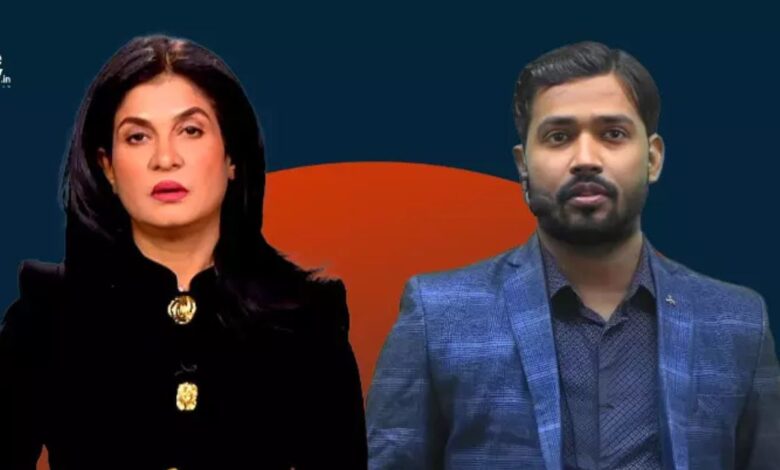
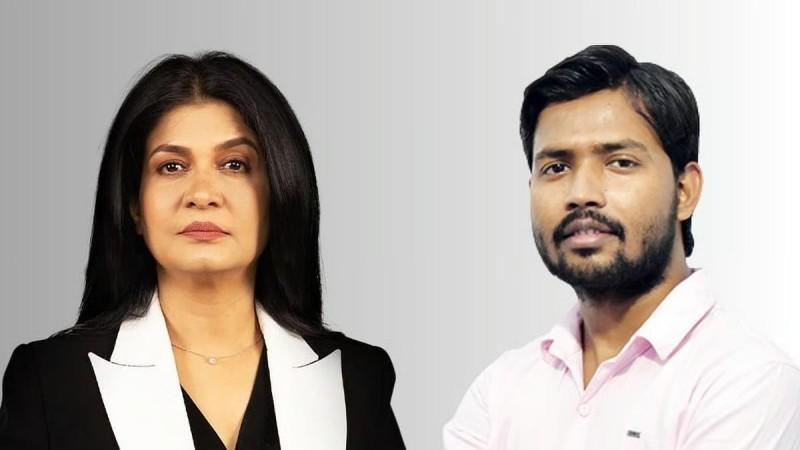
On June 2026, Aaj Tak’s Managing Editor and prime-time anchor Anjana Om Kashyap, along with TV Today Network, walked into the Delhi High Court and filed a ₹2 crore civil defamation suit against Faisal Khan, better known across India simply as Khan Sir, a Patna-based educator who has spent his life giving free and affordable education to students who cannot afford Kota. The matter was listed before the vacation bench of Justice Neena Bansal Krishna. Also named in the suit were educators Abhinay Sharma of Abhinay Maths, Babita Tyagi, Arvind Bhadauriya, and 4PM News Network, among others.
The suit, formally titled Anjana Om Kashyap & Anr v. Faisal Khan & Ors, alleges that Khan Sir made “scandalous, false, and grossly defamatory” statements against Kashyap after her on-air remarks about YouTube educators. According to the petition, Khan Sir had allegedly used expressions such as “bikau patrakar” (sold-out journalist), “chatukar,” “dalali,” and “fake news ki dukaan” while referring to Kashyap- remarks he made in direct response to her calling him and his peers worthless.
Let that sit for a moment. A journalist who publicly called teachers “do kaudi ke”, which means, not worth two coins, has filed a defamation suit because the teachers publicly questioned her credibility in return. She threw the first stone, on national television, with the full power of a prime-time platform behind her. They threw one back, from YouTube. And she went to court. This is not merely a celebrity spat. This is a document, filed in a court of law, that tells you the precise state of India’s free press, India’s education system, and India’s democracy, all at once.
The Fight That Started It: What Anjana Actually Said
The controversy began on May 29, 2026, when Kashyap hosted a live debate on Aaj Tak concerning NEET examination malpractices and the growing influence of online coaching platforms. In a moment that would ignite the internet for days, she turned her fire on YouTube educators; teachers like Khan Sir, who have built massive audiences by making competitive exam preparation accessible to students who cannot afford the ₹1.5 lakh annual fees of Kota coaching institutes.
According to multiple media reports, Kashyap described YouTube star teachers as “explainers” who run their platforms like a business. She said many of them draw things on blackboards not to educate but to “grab views, do drama, and make money from students.” She called them “do kaudi ke”- an expression meaning not worth two coins- and said they had no knowledge but had started to believe they were important people who could speak on any subject. In a phrase that went viral, she reportedly dismissed them as frauds and online consultants focused only on garnering views.
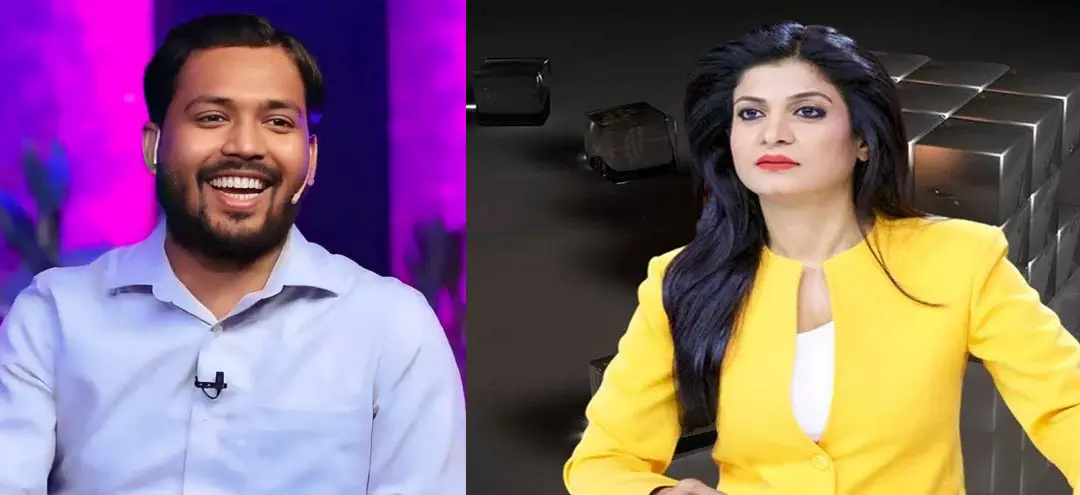
The backlash was immediate and overwhelming. Khan Sir, who teaches millions of students through his YouTube channel Khan Global Studies, many of whom are first-generation learners from small towns and villages responded sharply. So did several other educators, including Abhinay Sharma and Suman Mam of Ocean Gurukul, who pointed out that she runs free marathon classes for students who cannot afford coaching institutes and asked why a news anchor sitting in an air-conditioned studio was calling teachers frauds instead of addressing actual paper leaks and student unemployment. When Khan Sir responded with phrases that Kashyap found offensive, she moved court. This is the sequence of events. Not as a rumour.
Defamation as a Silencing Tool: A Pattern India Must Confront
The Anjana-Khan Sir case does not exist in a vacuum. It is one more entry in a growing catalogue of defamation suits deployed not to seek justice, but to silence criticism through the machinery of litigation. The cost of fighting a case- legal fees, court appearances, time, anxiety- is itself the punishment, regardless of whether the plaintiff ever wins.
Consider the pattern. In recent years, defamation suits and legal notices have been used against: journalist Paranjoy Guha Thakurta for investigative reporting on corporate interests; independent journalists Abhisar Sharma and Raju Parulekar over reporting on Adani’s Assam land deals; The Wire, Newslaundry, and journalist Ravish Kumar, who received content removal notices through a Delhi court’s provisional order following cases filed by Adani Enterprises Limited in September 2025.
Activist Medha Patkar, convicted in 2024 in a defamation case filed by Delhi’s Lt. Governor- a case that had dragged on for 23 years; comedian Kunal Kamra for a joke about Maharashtra Deputy CM Eknath Shinde; journalist Abhisar Sharma again, this time in a criminal defamation case filed in Gandhinagar; politicians Rahul Gandhi and multiple opposition leaders; independent news outlet Bhadas4Media; and journalists associated with Newslaundry and The Wire for coverage that powerful entities found inconvenient.
The Supreme Court itself, while examining a plea by the Foundation for Independent Journalism, observed that “time has come to decriminalise all this” — an implicit acknowledgment that India’s defamation laws are being weaponised. India retains criminal defamation under Section 356 of the Bharatiya Nyaya Sanhita, making it one of the few democracies where speaking your mind about a powerful person can land you in jail. The Global Investigative Journalism Network has documented how legal notices in India are often deployed as Strategic Lawsuits Against Public Participation (SLAPPs), not to win in court, but to bury the critic under legal expenses.
When a prime-time journalist files a ₹2 crore defamation suit against a teacher who runs affordable coaching classes, the question that every honest Indian must ask is: who has more resources to fight a legal battle here? And who is this suit really meant to silence?
The Fourth Pillar Is Not Cracked — It Has Collapsed
To understand how alarming the Anjana-Khan Sir case is, you must first understand what India’s mainstream media has become, and what it has chosen to stop being. The fourth pillar of democracy is meant to hold the other three accountable. In India today, that pillar does not merely lean. In significant parts, it has been hollowed out from within. The evidence is not editorial opinion. It is data.
In the 2026 World Press Freedom Index released by Reporters Without Borders, India is ranked 157th out of 180 countries — a six-place drop from 151st in 2025, which was itself up marginally from 159th in 2024 and 161st in 2023. For the first time in the history of the Index, over half of the world’s countries now fall into the “difficult” or “very serious” categories for press freedom. India remains firmly in the “very serious” category.
India’s overall press freedom score decreased from 40.34 in 2014 to 31.28 in 2024 — a sustained, decade-long deterioration. With an average of three or four journalists killed in connection with their work every year, India is one of the world’s most dangerous countries for the media.
The RSF notes: “With a rise in violence against journalists, highly concentrated media ownership, and outlets with increasingly overt political alignment, press freedom is in crisis in ‘the world’s largest democracy.'”
Now ask yourself what India’s most-watched prime-time anchors have been doing while all of this unfolds.
They were not covering Manipur. For months, as violence tore through the northeast Indian state of Manipur, ethnic violence that displaced tens of thousands of people, burned homes, and claimed lives, large swaths of India’s Hindi-belt television news barely acknowledged what was happening. A state was burning. Prime time was discussing something else. It required citizens to share videos on social media before any meaningful national conversation began, and even then, coverage was asymmetric, belated, and politically cautious.
They largely failed on NEET. The National Eligibility cum Entrance Test paper leak scandal, which directly impacted hundreds of thousands of students and their families, shook the credibility of India’s entire competitive examination system, and sparked nationwide student protests — received fragmented and inconsistent coverage from mainstream media. The same anchors who devote prime-time hours to shouting matches about political parties gave only peripheral attention to the systemic institutional failure that had stolen years of preparation from a generation of students.
CBSE mark sheet irregularities, SSC exam controversies, issues that touch the daily lives of crores of Indian families — drift in and out of the news cycle without the sustained investigative attention they deserve.
In 2020, the Supreme Court had to intervene to restrain the telecast of the “UPSC Jihad” programme, marking an early acknowledgment that certain forms of hate speech — especially when amplified through mass media — implicate constitutional values. The fact that India’s highest court has repeatedly had to step in to address the communal content of news broadcasts — content designed to inflame, divide, and distract — tells you everything about where the editorial compass of a section of Indian television has settled.
India’s mainstream media has largely chosen ratings over reality, spectacle over substance, and communal heat over institutional accountability. That is not an accusation without evidence. That is a description of a decade’s worth of documented choices.
The Jhal Muri Problem: What Gets Covered and What Does Not
Here is a specific and telling detail about Anjana Om Kashyap’s sense of journalistic priority. Aaj Tak has, on multiple occasions, run nostalgic and cultural segments on foods like jhal muri, the beloved Bengali snack. The channel has a well-documented record of humanising and celebrating India’s food culture through emotional storytelling. The flavour, the history, the emotion. Good television, no doubt.
But consider what that same journalistic attention and emotional investment could do if directed at a story that actually threatens Indian lives: the catastrophic failure of FSSAI, India’s Food Safety and Standards Authority, as a functional food regulator.
According to FSSAI’s own admission, nearly 20% of food samples tested in India during 2024-25, including popular chocolate brands, failed to meet required safety standards. State-wise data for 2024 reveals that Uttar Pradesh alone reported 52.8% of food samples failing safety standards, followed by Rajasthan at 28.4%, Maharashtra at 18.7%, Tamil Nadu at 14%, and Madhya Pradesh at 13%.
In Andhra Pradesh in March 2026, 12 people died out of 20 who suffered renal failure after consuming milk contaminated with Ethylene Glycol, a toxic chemical used in coolant. In February of the same year, a factory in Gujarat was discovered to have been making synthetic milk from urea and detergent and had been profitably running the enterprise for five years.
A 2023 CAG report showed that a third of all food samples tested in India failed safety standards. Despite this widespread failure, punitive action was taken against a mere 15% of the violators. An RTI request uncovered that between 2018 and 2022, the FSSAI issued millions of licenses but revoked only 1,225, meaning 99.965% of all licensed businesses, even those caught violating standards, faced no permanent consequence.
People are dying eating adulterated food. Twelve people died in Andhra Pradesh from contaminated milk. Synthetic milk made from urea was sold for five years in Gujarat before anyone caught it. One in five food samples across India is substandard or unsafe. This is the story of the Indian common person’s kitchen table. It is a story about systemic regulatory failure that affects every single household regardless of income, caste, or religion.
And yet, jhal muri has an emotional segment. FSSAI’s collapse as a regulator does not receive the sustained prime-time treatment it deserves. The choice of what to cover and what to ignore is itself a form of editorial statement. It tells you who a news channel believes its journalism is for.
The Silence About Mukesh Chandrakar: The Wound That Does Not Heal
On the night of January 1, 2025, freelance journalist Mukesh Chandrakar went to a dinner at the property of a contractor in Bijapur, Chhattisgarh. He never came back. His lifeless body was discovered from a septic tank on January 3. He was 33 years old. He had recently exposed a ₹120-crore corruption in a road construction project linked to contractor Suresh Chandrakar.
The postmortem revealed that Mukesh had been brutally killed, suffering five broken ribs, 15 fractures to the head, a broken neck, and having his heart ripped out. He was attacked with an iron rod, his body placed in a septic tank, and the tank sealed. Mukesh worked as a freelance journalist for NDTV and owned a YouTube channel called Bastar Junction, which covered local news from the region. He had once played a key role in securing the release of abducted policemen and villagers held by Maoists.
This was a journalist killed for doing journalism. A journalist who, ironically, like Khan Sir, worked through a YouTube channel because that was the medium through which he could reach his audience and do his work honestly. Now ask this: where was the sustained prime-time outrage from Anjana Om Kashyap, a fellow journalist, a managing editor of a major national news network, about the murder of Mukesh Chandrakar?
The Free Speech Collective documented nine murders and 33 attacks on journalists in India in 2025 alone. Nine journalists murdered. Thirty-three attacked. These are not statistics from a war zone. These are journalists killed for doing their jobs in India — in Bastar, in Uttar Pradesh, in states across the country. Where is the prime-time outrage? Where are the hour-long debates about the journalist safety crisis in India? Where are the demands for a comprehensive journalist protection law?
The same platform that found enough energy to call YouTube teachers “do kaudi ke” and to file a ₹2 crore defamation suit against one of them has not, to public record’s knowledge, devoted that same energy and that same institutional backing to the cause of dead and endangered journalists across India. Anjana Om Kashyap is a journalist. Mukesh Chandrakar was a journalist. He was killed. That is, or should be, her cause before anyone else’s. The silence — or the inadequacy of the response — is not merely uncomfortable. It is a moral failure.
The Mirror Problem: What She Said Before She Sued
There is a particular kind of irony that almost defies description in this case. Before filing a ₹2 crore defamation suit over words she found offensive about her journalism, Anjana Om Kashyap went on national television and called India’s YouTube teachers “do kaudi ke” — not worth two coins. She said they “know nothing.” She said they draw on blackboards to “grab views, do drama, and make money from students.” She called them frauds. She dismissed them as “explainers.”
Khan Sir responded. He called her, in his response, a “bikau patrakar” and accused her of working for money — language that his supporters argue is far less specific and personal than calling educators worthless on national television. She went to court. He had not gone to court. He had responded publicly, on social media, to a public attack made against his community on a public broadcast.
The legal and ethical question embedded in this sequence is straightforward: if public figures can be publicly criticised, and they must be, in a democracy, then the criticism Khan Sir offered in return for being called worthless is well within the bounds of public discourse. The Supreme Court itself has repeatedly affirmed that harsh words about public figures, particularly those concerning their professional conduct, occupy protected speech territory.
But there is a deeper point beyond the legal one. The words Anjana Om Kashyap used to describe YouTube teachers were not careful, measured media criticism. They were contemptuous dismissals of an entire community of educators who have, through their work, changed the lives of millions of Indian students. Khan Sir’s channel alone has tens of millions of subscribers, many of them young people from small towns who cannot afford traditional coaching. Suman Mam runs free marathon classes on YouTube. Abhinay Sharma has helped lakhs of students crack SSC and banking exams.
For many creator-educators, the backlash reflected a larger shift in India’s information economy: authority is no longer monopolised by television studios. It is increasingly earned directly through audience trust, expertise, and consistency. She called them frauds. They answered. She sued. It is difficult to describe this sequence without arriving at the conclusion that the defamation suit is less about protecting reputation and more about protecting authority, the authority of a prime-time anchor to speak without being spoken back to.
India’s Press Freedom: A Sliding Number with Devastating Consequences
India ranked 157th out of 180 countries in the 2026 World Press Freedom Index — down from 151st in 2025, 159th in 2024, and 161st in 2023. India ranks worse than its neighbours Nepal (87th), Sri Lanka (134th), Bangladesh (152nd), Bhutan (150th), and Pakistan (153rd). India is ranked below Palestine — a territory under active military occupation — in press freedom. That is not a metaphor. That is the RSF’s 2026 ranking.
India’s press freedom score fell from 40.34 in 2014 to 31.28 in 2024 — a decade-long sustained collapse that corresponds almost precisely with the consolidation of media ownership and the concentration of political influence over editorial decisions. Freedom House classified India as a “partly free” country in recent assessments, and multiple analysts have used the term “electoral autocracy” to describe the structural shift in India’s political system — a system in which elections continue to occur but the institutional checks on power, including the press, have been significantly weakened.
In 2025, around 3,070 instances of internet shutdown, blocking of apps, and 785 blocking orders were issued by the IT Ministry to various online intermediaries. The Free Speech Collective recorded nine murders and 33 attacks on journalists in 2025 alone, with 14 of 19 instances of harassment and 12 of 17 threats recorded against journalists doing their professional work.
The Khan Sir case must be read against this backdrop. When a nationally prominent journalist and her network use the civil courts to go after a popular educator who criticised her on social media, they are not using a legal right in isolation. They are using it in a context where the legal system’s very weight — its cost, its complexity, its timeline — is itself a tool of intimidation. They are doing this in a country where journalists are being killed, where press freedom scores are at a historic low, and where the independent digital media and YouTube journalism that people like Khan Sir and Mukesh Chandrakar represent is one of the last remaining spaces for honest public discourse.
This is not just about one anchor versus one teacher. This is about which direction India’s information ecosystem is heading.
YouTube Is Doing Journalism’s Job. That Should Shame the Fourth Pillar.
Here is the uncomfortable truth that no TV anchor wants to face: for tens of millions of Indians, YouTube channels hosted by educators, independent journalists, and citizen reporters are now more credible, more informative, and more honest than anything on prime-time television.
The debate over YouTube educators surfaced recently after television anchor Anjana Om Kashyap criticised online educators, questioning their expertise and motivations. But the real story is that free classes have fundamentally altered the economics of India’s coaching industry. For decades, India’s coaching economy was built on scarcity. Students travelled to Kota, Delhi, Hyderabad, and Patna because access to top teachers was limited. The best faculty often remained attached to a handful of institutions. Families spent heavily not only on tuition fees but also on accommodation, food, and relocation costs.
YouTube educators broke that model. They democratised access to quality teaching. A student in a village in Bihar, whose family earns ₹10,000 a month, can now watch Khan Sir explain India’s constitutional history with the same clarity and depth as a student paying ₹1.5 lakh a year at a Kota institute. That is not trivial. That is transformative.
And on the journalism side: it was not Aaj Tak that broke the story of Mukesh Chandrakar’s murder and its link to contractor corruption. Mukesh himself, through his YouTube channel Bastar Junction, did the investigative work. It was citizen journalists and digital outlets that maintained sustained coverage of the Manipur crisis when television news was looking elsewhere. It was independent YouTube channels that tracked the NEET paper leak story when mainstream channels were slow to follow.
The criticism from television personalities has also come at a time when TV news itself faces growing scrutiny over credibility and ratings-driven content. In March 2026, the Ministry of Information and Broadcasting directed the Broadcast Audience Research Council (BARC) to suspend publication of TV news TRP ratings, citing concerns over “unwarranted sensationalism and speculation.”
The irony is almost too pointed: the government suspended TRP publication because TV news had become too sensational and too focused on ratings. And the same period saw a prime-time anchor calling YouTube educators — who built their audiences through actual teaching — “do kaudi ke” view-chasers. The audience has noticed. The flight from television news to YouTube and digital platforms is not a passing trend. It is a verdict on credibility, and the verdict is not going in mainstream media’s favour.
The Ending Note: The Crime of Educating the Poor
And now, in the spirit of the most time-honoured form of democratic commentary — satire — let us acknowledge the true nature of Khan Sir’s crime. He is, after all, guilty of an extraordinarily serious offence in the Indian context. He gave free education to poor students.
In a country where education is one of the most profitable and ruthlessly exploitative industries, where coaching institutes charge lakhs of rupees, where private school fees devour middle-class salaries, where the aspirations of an entire generation are monetised at every possible point, Khan Sir committed the unpardonable act of making quality education accessible without charging for it.
The Indian parent is a specific kind of animal in the economic ecosystem. Their anxiety about their child’s future is not a weakness — it is a rational response to a system that has told them, clearly and repeatedly, that education is the only ladder out of poverty, and that ladder has a toll booth on every rung. That anxiety is the raw material on which India’s coaching industry runs. It is worth thousands of crores of rupees annually.
Khan Sir disrupted that. He sat in front of a camera, explained the Indian Polity in language that a Class 10 student from a small town could understand, and posted it for free on YouTube. Millions watched. Thousands cracked competitive exams they would not have had access to prepare for otherwise. So naturally, the system has been uncomfortable with him for a while. And now a ₹2 crore defamation notice has arrived. Of course it has.
Because in India, it is perfectly acceptable to charge a Class 12 student’s family ₹5 lakh for exam preparation. It is perfectly acceptable for an edutech company to take crores of rupees from students and then collapse. But a man who teaches for free, who speaks in the language of his students, who openly criticises those he believes are failing those students — he is the one who ends up in court. The free teacher is the dangerous one. The one making money off the system is just doing business.
What India Loses If This Silence Succeeds
If the message of the Anjana-Khan Sir case lands the way it appears to be intended — if YouTube educators and independent voices learn that criticising a prime-time anchor results in a ₹2 crore lawsuit — then something irreplaceable will be lost.
The digital public square — messy, imperfect, occasionally wrong, but genuinely free — is one of the few spaces where ordinary Indians can hold powerful institutions and powerful people to account. Where a teacher can say that a journalist is wrong. Where a journalist can say that a politician is corrupt. Where a student can say that an exam was rigged.
Defamation suits, deployed strategically against critics who lack the institutional resources to fight back, will poison that space. They will not win every case. But they do not need to. The filing of the suit is the message. The cost of the suit is the punishment. The chill effect is the goal. India does not need a quieter public square. India needs a louder one — because the institutions that are supposed to speak loudly about power have, in too many cases, chosen to whisper, or to speak only when speaking is safe.
Conclusion: The Teacher, the Anchor, and the Mirror India Needs
India in 2026 is a country ranked 157th in press freedom, where journalists are killed for exposing contractor corruption, where one in five food samples is unsafe, where students lose years of preparation to exam paper leaks, and where the institutional media — which should be the loudest voice against all of this — is instead filing ₹2 crore defamation suits against teachers.
Khan Sir did not invent the criticism he levelled at Anjana Om Kashyap. He reflected back to her, and to the watching public, a question that millions of Indians have been asking for years: whose side is this journalism on? That question deserves an answer, not a lawyer.
India’s democracy will not be saved by anchor desks. It will be saved — if it is saved — by the teachers who give knowledge for free, the journalists who report from septic tanks in Bastar, the students who protest in the streets, and the citizens who refuse to accept that speaking truth to power is a ₹2 crore offence.
The most dangerous person in India today is apparently not a corrupt contractor, not an adulterated food supplier, not a hawala operator, not a banned betting platform. According to the logic of this defamation suit, the most dangerous person in India is a man with a YouTube channel and a blackboard, who teaches poor students and occasionally says something that a prime-time anchor does not like.
History will remember which side of this argument was right. And it will not be kind to those who chose the lawsuit over the lesson.