Madhya Pradesh’s Ghost Hospitals: The BIMARU State Where Healthcare Exists Only on Paper — While People Die in Reality

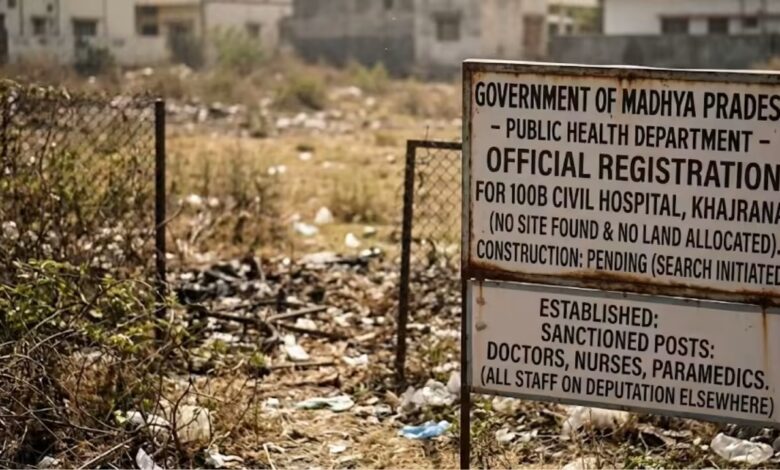
Indore, the so-called “cleanest city” and commercial capital of Madhya Pradesh, now boasts a world-class 100-bed civil hospital.
It has 87 sanctioned posts. Doctors, nurses, lab technicians and ward boys have been officially appointed and transferred. Salaries — reportedly running into crores over six years — have been regularly disbursed. The facility is marked “fully operational” in government portals. Transfer orders are still being issued as recently as June 2026.
There is only one small problem.
The hospital does not exist.
Not a single brick has been laid. No land has been physically handed over. The site is a dusty, overgrown empty plot with nothing but a faded hospital signboard standing like a cruel joke. This is not satire. This is the “Double Engine” government’s idea of healthcare delivery in 2026.
Welcome to BIMARU Madhya Pradesh — where “Bimar” doesn’t just mean sick. It means the state itself is terminally ill with corruption, callousness and contempt for its own people.
What Does BIMARU Actually Mean?
In the mid-1980s, eminent demographer Ashish Bose coined the term BIMARU while presenting a paper to then Prime Minister Rajiv Gandhi. It stands for Bihar, Madhya Pradesh, Rajasthan and Uttar Pradesh.
“Bimar” in Hindi means sick.
Bose used it because these states were demographically and developmentally “sick” — plagued by sky-high infant mortality, maternal deaths, uncontrolled population growth, abysmal literacy, crushing poverty and near-zero human development indicators. They were dragging down India’s national averages while the southern and western states surged ahead.
Decades later, apologists claim MP has “graduated” from BIMARU status because of some GDP growth numbers. Tell that to the mothers dying in Sidhi district. Tell that to the patients in Khajrana who still have no hospital. Tell that to the thousands waiting in crumbling Primary Health Centres across the state.
The label sticks because the disease — chronic governance failure — was never cured. It merely changed its symptoms.
The Indore Ghost Hospital: Corruption or Just Criminal Incompetence?
Approved on 23 June 2020 with much fanfare, the 100-bed Khajrana Civil Hospital was supposed to serve one of Indore’s fastest-growing and most densely populated areas.
Six years later:
- Zero construction.
- Zero beds.
- Zero patients treated here.
- 87 government employees drawing salaries while “posted” to a hospital that is literally an empty field.
Officials now sheepishly say the staff were “redeployed” to other hospitals. How convenient. The records still show them attached to a non-existent facility. Appointments continued. Transfers were issued. The portal proudly displayed it as operational.
This is not an “anomaly.” This is systemic rot.
When a government can create an entire fake hospital on paper, sanction posts, pay salaries for years, and keep the lie alive until exposed by the media and opposition, what else is fake? How many other “operational” facilities across MP exist only in files? How many crores have been siphoned under the garb of “health infrastructure”?
Social media is calling it a ₹3 crore salary scam. The government is calling it “land issues.” The people of Khajrana are calling it what it is — ** daylight robbery of public trust and public money**.
Why BIMARU States Bleed More Corruption Than the Rest of India
It is not a coincidence that BIMARU states consistently rank among the worst in governance, transparency and corruption perception.
Here’s why the rot runs deeper here than in Gujarat, Maharashtra, Tamil Nadu or Karnataka:
- Weak Institutions & Low Accountability Lower literacy and awareness in large pockets mean citizens are less likely to question, RTI or protest effectively. The political class thrives on this information asymmetry.
- Patronage Politics Over Development Politics Elections are won on caste arithmetic, freebies and muscle power rather than delivery of schools and hospitals. Why build real infrastructure when you can announce it, show it on paper, and move on to the next photo-op?
- Massive Leakage in Welfare Schemes Billions flow through centrally sponsored schemes (NHM, Ayushman Bharat, etc.). In BIMARU states, the last-mile delivery is weakest. Ghost beneficiaries, fake bills, substandard drugs, and “paper hospitals” are natural by-products.
- Land & Tender Mafia Culture Land acquisition is deliberately kept messy so that chosen contractors and middlemen can profit. The Indore case is the perfect example — land “issues” conveniently block real construction for six years while the patronage network around posts and salaries continues.
- Culture of Impunity When even a blatant ghost hospital survives for six years without anyone in the Health Department or Revenue Department raising red flags, it proves one thing: corruption here is not a deviation from the system. It is the system.
Compare this with southern states where civil society, media and an educated middle class act as watchdogs. In MP, the watchdog has been fed, tamed and turned into a pet.
The Human Cost: Real Deaths, Fake Hospitals
While the government plays file games in Indore, real tragedies unfold elsewhere.
In Sidhi district alone, 53 mothers died during or after childbirth between April 2025 and March 2026. The district hospital had just one anaesthetist. Delivery tables were non-functional. Staff strength was less than half of what was required.
This is not an isolated district horror story. Madhya Pradesh still posts some of the highest Infant Mortality Rates and Maternal Mortality Ratios in the country. Specialist doctors refuse to serve in rural areas because the system is broken. Equipment lies unused or broken. Drugs are either unavailable or of dubious quality.
Every “paper hospital” and every delayed project directly translates into preventable deaths — of newborns, of mothers, of poor patients who cannot afford private care.
The poor of MP are not just suffering from disease. They are suffering from a government that has mastered the art of looking busy while doing nothing.
The Ultimate Insult: “Double Engine” Sarkar Selling Dreams
The ruling dispensation loves to boast about the “Double Engine” government — Centre and State working in perfect sync for “Viksit Bharat.”
What the people of Madhya Pradesh got instead is a Double Engine of Deception:
- One engine announces grand projects and sanctions posts.
- The other engine ensures nothing actually gets built on the ground.
- Both engines ensure that files keep moving, salaries keep getting credited, and political credit keeps getting claimed.
This is not development. This is development on paper — the BIMARU way.
Time to Call a Spade a Spade
Madhya Pradesh does not need more photo-ops of foundation stones. It does not need more “sanctioned” posts for hospitals that will never be built. It needs accountability — real, brutal, public accountability.
It needs independent audits that go beyond files and actually visit sites with cameras. It needs a system where showing a hospital as “operational” without physical verification is treated as fraud, not routine administration. It needs political leaders who are more afraid of dead mothers in Sidhi than of losing the next election.
Until then, BIMARU will remain painfully relevant.
Because the state is still Bimar. In Madhya Pradesh, healthcare is often just another Another Racket Under the sun.
The ghost hospital of Indore is not an exception.
It is the perfect symbol of a government that has turned the entire state into one giant paper reality — while the real people of Madhya Pradesh continue to suffer in the harsh, brick-less truth.
The sick state needs a cure. But first, it needs leaders who stop treating governance as a file game and start treating it as a matter of life and death.
Because right now, in BIMARU Madhya Pradesh, the only thing growing faster than the population is the graveyard of broken promises.