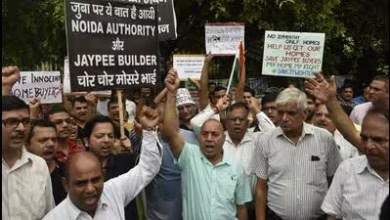
How India’s Demonetisation Became One Of History’s Most Spectacular Policy Failures?

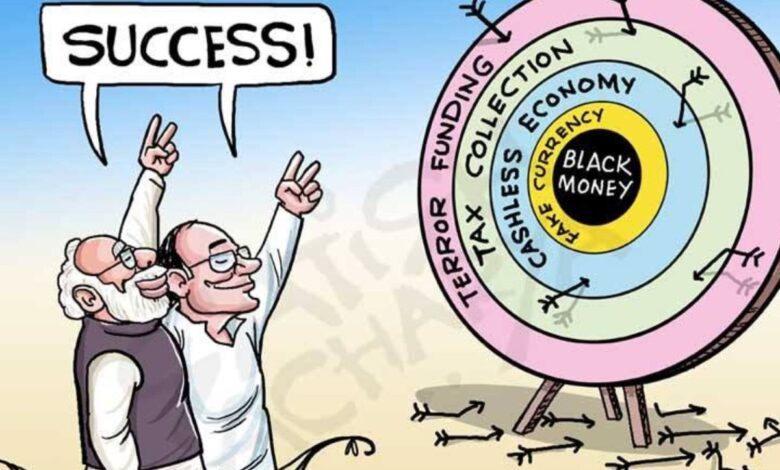
On the night of November 8, 2016, Prime Minister Narendra Modi appeared on national television and, with minimal warning, announced that India’s two highest-value currency notes, the ₹500 and ₹1,000 bills, were, effective midnight, worthless. The move invalidated 86% of the cash in circulation in a single stroke. It was dramatic, cinematic, and presented to the nation as an act of surgical precision against the dark arteries of the Indian economy: black money, corruption, and terror financing. The people would suffer briefly, Modi suggested, so that India could be purified.
Two years later, India’s own central bank delivered the verdict. It was damning. The Reserve Bank of India’s annual report, released in August 2018, confirmed what critics had been insisting from the beginning: 99.3% of the demonetised currency, notes worth ₹15.31 lakh crore out of ₹15.41 lakh crore invalidated, had been returned to the banking system.
In dollar terms, $216.7 billion came back. The government had confidently predicted that at least ₹3-5 lakh crore would not return, representing black money so dirty its owners would rather let it burn than declare it. Instead, only ₹10,720 crore stayed outside the system, roughly 0.7% of the total. Pronab Sen, former chief statistician of India, put it plainly to Al Jazeera: “Most of the stated objectives have been demolished.” This was not merely a policy that underperformed. It was a policy that disproved its own foundational premise.
The Premise Was Wrong From the Start
The government’s core theory rested on a misunderstanding, or a misrepresentation, of how black money actually works. The assumption was that India’s unaccounted wealth sat in physical cash, stashed in mattresses and steel trunks, waiting to be vaporised by a clever overnight ban. If you couldn’t return the cash without revealing yourself to the tax authorities, you’d lose it. The RBI would pocket the windfall, passing it to the government as a quasi-dividend. Estimates of this bonanza ran as high as ₹3 lakh crore.
The reality, as any economist not blinded by political expediency could have told you, is that serious black money is rarely held in cash for long. It moves through real estate, gold, foreign accounts, shell companies, and benami property. The ₹500 and ₹1,000 notes that ordinary Indians kept at home, in savings jars, in envelopes for weddings and medical emergencies, tucked into agricultural households that had never used a bank, were the cash that was most vulnerable to this policy. The genuinely wealthy, with access to accountants, lawyers, and networks of financial creativity, found ways to clean or park their money long before the deadline closed.
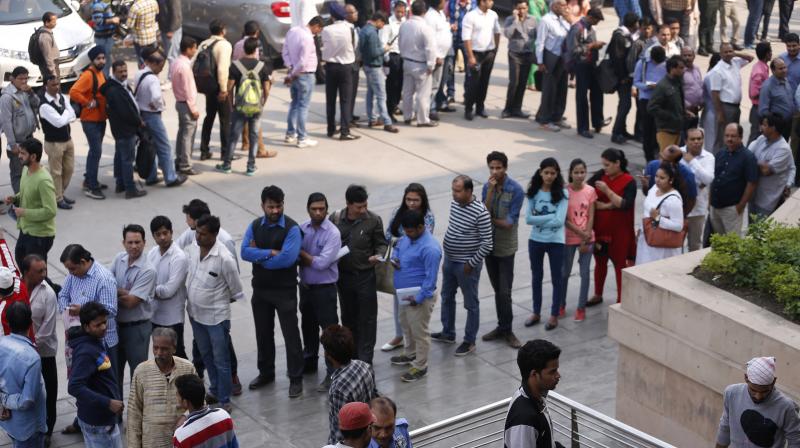
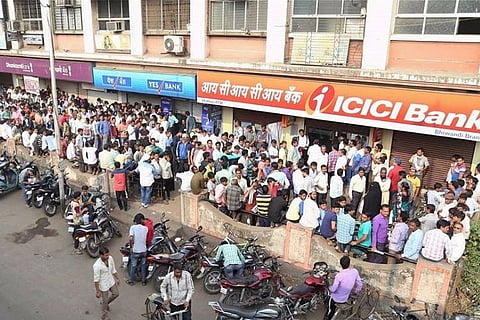
The queues outside banks and ATMs weren’t lines of black money hoarders in a panic. They were migrant workers, daily wage earners, farmers, and pensioners — people for whom cash was not a vehicle of corruption but the fundamental instrument of daily survival.
The Human Cost Was Real and Heavy
What the dry percentage figures in the RBI report cannot convey is what the months between November 2016 and early 2017 actually looked like on the ground. The informal economy, which accounts for roughly 85% of India’s employment, runs almost entirely on cash. When 86% of currency vanished overnight, it didn’t just inconvenience people. It paralysed supply chains, shuttered small businesses, and left daily wage workers without income and without any mechanism to claim it back.
Agriculture was particularly devastated. Farmers couldn’t pay for seeds or fertilisers; procurement channels and mandis slowed to a crawl during a critical harvest season. Migrant labourers streamed back to their villages because contractors couldn’t pay them.
In November and December 2016, a Harvard-led NBER study found that employment, economic output, and bank credit each declined by 2 percentage points in the quarter of demonetisation alone, which was an impact comparable, the researchers noted, to a 200 basis point tightening of interest rates. More than 100 deaths were linked to the chaos: people who collapsed from exhaustion standing in bank queues, patients denied treatment because hospitals wouldn’t accept old notes, and suicides by those who lost their businesses and livelihoods. These were not unfortunate side effects of an otherwise successful operation. They were the entire cost of a policy that delivered essentially nothing in return.
The GDP Damage
India’s macroeconomic data in the aftermath tells a story that government spokespeople worked hard to muddy. GDP growth slipped from 8% in 2015-16 to 7.1% in 2016-17 and further to 6.7% in 2017-18. The government’s own Economic Survey for 2016-17 acknowledged that demonetisation constituted “an aggregate demand shock, an aggregate supply shock, an uncertainty shock, and a liquidity shock” simultaneously — an almost comically unflattering self-description. The World Bank estimated a growth decline of up to 1 percentage point attributable to demonetisation. The RBI’s own cost of printing replacement currency doubled in a single year, jumping from ₹3,421 crore in 2015-16 to ₹7,965 crore in 2016-17.
Add to this the operational costs, recalibrating ATMs across the country, transporting new notes, deploying banking staff for months of overtime — and the bill for the exercise ran to tens of thousands of crores, against a “black money capture” of barely ₹10,000 crore. It was, by any serious accounting, a negative return on investment of staggering proportions.
The Shifting Goalposts
Perhaps the most intellectually dishonest chapter of the demonetisation saga was what happened when the black money windfall failed to materialise. The government and its supporters did not acknowledge the failure. They changed the subject, and kept changing it.
First, the objective became “moving India to a cashless economy.” When cash in circulation climbed back to pre-demonetisation levels within a year, undermining that claim, the narrative shifted to “widening the tax base.” Then came “formalising the economy,” “fighting terror financing,” and “increasing digital transactions.” Each of these is a legitimate policy goal. None of them required the overnight invalidation of 86% of the nation’s currency. And none of them justify the economic disruption and human suffering that actually occurred.
As Pronab Sen noted, the idea that cash-based commerce is inherently illegal rested on a false premise: “A cash-economy is not an illegal economy in any sense.” The informal sector that runs on cash is simply the informal sector, predominantly poor, predominantly rural, predominantly honest.
The Silver Linings Were Real, But Modest
There were genuine, if limited, gains. The number of suspicious transaction reports by the banking system increased by 345%, which created a data trail that tax authorities could follow in subsequent years. Corporate tax return filings grew by 17.2% in FY2017-18, far above the prior trend. Digital payment volumes surged, transactions using digital wallets doubled between October and December 2016 alone, and the trend, accelerated by the UPI ecosystem that followed, has proven durable. The tax base did broaden somewhat, and more individuals entered formal banking.
But here is the inconvenient question: could these gains have been achieved at a fraction of the cost, through patient institutional reform, tax simplification, and the digital infrastructure investment that the government eventually made anyway? The answer, almost certainly, is yes. You do not need to amputate the arm to cure a wrist infection.
The Verdict
India’s 2016 demonetisation will be studied by economists and policymakers for decades, not as a model to emulate but as a cautionary tale about the consequences of radical, unplanned policy interventions in complex, cash-dependent economies. It failed on its primary stated objective, the RBI’s own numbers make this undeniable. It imposed enormous costs on the very people it claimed to protect, while those with real black money largely found their way around it. Its economic damage was measurable and significant. And the central institution it implicated most deeply — the Reserve Bank of India, which reportedly had less than a day’s notice before the announcement, suffered a reputational blow to its independence from which it took years to recover.
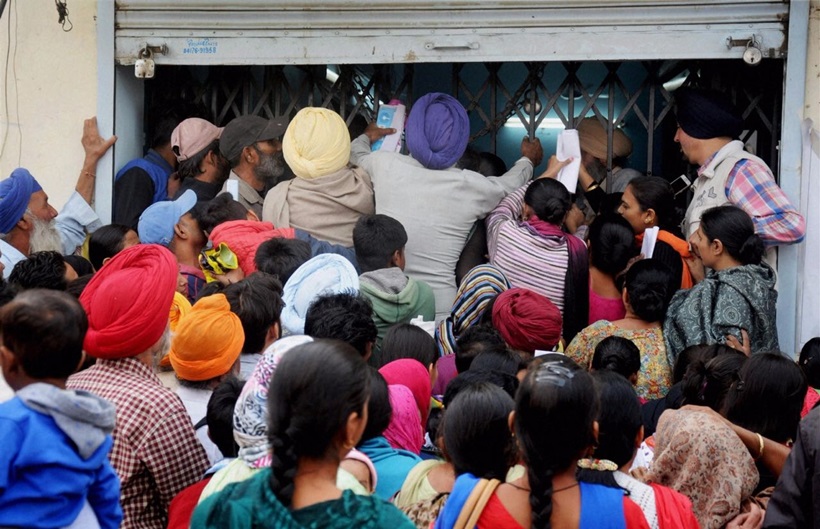
The queues outside Indian banks in November 2016 were not a sign of a nation purifying itself. They were a portrait of ordinary people paying the price for a policy built on wishful thinking, poor planning, and a fundamental misreading of where India’s black money actually lives. The RBI’s 2018 annual report, with its quiet, bureaucratic confirmation that 99.3% of the notes had come home, said everything that needed to be said. The great demonetisation was not a surgical strike on corruption. It was a self-inflicted wound dressed up as a cure.