Zepto’s Fall In Unlisted Market: What This Pre-IPO Event Says?
When The Unlisted Market Speaks, Is Anyone Listening? The Quiet Concern Around Zepto's IPO


The drumbeats around Zepto’s upcoming IPO are getting louder. Investment banks have been lined up, a confidential DRHP has been filed, and the narrative of India’s most exciting quick-commerce unicorn heading to the public markets has been packaged and polished. But while the IPO campaign is busy constructing a story of flawless momentum, there is a quieter, less choreographed market that tells a rather different one — and it deserves far more attention than it is getting.
The Unlisted Market: A Mirror That Doesn’t Lie
Before any company lists on a stock exchange, its shares often trade informally in the unlisted or pre-IPO market — a space where sophisticated investors, early employees, and speculators buy and sell equity outside formal exchange infrastructure. This market is not perfect. It is illiquid, lightly regulated, and driven by sentiment as much as fundamentals. But precisely because it is not managed by PR teams or investment bank syndicates, it tends to surface doubts that formal IPO roadshows do not.
So here is the question that deserves to be asked plainly: “if Zepto’s story is as compelling as advertised, why have its unlisted shares fallen sharply, even as its IPO preparations proceed at full speed?”
According to tracking data from domestic unlisted brokerages including UnlistedZone and Planify, Zepto’s unlisted shares peaked in February and March 2026 at highs of ₹52 to ₹55 per share. By late May 2026, those same shares were trading between ₹39 and ₹43, which is a decline of roughly 25% to 30% from those recent highs, with the 52-week low recorded at ₹39. That is not a minor correction. That is, perhaps, the unlisted market quietly raising its hand.
The Financials of Zeppto: Growth Is Real, But So Are the Losses
To be fair to Zepto, the revenue story is genuinely impressive. According to the company’s audited financial statements, Zepto’s total sales rose 129% year-on-year to ₹9,668.8 crore in FY25, up from ₹4,223.9 crore in FY24. That kind of topline growth, sustained over multiple years, is not common in any industry, let alone one as operationally complex as quick commerce.
But growth alone has never been a substitute for a path to profit, and this is where the picture becomes more difficult. In that same FY25, Zepto’s net loss expanded 177% year-on-year to ₹3,367.3 crore, compared to a loss of ₹1,214.7 crore in FY24. Read that again, which says, revenues doubled, but losses nearly tripled. In FY25, Zepto’s net losses amounted to approximately 35% of its total turnover, up from around 29% in FY24.
This is not a company marching steadily toward breakeven. This is a company where the cost of growth is outpacing the growth itself. And that divergence is not narrowing, but it is widening.

The Burn Is Structural, Not Cyclical
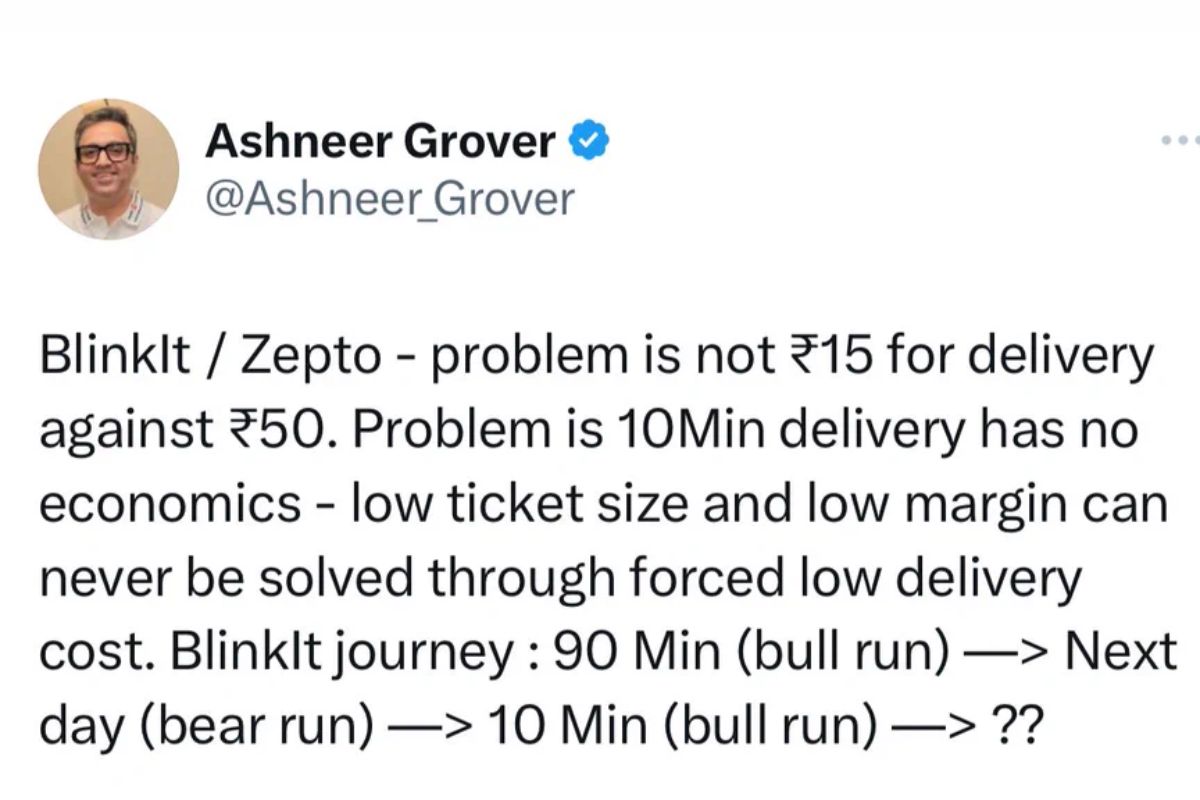
One might argue that burning cash to gain market share is a rational strategy in a winner-takes-all market. And in some contexts, it is. But the structural economics of quick commerce make that argument harder to sustain than it appears at first glance.
In the quick-commerce business model, companies typically recognise only about 15–20% of gross merchandise value as actual revenue. This means that Zepto’s reported ~₹9,668 crore in total sales for FY25 translates to an estimated operating revenue of between ₹1,495 crore and ₹1,994 crore once the GMV accounting reality is applied. Against that operational base, a net loss of ₹3,367.3 crore represents a burn that dwarfs the underlying business’s ability to self-sustain, at least at this stage.
Furthermore, Zepto does not operate in isolation. A Moneycontrol analysis found that Blinkit, Swiggy Instamart, and Zepto collectively burned nearly ₹9,000 crore across just 9 to 11 months, and none of them has shown any intention of reducing that spending. The competitive pressure — not some temporary market condition — is what is driving the burn. And competitive pressure in this sector shows no sign of easing.
Zepto’s most recent private funding round, a $450 million raise led by CalPERS in late 2025 valued the company at approximately $7 billion. The proposed IPO is targeting a primary raise of around ₹11,000 crore, with the company’s shareholders having already approved this figure. The IPO is being advised by Morgan Stanley, Goldman Sachs, Axis Capital, HSBC, JM Financial, IIFL Capital, and Motilal Oswal, which is a banker lineup that signals ambition, not modesty.
Now, $7 billion is a serious valuation for a company that lost ₹3,367 crore in its most recent fiscal year. The unlisted market, at its peak, was pricing Zepto in line with that $7 billion private-round figure. But the subsequent 25–30% drop in unlisted share prices suggests that market participants who were once willing to pay a premium aligned with that private valuation are now backing away — re-pricing their expectations downward as they look more carefully at the underlying unit economics. That is not irrationality. That is recalibration.
The Competitive Landscape Makes Things Harder, Not Easier
Zepto currently holds approximately 29–30% market share in India’s quick-commerce segment, trailing Blinkit, which commands around 44–46% of the market. Blinkit is backed by Zomato, a publicly listed company that has already raised over $1 billion via a QIP post-listing and is sitting on a substantial cash war chest. Swiggy Instamart, despite its own losses, benefits from Swiggy’s food delivery cross-subsidy ecosystem.
What this means is that Zepto enters the public market as the third-place player in a capital-intensive war, competing against two rivals who have access to public capital markets and have already demonstrated their willingness to spend aggressively and indefinitely. The question investors need to honestly wrestle with is: what structural advantage does Zepto possess that would allow it to close this gap rather than be slowly ground down by it?
What the Unlisted Market May Already Know
Here is a reasonable interpretation of what is happening in the unlisted market. Sophisticated participants, aka the people who are buying and selling Zepto shares based on actual financial analysis rather than IPO-cycle hype have looked at the FY25 numbers, looked at the competitive positioning, looked at the $7 billion valuation ask, and decided that the risk-reward at the peak price was not compelling. The resulting 25–30% price decline is not panic, but it is informed scepticism.
None of this means that Zepto will fail, or that its IPO will not generate strong listing-day returns. India’s public markets have a long history of rewarding exciting growth stories regardless of near-term profitability timelines, and Zepto’s revenue trajectory is genuinely striking. Zepto operates over 1,000 dark stores across 70+ cities and handles approximately 1.7 million daily orders, which is real operational scale.
But scale and sustainable economics are not the same thing. And a 25–30% correction in the unlisted market, happening right as the IPO machinery is spinning at full speed, is the kind of signal that every retail investor considering this listing should pause and take seriously.
The Question That Remains
The unlisted market does not have all the answers. It is an imperfect mechanism, prone to liquidity-driven swings and rumour. But when the drumbeats of an IPO campaign grow loudest, it is usually the quieter signals that deserve the most scrutiny.
Zepto’s losses rising faster than revenues. A market-share position that trails the category leader by 15 percentage points. A proposed $7 billion valuation being quietly walked back in the secondary market. A combined sector burn of ₹9,000 crore in under a year with no end in sight.
Each of these data points, taken alone, is explainable. Taken together, they form a pattern of questions that the DRHP, when it is finally public, will need to answer in convincing detail. Until then, the 30% drop in the unlisted market is not noise. It may well be the most honest thing anyone has said about Zepto’s IPO so far.

All financial data cited in this article is sourced from publicly available reports, audited financial statements, and verified unlisted brokerage tracking platforms as referenced inline. Readers are encouraged to independently verify each data point before making any investment decisions. This article represents analytical opinion and investor sentiment, but is not investment advice.