AI Can’t Feel Heartbreak. Then, Can It Create Better Love Music Than You?
The Labels Funding Their Own Destruction: How Big Music Is Betting Billions on AI While Songwriters Starve

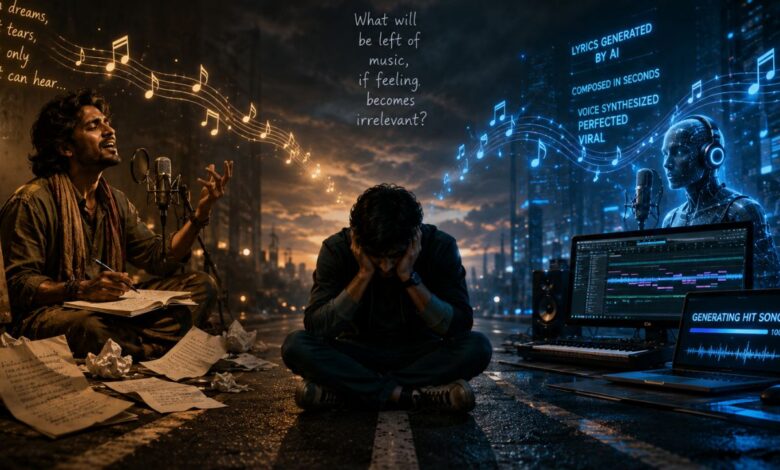
Imagine…
The studio on the west side of Nashville smells like coffee gone cold and ambition slightly souring. Sarah Buckley (let’s say) has won two Grammy nominations, written cuts for three platinum albums, and spent the better part of fifteen years learning the architecture of a song the hard way- wrong chord by wrong chord, missed rhyme by missed rhyme, late night by late night. This year, she lost three sync licensing deals. Not to a younger writer. Not to a more fashionable producer. She lost them to software that doesn’t sleep, doesn’t eat, and charges the licensing company a flat monthly subscription fee in place of royalties.
“She sits now with a legal pad, working on a verse about a feeling the algorithm has never had; the specific grief and anger of watching something you built get replaced by something that was built from you, without your permission and without your name.” This was the similar feeling Studio Ghibli co-founder Hayao Miyazaki had, when he strongly rejected AI art and animation, calling it an “insult to life itself”.
Now, the harsh reality!
Cut to San Francisco. Trim offices, floor-to-ceiling glass, the clean optimism of money that has not yet had to account for itself. A venture capital partner clicks a pen and signs. The figure on the term sheet is $400 million. The recipient is Suno, an AI music generation startup that, as of June 3, 2026, has just closed a new funding round at a valuation of $5.4 billion. The company’s product can produce a fully realised song, vocals, instrumentation, lyrics, sonic texture, from a text prompt typed in under thirty seconds.
Between the above two situations, the entire argument about, is the future of music. One of them is where music has always come from. The other is where the money has decided it should come from next. And right now, those rooms are not in conversation. They are in collision.
The Investment Boom: Follow the Money
When you want to understand what an industry actually believes, as opposed to what it says at press conferences and charity galas, you follow the money. And in the music business, the money is flowing in one direction with remarkable clarity: into the machines that are replacing the human beings the industry built itself on.
The scale of investment in AI music generation is staggering, and it has accelerated with a velocity that leaves policy, ethics, and the careers of working musicians scrambling in its exhaust. The global AI music market, valued at approximately $300 million in 2022, is projected to reach $2.6 billion by 2032, growing at a compound annual growth rate of 26.6%, according to Allied Market Research. These are not speculative projections about a distant future. They are market signals about decisions being made in boardrooms today.
Suno’s June 2026 funding round, $400 million at a $5.4 billion valuation is the most vivid single data point, but it is far from the only one. In 2024, Suno had already raised $125 million in a Series B led by Lightspeed Venture Partners, positioning it as the most capitalised pure-play AI music company in the world. Udio, its closest competitor in terms of audio fidelity, raised $10 million in seed funding from Andreessen Horowitz in early 2024.
That a16z is the lead investor here is not incidental; the firm has made AI-generated content a strategic thesis, betting that the marginal cost of creative output will approach zero and that whoever builds the infrastructure to supply that output will capture extraordinary value. What makes all of this genuinely scandalous, however, is not that venture capital is funding AI music companies. That is simply capital chasing returns, which is what capital does. What is scandalous is who else is funding them, and what they get in return.
Universal Music Group, the world’s largest music rights holder, has simultaneously positioned itself as the fiercest defender of artist rights against AI companies and quietly pursued strategic partnerships and equity stakes in AI platforms that it deems “licensed” and label-compliant. Sony Music’s AI research division has been actively developing proprietary generative tools for internal use, an investment of both capital and engineering talent that signals the company views AI music not as an external threat to be resisted but as an internal capability to be captured. Warner Music Group struck a partnership with Endel, an AI-powered soundscape app, and has reportedly explored deeper arrangements with several generative audio platforms.
The pattern is consistent and, once you see it, impossible to unsee: the major labels are engaged in a form of institutional hedging. They are publicly championing human artists in court documents and press releases while privately investing in the infrastructure that renders those artists economically redundant. This is not hypocrisy born of confusion. It is a calculated strategic position that reflects a fundamental change in how the music industry conceptualises what it sells.
For most of the twentieth century, the music industry sold art, recordings of specific performances by specific human beings whose personal stories, public images, and emotional authenticity were the entire mechanism of the product’s value. What the AI investment boom reveals is that the industry has quietly reclassified its product. It no longer sells art. It sells content, audio material calibrated for consumption, optimised for streaming metrics, and producible at near-zero marginal cost once the infrastructure is built.
The difference between art and content is not aesthetic. It is economic. Art requires a human being. Content does not. And every dollar flowing from music label boardrooms into AI startups is a dollar voting for the content model over the art model, even as those same labels continue to book human artists on stadium tours and sign development deals with twenty-two-year-olds who will spend three years learning that the contract they signed was not quite what it appeared to be.
Google has its own foot in this river. Its MusicLM project demonstrated the ability to generate high-quality audio from text descriptions as early as 2023, and the company has continued developing music-adjacent AI capabilities across its research division and through YouTube’s infrastructure. OpenAI, for its part, has made music-adjacent moves through partnerships and the generative audio capabilities embedded in its broader platform, signalling that music is very much within its ambitions even if it has not yet released a standalone product.
The industry’s argument, when it bothers to make one is that licensed AI partnerships represent a path to monetisation that compensates rights holders while expanding the market. What this argument consistently omits is the songwriter, the session musician, and the independent artist who holds no master rights and whose livelihood depends not on licensing portfolios but on the continued relevance of human creative labour.
Meet the Machines: The Startups Reshaping Music
To understand what is actually happening on the ground — or rather, in the cloud — it helps to look closely at the tools themselves, because the technology has reached an inflection point that is categorically different from anything that preceded it.
Suno AI, currently the sector’s most valuable private company at $5.4 billion, generates complete songs from a short text prompt. Type “melancholic indie folk song about leaving a city you love, female vocal, acoustic guitar, cello” and receive, within seconds, a track that sounds — with unsettling competence — like a real recording by a real artist.
The company claims over 10 million users as of 2024, a number that will certainly be higher by the time this article reaches you. Its CEO, Mikey Shulman, has spoken publicly about use cases ranging from birthday songs to hospice tributes, positioning the tool as a democratising force for personal expression. Fortune, in its June 2026 profile of the company, noted that Suno is “finding real-world uses for AI-generated music” while acknowledging the deeper question of whether it constitutes a sustainable multibillion-dollar business remains less clear.
Udio, backed by a16z, operates in the same space with particular emphasis on audio fidelity. Its outputs have, in blind listening tests, been indistinguishable from professionally produced human recordings. That sentence deserves a moment of attention: indistinguishable. Not close. Not almost. Indistinguishable, in a significant proportion of controlled test cases.
Boomy sits at the more democratised end of the market — a platform that enables users with no musical training whatsoever to generate songs, which can then be distributed to streaming platforms. By 2023, Boomy users had created over 14 million songs, a figure that represented nearly 13% of all music ever uploaded to streaming platforms at that time. One company, one platform, one year, and 13% of all music ever made. Let that number sit.
AIVA, a European AI composer, has been used by over 30,000 content creators globally and holds the distinction of being the first AI officially recognised as a composer by a music rights society. Mubert generates royalty-free music in real time and has partnered with major content platforms, directly competing with the sync licensing market on which thousands of independent composers depend. Beatoven.ai, an Indian startup, targets content creators specifically, producing background music at a price point that makes hiring a human composer for the same purpose economically irrational. Soundraw and Loudly are carving into the $500 million-plus background and sync music market with similar tools and similar logic.
The technological leap from what came before to what exists now is not incremental. Early computer-generated music, think MIDI sequencers and algorithmic composition from the 1970s and 1980s was a novelty. It produced outputs that were recognisably computational, technically interesting, and artistically limited. The current generation of AI music tools is built on transformer-based deep learning models trained on millions of human-made recordings, and the difference in output quality is not a matter of degree. It is a difference in kind.
And here lies the ethical contradiction that the industry has preferred not to examine too closely. Every one of these models was trained on music made by human beings who were never asked, never compensated, and never informed. The data that makes Suno sound like a real artist is a real artist, or rather, the distilled creative labour of hundreds of thousands of real artists whose lifetimes of work were ingested by a model that now competes with them in the market they built.
This is not a metaphor. It is the literal mechanism by which the technology functions. These tools work by learning the statistical patterns of human music-making at a granular level, the way a chord resolves, the phrasing of a vocal melody, the textural relationship between a bass and a kick drum and then remixing those patterns into novel outputs. The outputs are novel. The creativity that enabled them was not.
The Human Cost: What Is Happening to Songwriters Right Now
Before the philosophy, before the law, before the market projections, there are people. There are people sitting in studios and apartments and coffee shops, trying to make a living from the thing they have devoted their lives to, and finding that the market for that thing is contracting in ways they did not consent to and cannot easily stop.
The financial situation of the professional songwriter was not healthy before AI. It was, by almost any measure, already a crisis. The National Music Publishers’ Association reports that the average full-time songwriter earns under $25,000 per year, a figure that falls below the poverty line in most major cities where the music industry is concentrated. Spotify pays between $0.003 and $0.005 per stream, meaning an artist needs roughly 250 streams to earn a single dollar. A song that achieves one million streams, an impressive, non-trivial feat for an independent artist, generates somewhere between $3,000 and $5,000 in streaming royalties. That is the economics of professional songwriting in the streaming era, before AI entered the equation.
Now AI has entered the equation. And what it changes is not just the royalty rate, it changes the supply side of the market in a way that makes every human-made song compete against an essentially infinite supply of algorithmically generated alternatives that cost the commissioning party a subscription fee instead of a licensing deal.
The sync licensing market, the placement of songs in films, television, advertising, video games, and podcasts has historically been the economic lifeline of the independent composer. A single placement in a national television advertisement could mean $10,000 to $100,000 for a composer who might otherwise earn $25,000 in a year. That market is contracting.
Platforms like YouTube, TikTok, and podcast networks are moving toward AI-generated background music that eliminates the sync licensing transaction entirely. The Music Workers Alliance estimates that session musician bookings dropped by approximately 25 to 30 percent in 2023 and 2024 in major markets. That is not a rounding error. That is hundreds of thousands of lost gig-economy music jobs across a sector that was already precarious.
In April 2023, a coalition of over 200 prominent recording artists, songwriters, and music executives signed an open letter organised by the Artist Rights Alliance, calling on AI companies, streaming services, and digital platforms to cease the use of AI to “infringe upon and devalue the rights of human artists.” Signatories included Billie Eilish, Nicki Minaj, Katy Perry, and dozens of others whose household-name status would seem to insulate them from the crisis. They signed anyway, because they understood that the structural threat did not care about fame, it cared about the market mechanics of creative labour, and those mechanics apply regardless of how many Grammys hang on your wall.
Surveys paint an equally bleak picture from the ground up. Approximately 72% of professional musicians report that AI has already negatively impacted their income or opportunities, according to music industry research. This is not a fear about the future. It is a description of the present.
The structural argument underneath all of these numbers deserves to be stated plainly: AI music doesn’t get sick. It doesn’t need advances against royalties. It doesn’t demand tour support or creative control or a guaranteed number of promotional appearances. It doesn’t post on social media in ways that create brand crises. It doesn’t need health insurance, doesn’t form a union, and doesn’t age out of demographic appeal. From the perspective of a major label’s CFO, operating in a business that has always extracted the maximum value from human creative labour for the minimum possible expenditure- AI music is not a disruption. It is a dream. It is the perfect artist, finally available at scale.
What this means in practice is that the model of discovering, developing, and sustaining human talent, the model that gave us Aretha Franklin, Bob Dylan, Kendrick Lamar, and Taylor Swift is being quietly sunset. Not announced. Not debated. Just slowly allowed to atrophy as capital migrates toward systems that do not require the inconvenience of the human beings those systems are built to replace.
The Creativity Debate: Can a Machine Have a Soul?
In April 2023, a track called “Heart on My Sleeve” appeared on major streaming platforms. It featured vocals in the styles of Drake and The Weeknd, production that sounded indistinguishable from their actual catalogue, and lyrics that sat comfortably within both artists’ established aesthetic registers. It accumulated millions of streams before being removed. It was not made by Drake. It was not made by The Weeknd. It was made by an anonymous producer using AI voice-cloning technology, and for the hours it was live, many listeners had no idea.
That incident is often framed as a legal story, which it is. But it is also a philosophical story, and the philosophical dimensions are not being adequately examined. If listeners cannot tell the difference, and in controlled blind listening tests, participants fail to correctly identify AI-generated compositions versus human ones in more than 50% of cases- then what exactly are we arguing about when we argue that AI music is not “real” music?
Nick Cave, who is not a man given to hedging, provided the clearest answer when he described AI-generated music as “a grotesque mockery of what it is to be human.” His objection was not that the music was technically poor. His objection was that the act of making music, for him and for most serious musicians, is an act of meaning-making that emerges from the specific texture of a specific life.
Heartbreak is not a data point. Grief is not a pattern in a training set. The blues did not emerge from a statistical model calculating the most effective expression of sorrow; it emerged from actual sorrow, in actual bodies, under actual conditions of oppression, and its power is inseparable from that origin.
This is the counterintuitive truth that the AI music debate keeps circling without quite landing on: the problem is not that AI music is bad. It is that AI music is good enough. And good enough at near-zero marginal cost is, in economic terms, catastrophic for anything that requires significant human labour to produce. When a competitor can replicate your product at a fraction of your cost, the market for your product collapses, not because your product became worse, but because the market cannot distinguish between them at the price point where the decision is being made.
Brian Eno, whose contributions to the theory and practice of generative music span decades and who has himself experimented extensively with algorithmic composition, has acknowledged the genuine creative potential of AI systems while maintaining that the human intention behind music, the why of it remains irreducible. Grimes, who has taken perhaps the most provocative pro-AI position of any mainstream artist (offering her own voice for AI music generation and describing AI as “the future of music”), represents the optimistic pole of the debate.
She is not wrong that AI opens sonic possibilities that human beings could not easily access. She is, perhaps, underestimating what is lost when the human need that music has always served, the need to feel heard, to feel understood, to feel less alone in a specific kind of pain is decoupled from the human being doing the listening and the human being doing the feeling.
What does it mean culturally when the dominant form of emotional expression is generated by a statistical model trained on other people’s heartbreak? The music that sustains us; the song you listened to on repeat after a relationship ended, the album that made you feel seen at seventeen, the playlist you made for someone you loved drew its power from the fact that a real person made it from a real feeling. If the sounds are identical but the origin is not, something has changed. What has changed is not the audio file. What has changed is the relationship between the listener and the source of the sound. And that relationship is not decorative. It is the whole point.
The Legal Battlefield: Copyright, Chaos, and No Clear Answer
In June 2024, the Recording Industry Association of America did something it had not done since the Napster era: it went to war. The RIAA filed lawsuits against both Suno and Udio, alleging that both companies had trained their generative AI models on copyrighted recordings without obtaining licences, and without compensating the rights holders.
Suno, the complaint alleged, had effectively copied “decades of sound recordings” from the catalogues of major labels. Given that statutory damages in copyright infringement cases can reach $150,000 per infringed work, and given the scale of training datasets that may encompass millions of tracks, the theoretical damages exposure is not merely large. It is, as several legal scholars observed at the time, potentially in the trillions of dollars.
Both cases proceeded through preliminary stages into 2025, and as of mid-2026, the central legal questions remain unresolved. The core issue, whether training an AI model on copyrighted material without a licence constitutes infringement, or whether it qualifies as transformative use under the fair use doctrine, is one that existing copyright law was not designed to answer. The cases are, in essence, asking courts to make law in real time on a question of enormous economic consequence.

The US Copyright Office has offered one relatively clear position: AI-generated content that lacks a human author is not eligible for copyright protection. This matters enormously for the business models of AI music companies. If a song generated entirely by Suno cannot be copyrighted by Suno or by the user who prompted it, then there is no intellectual property to sell, license, or defend — only a service. The Thaler v. Perlmutter case, in which an AI developer attempted to register a copyright for an artwork generated autonomously by an AI system, was decided in a way that reinforced this position: copyright requires human authorship, and a machine cannot be an author.
The EU AI Act, which came into full effect in 2024 and 2025, introduces disclosure obligations for AI systems used in creative contexts, including requirements that AI-generated content be labelled as such in certain commercial applications. These disclosure requirements, while meaningful in principle, have proven inconsistent in practice. The ghost-production grey zone is real and expanding: labels are already releasing AI-assisted music — tracks that may use AI for arrangement, production, vocal processing, or even melodic generation — without disclosing the AI’s involvement to listeners or, in many cases, to the human artists whose names appear on the release. There is currently no legal requirement in most major music markets to disclose AI involvement in a commercial release.
The parallel from the visual arts world is instructive. The ongoing litigation between Getty Images and Stability AI — in which Getty alleges that its image library was used without licence to train a generative AI system — has moved through courts in both the UK and the US and raised many of the same questions about training data, transformative use, and the rights of original creators. What that litigation has demonstrated, above all, is that the legal process moves slowly and that technology does not wait for it.
The WIPO has characterised the AI music situation as potentially the industry’s next Napster moment — a reference to the peer-to-peer file-sharing platform that the major labels ultimately defeated in court but that fundamentally and permanently restructured the economics of the music business anyway. The lesson of Napster is not that the industry won. It is that winning in court and winning in the market are different things, and that technology, once deployed at scale, reshapes consumer behaviour in ways that legal victories cannot easily reverse.
The window to establish meaningful protections for human creators is not infinite. Every month that passes without clear legislative frameworks is a month in which AI music companies scale further, users habituate further, and the cultural and economic expectation of free or near-free music creation embeds itself further into the infrastructure of the industry. Legislation is running years behind technology. That is not a metaphor. That is the operational reality that working songwriters are living inside right now.
The Streaming Economy: When AI Floods the Market
Spotify revealed in late 2025 that it had removed over 75 million “spammy” AI-generated songs from its platform, a number so large it is worth pausing over. Seventy-five million tracks. Gone. The previous high-profile removal had been in 2023, when the platform purged tens of thousands of Boomy-generated tracks that had been artificially inflating streams through bot-driven plays in an attempt to game the royalty pool. Both episodes are symptoms of the same underlying structural problem: when the marginal cost of creating and uploading a song approaches zero, the natural behaviour of anyone seeking to profit from the royalty system is to flood it with as much content as possible.
This creates what economists would call a royalty pool dilution effect, and it is worth understanding precisely how it works because its implications are devastating for independent human artists. Streaming platforms like Spotify do not pay a fixed rate per stream.
They pay a proportional share of a total royalty pool, calculated per period. Every song on the platform competes for a share of that pool. When Boomy users upload 14 million songs, when AI systems generate and distribute thousands of tracks per day, when the total number of songs on streaming platforms grows faster than the total listening time available, the mathematical result is that every human-made song’s share of the royalty pool shrinks, even if its absolute number of streams remains constant.
Spotify’s 2024 policy update made this worse for independent artists. The platform announced it would eliminate royalty payments for tracks that do not reach a minimum of 1,000 streams per year — a threshold framed as a measure against spam but that disproportionately affects the long tail of independent human artists. The typical AI bulk uploader is not producing one song that gets 500 streams. It is producing ten thousand songs, several of which clear the threshold. The policy was presented as a solution to AI spam; in practice, it penalised small human artists while leaving industrial-scale AI uploading substantially undisturbed.
Distribution platforms, DistroKid, TuneCore, and others have updated their terms of service to theoretically prohibit certain uses of AI music, but enforcement is inconsistent, verification is nearly impossible at scale, and the economic incentive for these platforms, which charge per-upload fees, runs directly counter to restricting the volume of uploads.
The economic endgame of this trajectory is not complicated to model. If the marginal cost of creating music falls to zero, if distribution costs fall to near-zero, and if the royalty pool continues to be diluted by effectively unlimited AI-generated content, then the royalty-based revenue model does not become less profitable for independent human artists. It becomes incoherent as a revenue model for them entirely. The system will continue to exist. The money will continue to flow. It will flow to the platforms, to the AI companies, and to the major labels with the catalogues and the equity stakes. It will not flow to the songwriter in Nashville with the legal pad and the cold coffee.
Society’s Soundtrack: Culture, Memory, and What We Lose
Music is not a product that humanity invented to pass the time. It is, across every culture and every period of recorded history, the primary technology through which human beings process what cannot otherwise be processed: collective grief, collective joy, identity, love, rage, and the particular solitude of being alive in a specific body in a specific moment.
The blues was not entertainment. It was survival, a technology for bearing what could not otherwise be borne. The protest songs of the 1960s did not merely reflect social movements; they constituted them, giving dispersed and frightened people a shared language for their conviction. Hip-hop was not a genre that emerged from market research. It was the voice of communities that no other medium was willing to give a voice to, and its commercial success came not in spite of its authenticity but because of it.

What happens to that function when the music that fills our social environments is algorithmically optimised for engagement rather than grown from experience?
The question is not theoretical. AI music is already dominant in background and ambient contexts: the hold music for your insurance company, the soundtrack to the brand video for a product you are mildly interested in, the background score for the podcast you half-listen to while commuting. In these contexts, the absence of human authorship may be, genuinely, inconsequential — no one’s identity formation depends on what plays during an advertisement for athletic wear.
The danger is not that AI will make background music. The danger is that background music is the entry point. The Dazed Digital investigation into AI-generated “musicians” found that AI-generated acts are already climbing music charts and signing multi-million-dollar record deals, with virtual artists like The Velvet Sundown achieving streaming numbers comparable to established human acts. As AI migrates from background to foreground, from incidental to intentional listening, the risk is not that the music gets worse by any measurable sonic standard. The risk is that it gets averaged.
That it becomes a statistical middle of what emotion sounds like rather than any actual emotion. That the cultural monoculture that the streaming algorithm has already begun to create- flattening genre, suppressing the odd and the difficult and the uncommercial- accelerates toward its logical endpoint: a world where the dominant sonic experience is the most engagement-optimised possible version of the most popular emotional category.
There is also a simpler, more personal argument, and it deserves to be made without irony. Songs are how we remember where we were. The song playing when you fell in love, when you lost someone, when you were seventeen and believed something impossible was going to happen to you- those songs are anchored to memory in a way that is not merely associative but constitutive. They are, in some meaningful sense, part of how the memory was formed.
What does it mean for the generation currently coming of age to have their formative soundtrack produced by a system trained on the emotional residue of previous generations, optimised for algorithmic discovery, and authored by no one? It may mean nothing. Or it may mean the slow evacuation of something we will not know we lost until we reach for it and find it gone.
The Steel Man: The Case for AI Music
Intellectual honesty requires engaging seriously with the strongest version of the opposing argument, so here it is, stated with all the force it deserves.
AI music tools are, genuinely, democratising. For the teenager in rural Kerala or rural Kentucky who has music inside her and no access to instruments, lessons, producers, or studio time, Suno is not a threat. It is an instrument. It is a means of expression that did not previously exist, and the music she makes with it is hers in every meaningful sense except the technical one. Lowering the barriers to musical expression is not obviously a bad thing, and dismissing it because it threatens existing industry structures is a form of gatekeeping that has historically served the powerful more than the creative.
AI has also produced genuinely novel sonic territory. Combinations of timbres, rhythmic structures, and harmonic relationships that no human composer would have intuitively arrived at have emerged from generative models, and some of them are interesting in ways that expand the vocabulary of music rather than merely replicating it. The creative frontier is not a zero-sum game.
Many working musicians are, in fact, already using AI tools not as replacements but as creative collaborators — for generating chord progressions to react against, for creating demos quickly, for handling the technically tedious parts of production that consume time without contributing artistically. AI as tool is a different proposition than AI as replacement, and conflating them obscures a real distinction.
The historical argument also deserves its due. The phonograph was going to kill live music. The synthesiser was going to kill session musicians. The drum machine was going to kill drummers. Auto-Tune was going to kill authentic vocal performance. Digital audio workstations were going to make trained musicians irrelevant. None of these things happened exactly as predicted, and in each case the technology expanded the total market for music in ways that created new opportunities.
All of this is true. And yet the current moment is categorically different in ways that make historical analogies partially misleading. The speed, the scale, the economic incentives, and the involvement of trillion-dollar technology companies in infrastructure that did not previously exist combine to create conditions that prior disruptions did not. Previous technologies changed how music was made or distributed. This one claims to replace the human making the music. And it is being funded not by independent tinkerers but by the very institutions that are supposed to represent the human beings being replaced. That is not a technological shift. That is a structural betrayal.
The Verdict: Art as Extraction
Let us be precise about what has actually happened here, because precision matters when the stakes are this high.
The music industry’s investment in AI is not innovation. Innovation implies creating new value. What is happening is better described as extraction — the systematic harvesting of value that was created by human beings over a century of musical culture, processing it through a model, and selling it back at higher margin and lower cost, without acknowledgement, without compensation, and without the consent of the people whose work made it possible. The inputs were human. The process that transforms them is algorithmic. The profits are institutional. The losses are personal.
The legal system will eventually catch up. Courts will rule on whether training on copyrighted music constitutes infringement. Legislatures will eventually pass frameworks for AI disclosure and artist compensation. The Copyright Office’s positions will solidify into binding law. But “eventually” is doing a great deal of work in that sentence, because in the music industry, a generation is roughly ten years — the window in which a songwriter’s career either establishes itself or does not. The generation of songwriters and session musicians and independent composers currently in their twenties and thirties will have navigated their entire formative professional years before the legal framework that might have protected them exists. For them, “eventually” is not a comfort. It is an obituary.

What needs to happen is not complicated, even if it is politically and economically difficult. Every commercial release that involves AI in its creation — whether in composition, arrangement, production, or vocal generation — should be required to disclose that involvement clearly and specifically. This is a minimum standard of honesty. A levy system should be imposed on AI music platforms, with revenues directed into a songwriter and musician compensation pool administered independently of the major labels.
Collective bargaining rights for music creators should be explicitly extended to cover AI-related displacement, allowing unions and guilds to negotiate protections for workers whose roles are being automated. A moratorium on training AI models on copyrighted music should be imposed until consent and compensation frameworks exist and are operational — not promised, not in negotiation, but operational.
None of these measures would stop the development of AI music. Nor should they. The technology exists and it will continue to exist and some of what it produces is genuinely valuable. But value should not be extractable from human creative work without the agreement of the humans who created it. That is not a radical position. It is the foundational principle of copyright law. The current situation is one in which that principle has been technologically circumvented and legally outpaced, and the people paying the cost are the ones who can least afford it.
The question was never whether AI could make music. Given enough data and enough compute, the answer to that was always going to be yes. The question is whether we still believe that music made by humans, for humans, from lived human experience, is worth protecting. And right now, the money says no.