Mamaearth: A Castle Built On Marketing Scaffolding?
The Toxin-Free Illusion: How Mamaearth Built a ₹2,000 Crore Revenue Brand With No In-house Manufacturing, No Patents, and No Mercy on the Marketing Budget

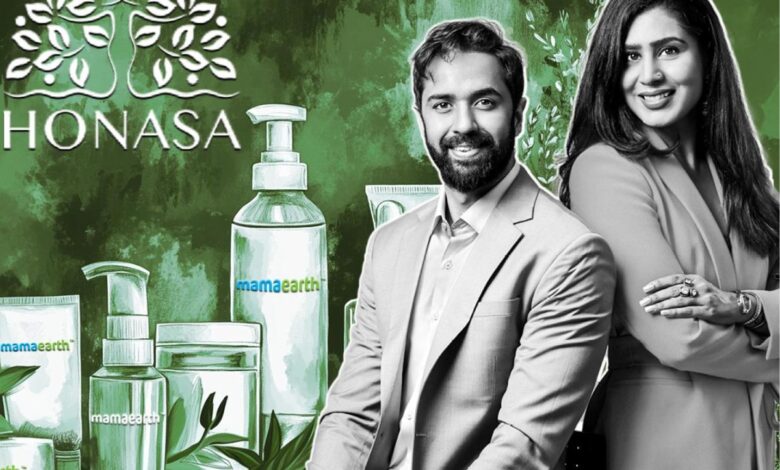
In FY25, Honasa Consumer, the parent company of Mamaearth, The Derma Co., BBlunt, Dr. Sheth’s, Aqualogica, and Staze, spent ₹743.65 crore on advertising. That is 36% of its total revenue of ₹2,066.9 crore for the year. For every ₹100 the company earned, it spent ₹36 on simply telling people it existed.
For context, Hindustan Unilever, the 90-year-old FMCG giant that owns Dove, Lux, Surf Excel, and Clinic Plus, runs its advertising at 13–15% of revenue. Aggressive challengers in the Indian FMCG space rarely breach 22%. And yet here is a nine-year-old D2C brand, now a publicly listed company, spending more than a third of its revenue on marketing, and somehow describing this as a growth strategy rather than a structural confession.
But here is what makes this number truly remarkable: it was not always this high in absolute terms. It was always this high as a percentage. Going back to FY21, Mamaearth spent approximately 39% of revenue on advertising. In FY22, it climbed to 40–41%. FY23 saw it at 35.3%. FY24 at 34.4%. FY25, back to 36%. In absolute terms, as per tracxn data, it is ₹391 crore (FY22), ₹530 crore (FY23), ₹661 crore (FY24), ₹744 crore (FY25).
Not a single year has seen advertising spend decline as a percentage of revenue in any meaningful way. For a company that IPO’d on the promise of growing into its marketing spend, that is not a trend. That is a structural dependency.
The question worth asking here is blunt: Is Mamaearth a beauty company that markets its products, or a marketing company that happens to sell beauty products?
II. The Year-on-Year Advertising Escalator — And What It Reveals
Advertising costs do not lie. They reflect what a business believes is the only reliable engine of demand generation. At Mamaearth, the escalator has moved in one direction, every single year.
What should this chart look like in a maturing brand? The ratio should fall. As brand equity compounds, as consumers form habits, as word-of-mouth replaces paid acquisition, as loyalty programs generate organic repeat — a healthy business sees its ad-to-revenue ratio compress. That is what happened to Colgate. To Dettol. To Asian Paints. Their early-years advertising ratios were high. Then they fell and stayed down.
Mamaearth’s has not. And this is not a matter of interpretation, but it is a corporate scorecard failure hiding in plain sight. In FY25, even as revenue grew just 7.66% year-on-year, overall costs grew 12.8%. Expenses outpaced income. Profit after tax fell 34.24% to ₹72.6 crore from ₹110 crore the previous year. Profit before tax fell 39% to ₹89.6 crore. EBITDA margins, which should be expanding at this stage of the company’s maturity cycle, contracted to around 5%.
At this rate of ad spend growth versus revenue growth, the math is unambiguous: if you spend faster than you earn, profitability eventually becomes a rounding error. For a publicly listed company with retail shareholders, that is not an academic concern, but it is a direct wealth destruction event.
When Honasa Consumer listed in November 2023 at an IPO price of ₹324 per share with an implied valuation of approximately ₹10,500 crore, analysts who recommended caution flagged this asymmetry. Within a year, the stock had plummeted more than 40% from its highs, briefly touching a 52-week low of ₹242.60. The Indian retail investor who bought in at the IPO on the promise of India’s largest D2C beauty brand has spent much of the post-listing period staring at a loss.
What the advertising data tells us, at a structural level, is this: Perhaps, Mamaearth’s demand is predominantly induced, not organic. It is manufactured majorly through influencer campaigns, YouTube pre-rolls, Instagram reels, and celebrity endorsements, and not through a product that consumers seek out independently. The brand’s own management has acknowledged that shifting from acquisition to retention is a priority, which is a healthy acknowledgement but not, yet, a solved problem.
III. The 37-Factory Architecture: What Is Mamaearth Actually Selling?
Here is a question that every Indian consumer who has spent ₹499 on a Mamaearth Vitamin C face wash deserves a clear answer to: Who actually makes this product?
The answer, sourced directly from Honasa Consumer’s own IPO documents, is instructive. Mamaearth outsources the manufacturing of all its products to third-party contract manufacturers under non-exclusive contract manufacturing arrangements. The word is critical. Non-exclusive means these same factories can and do, manufacture products for competing brands, simultaneously, in the same production lines.
As of the IPO filing, Honasa Consumer worked with 37 contract manufacturers to produce its entire product range. The company does not own a single manufacturing facility of its own.
The most publicly traceable of these manufacturers is AG Organica, based in Noida, Uttar Pradesh. Their own marketing website openly lists their clients: Mamaearth, Sanfe, Dabur, Peesafe, Clovia, Woolzies, Veda Naturals, Ustraa, BabyChakra, and others. AG Organica operates a 25,000 sq. ft. production area with in-house R&D and quality control, and holds GMP, ISO, USDA, Halal, Ayurvedic, FSSAI, and ONECERT certifications.
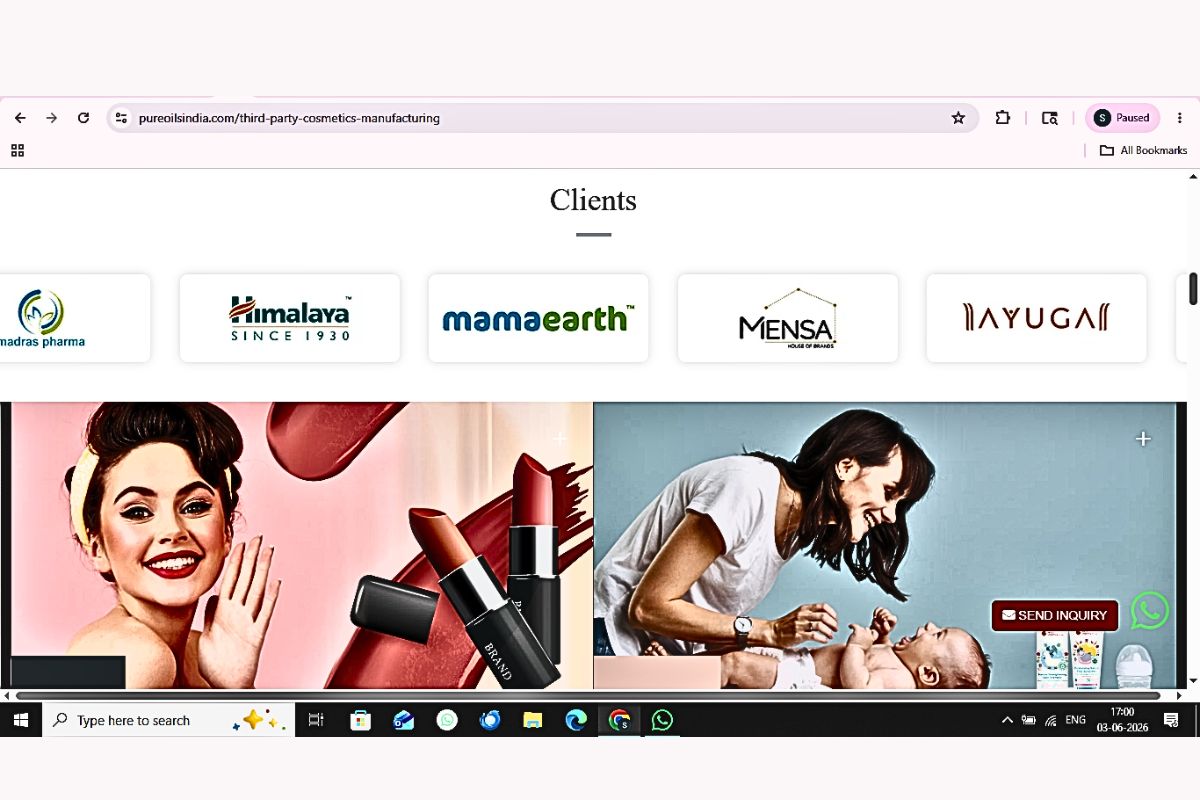
Read that client list again. Mamaearth and Dabur, they share the same contract manufacturer. Mamaearth and Ustraa, which targets men. Mamaearth and BabyChakra, which targets infant care. These are competing brands across entirely different consumer categories, all emerging from the same industrial park in Noida. This is not alleged. It is on the manufacturer’s own website. We are not saying that the formula is same; but is it different? Is it researched, as the founders claim?
To be fair, contract manufacturing is not a sin in the FMCG world. HUL, P&G, and virtually every large consumer goods company uses contract manufacturers for parts of their portfolio. The question is what gets owned and what doesn’t.
The contract manufacturing industry for cosmetics operates on three tiers. White Label: a pre-made, standardized formula that multiple brands rebadge. Base Strategy: the factory has a core formula base, and brands customize it by adding a “hero ingredient”, like onion extract, vitamin C, turmeric, and a fragrance. Custom Formulation: the brand works with the factory’s chemists to create something genuinely novel from scratch, with ownership of IP.
Most D2C brands, including Mamaearth, operate primarily at the Base Strategy level. The onion hair oil, the vitamin C face wash, the ubtan face scrub are not novel inventions. They are industry-standard cosmetic bases with trending hero ingredients dropped in, plus a fragrance profile. The factory already has these bases in its library, fully tested and ready to scale. The brand pays for the label, the certification, and the marketing story.
This is not speculation. It is confirmed by the absence of patents. Mamaearth holds no patents for any of its product formulations. For a company that has launched between 159 and 225 new SKUs per year and claims to offer “special formulations,” the absence of any intellectual property protection on those formulations is a precise answer to the question of how genuinely novel they are.
The uncomfortable inference: When Mamaearth launched its Onion Hair Oil in 2019–20, riding the Google Trends wave around onion-based hair care, the brand did not invent onion hair oil. The contract manufacturer already had an onion-extract haircare base in their library. Mamaearth added its packaging, its MadeSafe certification, and launched a massive influencer campaign. WOW Skin Science did the same thing through the same ecosystem, at roughly the same time. Neither brand had the formula. Both brands had the marketing.
The formula ownership risk is not theoretical. When a brand does not own its formula, the manufacturer can legally make an identical or near-identical product for any competitor. Unless Mamaearth has specifically negotiated formula exclusivity clauses, which the DRHP’s “non-exclusive” language strongly implies they have not, any new startup with ₹X lakhs could walk into AG Organica tomorrow, commission the same base formula with the same hero ingredient, and launch a competing product. The only thing Mamaearth would have over that competitor is brand recall, which, as established, costs it ₹744 crore a year to maintain.
In the words of an analyst tracking D2C brands: “They took the opportunity to become first and not become best.“ That statement is worth sitting with. First-mover advantage in trend-driven beauty categories is real but perishable. Being best, having a genuinely defensible formulation, a proprietary ingredient, or a clinical outcome no one else can replicate, is what converts a brand into a business.
The most honest summary: the 36% marketing spend is not supplementing a strong product moat. It is substituting for a product moat that does not exist. Remove the advertising, and there is very little technical reason for a consumer to prefer Mamaearth’s turmeric face wash over a dozen identical alternatives made in the same Noida industrial park.
IV. The House of Brands: Bold Strategy or a Trap with a Beautiful Entrance?
Honasa Consumer’s official positioning is that of a “House of Brands”, which is a portfolio company that launches and scales multiple beauty brands under one roof, sharing distribution infrastructure, data capability, and operational expertise. The model draws inspiration from Procter & Gamble and Unilever, which have used this architecture to build some of the world’s most durable consumer goods empires.
But here is the question no one in the investor presentations asks loudly enough: Are Honasa Consumer and P&G actually playing the same game?
Honasa’s sub-brands, The Derma Co., Aqualogica, BBlunt, Dr. Sheth’s, Staze, are still overwhelmingly dependent on advertising to generate awareness. There is no meaningful cross-subsidization from one brand’s profits to another’s. The Derma Co., the most promising of the lot, reached ₹500 crore in FY25 revenue, growing over 30% annually — which is genuinely strong. Dr. Sheth’s crossed ₹150 crore in the same period. But the smaller brands? Advertising spend on the five sub-brands was ₹162 crore against combined sales of only ₹260 crore, which is a 62% marketing-to-revenue ratio for those brands alone.
Is that brand building, or it is a capital bonfire???
Mamaearth itself, the flagship, the anchor, the brand that generated over 67% of group revenues, underwent what the company diplomatically describes as a “transition” in FY25, meaning its growth stalled while newer brands were being pushed. When your flagship slows and your alternates need 62% of their own revenue in marketing to survive, the House of Brands stops looking like P&G and starts looking like a house of obligations.
The spectre haunting this model has a name and a very recent obituary: Good Glamm Group.
Good Glamm once had a $1.26 billion valuation. It raised $342 million. It built a portfolio of 10-plus brands, MyGlamm, Sirona, The Moms Co., Organic Harvest, St. Botanica, POPxo, ScoopWhoop, and called itself India’s content-to-commerce unicorn. By July 2025, its CEO Darpan Sanghvi posted a public apology on LinkedIn as lenders moved to dismantle the company and sell its brands individually. ScoopWhoop, acquired for ₹100 crore, was sold for ₹20 crore. Sirona, acquired for ₹450 crore, went back to its founders for ₹150 crore. The company’s valuation had dropped approximately 90%.
Industry analysts identified the cause with clinical clarity: a flawed acquisition-heavy strategy of Good Glamm that prioritised rapid scale over operational synergy and profitability. Centralised operations led to inefficiencies. Negative customer feedback linked brand decline to alleged product formula changes post-acquisition. Leadership turnover gutted institutional knowledge. And most fatally, the advertising budget was spread so thin across so many brands that none of them got enough to achieve genuine market penetration.
Honasa Consumer is not Good Glamm Group. It is a publicly listed, regulated company with real revenues, genuine brand equity in Mamaearth and The Derma Co., and a management team that has at least demonstrated the willingness to cut losses, as seen with the Momspresso shutdown and Ayuga discontinuation. But the structural warning embedded in the Good Glamm story is too precise to ignore: the House of Brands model, when executed without the distribution muscle and margin efficiency of P&G, becomes a multiplication of marketing obligations, not a multiplication of competitive advantages.

Every new brand Honasa adds to its portfolio is another mouth that needs to be fed with advertising spend before it earns its own oxygen. The acquisitions of BBlunt (₹134 crore), Dr. Sheth’s (₹28 crore), and Reginald Men (₹195 crore) are all being positioned as strategic additions. But each of them needs a standalone marketing budget before they can justify their acquisition price. At 62% marketing-to-revenue on the sub-brands, the payback periods stretch into a horizon that requires sustained investor patience — and in the post-IPO environment where quarterly earnings scrutiny is unforgiving, patience is a finite resource.
V. The IPO, the Crash, and the Post-Listing Reality Check
The Honasa Consumer IPO opened in November 2023 with shares priced at ₹308–324, raising ₹1,701 crore. It was oversubscribed 7.6 times. The narrative was compelling: India’s largest digital-first beauty brand, with a proven playbook, scaling a portfolio of challenger brands into a multi-brand empire.
What followed was a masterclass in the difference between a brand story and a financial story. By September–October 2024, the stock had crashed more than 40% from its highs. It briefly touched a 52-week low of ₹242.60, falling below the IPO issue price. The trigger: a Q2 FY25 earnings release that showed Honasa’s first net loss in five quarters, ₹18.57 crore as revenue declined 6.90% year-on-year to ₹461.82 crore.
A company that IPO’d on the back of 80% revenue CAGR over FY21–FY23 reported a revenue decline in Q2 FY25. The same quarter also recorded the Mamaearth’s highest advertising violations of any company tracked by the Advertising Standards Council of India for FY24, 187 instances of non-compliance.
The company spent ₹206 crore on ads in just Q1 FY26 and has already utilised ₹127 crore of its IPO proceeds specifically for brand building. That is IPO money, which is raised from Indian retail and institutional investors, are being directed into an advertising budget. For a company that raised capital to “finance advertising costs to increase brand awareness,” this is entirely disclosed and legal. But is it the most productive deployment of shareholder capital? That is a legitimate question that every investor in this stock deserves to ask loudly.
For context, the company’s return on advertising has been consistently around 2.5% in recent years, a figure flagged by Swastika Investmart as reflecting “lower client retention.” A 2.5% return on a ₹744-crore advertising spend means that for every rupee of advertising, Mamaearth generates ₹1.025 in revenue. That is a remarkably thin yield for the single largest cost item on the profit and loss statement.
By Q2 FY26 (September 2025), the company had mounted a recovery, where profit returned, revenue grew 16.5% year-on-year to ₹538 crore, and the stock bounced approximately 9% on results day, with ICICI Securities setting a target price of ₹400. The narrative of turnaround was back. But the structural questions, about ad dependency, formula ownership, and House of Brands complexity, have not been answered by one good quarter.
VI. What Mamaearth Has Genuinely Built — And Why It Still Matters
Intellectual honesty demands that this not be a purely prosecutorial article. There are real foundations at Honasa Consumer that deserve acknowledgement.
Distribution at scale: Mamaearth reached over 2.16 lakh FMCG retail outlets by December 2024, a 22% year-on-year jump. It is positioned as the No. 3 brand offline in the face wash category per Kantar’s Brand Health Track. Physical shelf presence, unlike a social media following, does not evaporate overnight. The shift in Q4 FY25 to 71% of revenue from direct distributors (up from 38% the previous year) signals a maturing supply chain.
Gross margin architecture: At approximately 70%, Mamaearth’s gross margins are significantly higher than Nykaa BPC at 44% or HUL at approximately 50%. This is genuine structural headroom — it means the underlying products are not being sold at thin commodity spreads, and there is room to invest in efficiency if operational discipline improves.
Data infrastructure: The D2C model gives Honasa Consumer first-party consumer data that traditional FMCG companies simply do not possess — purchase frequency, ingredient preferences, skin type clustering, regional demand signals. This enables 8–12 week product launches, a 20–30% time-to-market edge over legacy FMCG rivals. In a trend-driven category where the window between a Google Trends spike and peak market saturation is sometimes four months, speed is a genuine competitive advantage.
The Derma Co. validation: The Derma Co.’s trajectory, from zero to ₹500 crore in five years, growing over 30% annually, reaching ₹100 crore in offline ARR alone, suggests that the Honasa playbook, when applied to a well-differentiated brand proposition (science-backed active skincare), can build something durable. That is a proof of concept that deserves credit.
The loyalty program: ‘Goodness Insider’ reportedly drives repeat purchase rates above 40%. If this holds and expands, it would signal genuine habit formation, the beginning of an organic demand engine that does not require continuous advertising oxygen.
VII. The Core Diagnosis: A Scaffolding Castle
The most precise metaphor for Mamaearth as a business in mid-2026 is not a sand castle that would imply it crumbles at the first wave. It is, perhaps, a scaffolding castle: the structure is real, the walls have thickness, the floors are occupied. But the scaffolding, the 36% advertising drip is still holding parts of the structure upright. It has not yet been converted into load-bearing walls.
The critical test is whether EBITDA margins can expand without proportional advertising growth. Management has guided toward normalization “in the longer term” through multiple quarters. But EBITDA margins remain around 5% — the target of 12–15% for a company of this maturity feels distant, not imminent.
The deeper structural question, which no earnings call has yet satisfactorily answered, is this: in a beauty market where competing brands can use the same contract manufacturers, the same hero ingredients, the same influencer networks, and largely the same visual language, what is the lasting differentiation that Mamaearth’s ₹744-crore annual advertising spend is actually building?
Brand equity, one would say. And that answer is partly correct. Brand recall is real. Consumer trust, once earned, is sticky. But brand equity is only a durable asset when it is reinforced by a product experience that earns repeat purchases independently of the next ad campaign. The repeat customer attraction without high spending remains a challenge suggests that the product experience is not yet doing that job reliably.
VIII. The Regulatory and Ethical Overhang
Any honest assessment of Mamaearth must contend with the advertising compliance record. The ASCI Annual Complaints Report for FY24 identified Honasa Consumer as the largest advertising violator in India, with 187 instances of non-compliance. The violations span across the brands, misleading health claims, inadequate disclosure of sponsored content, unsubstantiated certifications, and celebrity endorsement without proper fact-checking of claims.
Mamaearth claims on its website to be Asia’s first brand with Made Safe certified products. Yet the Made Safe certification body’s own website does not list Mamaearth as a certified brand. The company’s website shows 23 products listed as certified, without supporting documentation. Claims of QACS Lab testing and FDA approval on the website remain unverified and unsupported by publicly accessible evidence.
For a brand built entirely on the proposition of being “toxin-free,” “natural,” and “safe”, a proposition that is the entire emotional and commercial foundation of its appeal to millions of Indian families- these compliance failures are not minor administrative lapses. They go to the core of the brand promise. When the product’s differentiation is “we are safe and others are not,” every misleading safety claim is not just an ASCI violation. It is a betrayal of the consumer trust that the ₹744-crore advertising budget was deployed to build.
ASCI’s rulings are, it must be noted, advisory and non-binding under Indian law. The Consumer Protection Act, 2019 provides stronger remedies, but enforcement has been slow and case-by-case. The Advertising Standards Council’s 187 violations remain largely unremedied in any systemic sense. In a regulatory environment where consequences are light, the rational corporate calculation may be that the reputational cost of getting caught is lower than the revenue opportunity cost of not making the claim. That is a calculation that says something uncomfortable about the incentive structure in Indian beauty advertising, and Mamaearth is far from alone in exploiting it. But given its scale and visibility, the expectation of responsibility scales proportionally.
IX. The Final Reckoning: Questions That Demand Honest Answers
We aren’t saying Mamaearth is a fraud. It has real revenues, real distribution, real consumer brand recall, and a management team that has at least demonstrated the capacity for course correction (Momspresso shutdown, Ayuga discontinuation, distribution restructuring).
But it is also a company that, 9 years into its existence and 2 years into its life as a public entity, still cannot answer the following questions without resorting to forward guidance rather than demonstrated performance:
One: Why has advertising spend, as a percentage of revenue, never declined meaningfully; not in a single fiscal year since FY20? What structural change in the business model will cause this ratio to fall?
Two: Without formula patents or manufacturing exclusivity, what prevents a better-capitalized competitor, a Nykaa private label, a Minimalist, an emerging D2C backed by fresh PE money, from manufacturing identical products through the same contract manufacturers and outspending Mamaearth on advertising?
Three: The IPO prospectus confirmed 37 contract manufacturers operating under non-exclusive arrangements. What percentage of Mamaearth’s SKUs have any form of formula exclusivity or unique IP? If the answer is close to zero, what exactly are shareholders buying when they invest in Honasa Consumer?
Four: With the sub-brands running at a 62% advertising-to-revenue ratio, what is the explicit financial trigger at which Honasa Consumer would consider discontinuing or divesting an underperforming sub-brand? Is there a performance threshold? Or will The House of Brands simply continue to be a House of Marketing Obligations?
Five: One of the major reasons why The Good Glamm Group collapsed because it built a house of brands without the operational depth to support it. Good Glamm had a $1.26 billion valuation and raised $342 million. Honasa Consumer has more discipline, more transparency, and more genuine brand equity. But the structural similarities, which shows acquisition-led portfolio, high advertising dependency, margin compression are visible. What is the concrete operational differentiation that ensures Honasa’s outcome diverges from Good Glamm’s?
These are not hostile questions. They are the questions that any public market investor, particularly the Indian retail investor who trusted a beauty brand’s IPO narrative deserves to have answered with data rather than aspiration.
X. Conclusion: The Tide Has Not Come In Yet — But It Is Forming
The Mamaearth story is, at its core, a story about what Indian consumer marketing can do when it is executed brilliantly, and what it cannot do when it is asked to do things that only a product can do.
Varun and Ghazal Alagh built something genuinely impressive from scratch. A ₹2,067-crore revenue business in 9 years, with 70% gross margins, 2.16 lakh retail outlets, and a brand that millions of Indian mothers associate with safety and trust; ofcourse that is not nothing. That is, in fact, remarkable.
But the market has a memory. The retail investor who bought at ₹324 per share and watched the stock fall below that price within a year has a legitimate grievance, not against the founders’ effort, but against a valuation that priced in a future that the operational fundamentals had not yet earned.
The scaffolding castle can become a real fortress. The gross margin headroom is sufficient to fund the transition. The Derma Co.’s success proves the playbook can work when differentiation is genuine. The distribution network is a real, hard asset.
But the fortress only gets built when the scaffolding comes down; when advertising as a percentage of revenue falls, when product IP is owned rather than borrowed, when sub-brands generate organic pull rather than requiring 62% of their own revenue to simply survive, and when the House of Brands becomes a house of profits rather than a house of marketing obligations.

Until then, until the ad-to-revenue ratio breaks below 25%, until EBITDA margins approach 12%, until a vintage SKU shows compounding repeat purchase without fresh advertising stimulus; the question hanging over India’s most famous D2C brand remains unresolved:
Is Mamaearth a business that has earned its valuation, or a marketing story still waiting for its business to catch up?